 The Pope’s first official trip outside of Rome took him to the FAR south of Italy, the island of Lampedusa, which I’ve written about before.
Click HERE to see Huffington Post’s report on the visit.

The Pope’s first official trip outside of Rome took him to the FAR south of Italy, the island of Lampedusa, which I’ve written about before.
Click HERE to see Huffington Post’s report on the visit.
Symbol of the town of Bianchi, my great-grandfather’s birthplace.
When my sister and I began looking into our roots years ago, we were given information by various family members. Someone–perhaps it was our grandmother or one of her brothers–gave us the name of our great great grandparents: Pasquale Arcuri and his wife, “Nugenzie”.
I had not yet studied the Italian language or visited Italy, but Nugenzie seemed a strange and unlikely name for an Italian great-great-grandmother. However nothing more came to light on that branch of the family, and we turned our attention to other roots and branches.
Recently, because I’ll be in Calabria this year, I hired Roots in the Boot to research my Italian ancestors. In the course of that research, the names of these same great-great grandparents were found: Pasquale Arcuri and Maria Innocenza Perri.
Innocenza.
You know how pronunciation and spelling become scrambled between languages? I’m betting that ‘Innocenza’ morphed as the double “N” caused the “I” to be all but dropped, and that “C”–pronounced like “Ch” because it is followed by an ‘e’–also sounded to someone’s ear like a soft “G”, so that’s what was written down. However when my sister and I read it, we thought it was a hard “G” and couldn’t make any sense of Nugenzie. Innocenza.
I wish I had a photograph of her. Her son was born in 1846, and she died before he married in 1900.
Now I have hired Roots in the Boot to follow up with more research on the Arcuri family line, and perhaps I’ll discover distant cousins still in Italy who can tell me more about Maria Innocenza Perri. There are several Perri names listed in the current Italian White Pages in Bianchi, where her son was born.
Stay tuned!
Readers, have you found mixed up Italian names in your family research?

Sardella, photo by RennyDJ found in Wikimedia Commons.
I’m always learning about Italian foods. Here’s one, featured today in Italian Notebook. “Caviar” that is really baby sardines, spiced up with peperoncini. It’s eaten spread on bread–the same way I’ve seen Russian kids eat caviar. I’ll be on the lookout for it soon in Calabria.
Readers, have you tried it? What do you think?

Maddalena leggente by Allori (1535-1607) public domain image from Wikimedia Commons.
I’m sharing this link to the Sons of Italy blog today because I love their advice: Read a novel about Italy as part of your travel preparations!! And if you aren’t planning a trip to Italy, a novel can transport you there for a few hours. They have some great suggestions, some I’m adding to my own “to be read” list.
Can you add something you’ve read to their list? Please comment!

Look at that beautiful boot! Image from Wikimedia Commons.
Maybe you want to go to Italy, not as a tourist, but as a resident. I recently found a website which seems packed with valuable information for “expats”. If you imagine moving there, here’s some reading that will help you leap in with your eyes open.
FYI, temperatures in Naples are in the 70’s recently–but so is the humidity.
The online magazine International Living also has many articles about aspects of living in Italy.
FYI, according to the website numbeo.com, the median cost of a three-bedroom apartment in downtown Cosenza is 700 Euro/month (about $910 USD). Outside the city, it’s closer to $500.
A Google search for “living in Italy” returns more than half a million results, so no shortage of information out there. You’ll also find many expat bloggers, and finding one in the region or city you are most interested in can give you a more personal window on life there. To close, here’s a link to one of them, a post on living in Italy by one of my favorite bloggers, Michelle Fabio of Bleeding Espresso, who lives in Calabria.
Readers, do you know of a useful website for someone interested in living and working in Italy? Post about it, with a link, in the comments, please.
Here’s a video from ItalyMondo, showing some of what is involved with a family history search in Italy. I’m hoping for some similar experiences in Calabria this summer–If only my Italian were as good as the man in this video!!
What family research adventures have YOU enjoyed in Italy? What about research on Italian roots, conducted outside of Italy?
 In 2011, in recognition of the 150th anniversary of the unification of Italy–the Risorgimento–author Mary Jane Cryan produced a book about the Irish and English who participated in the process.
Yes, this is one of those niche interest books–and perhaps a very small niche. Only 200 copies of the book were produced, and they can be ordered from the author. But the book is ideal for uncovering the fine detail desired by, for example, a historical novelist or writer of narrative history.
Perhaps you, like me, were unaware that any Irish or English participated in the unification effort in Italy. The Irish mostly joined forces behind the Roman Catholic church and the pope, whose control of central Italy was threatened, though a few supported Garibaldi. For the English, who for more than a decade had hosted a number of well-known Italian exiles, Garibaldi was a hero.
Cryan describes the experiences of both groups, as documented in personal and official correspondence, news reports and editorials, and other contemporary sources. In addition to key players, Cryan includes the experiences of a wide variety of people who participated in various ways–soldiers, journalists, wives, fund-raisers. The views of these participants, mostly outsiders but actively involved, add color and interest to the book.
Did I say color? There are great color illustrations too!
Cryan’s sources include material brought to light in recent years, and the book has end-notes, appendices, and bibliography.

Mary Jane Cryan
Mary Jane Cryan has lived in Italy since 1965. From “About the Author”, Cryan “has been an international educator, journalist, and guidebook writer. She is the recipient of numerous awards for her contributions to historical research and cultural promotion…” Study of the Risorgimento is not new to her; it was the subject of her own doctoral thesis in 1985.
The book is for sale through Cryan’s website, Elegant Etruria, which includes articles on travel, history, and antiquing. She also offers services in travel consultancy and excursions.
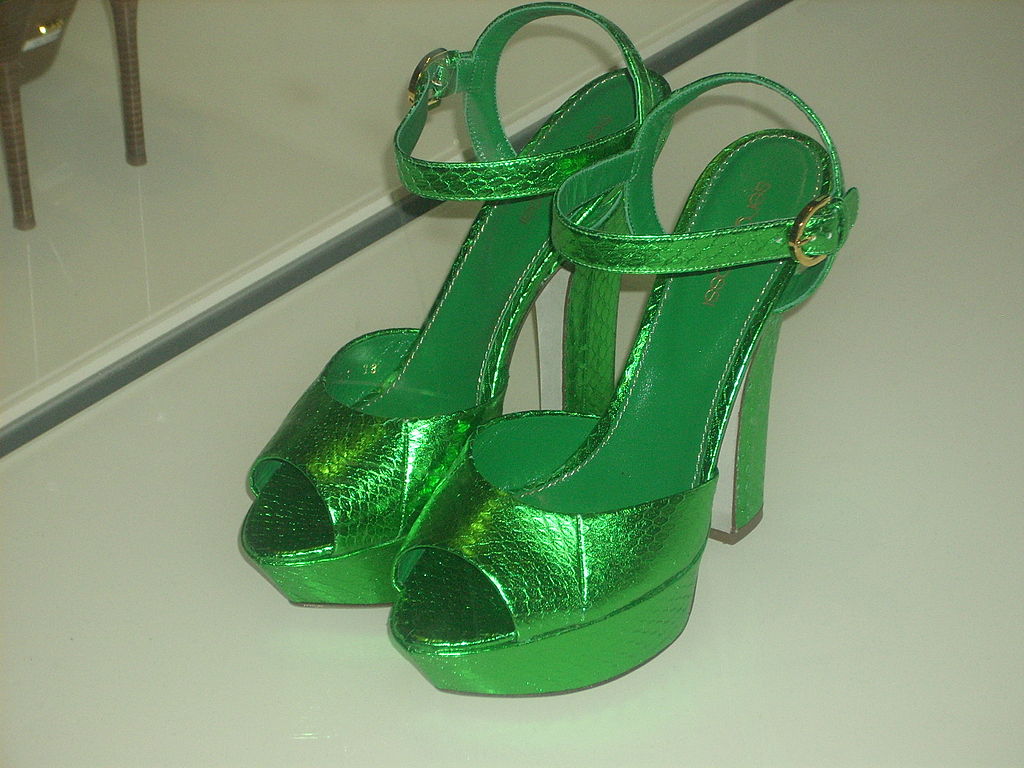
Designer shoes from Taormina.
I hired Roots in the Boot to research my family roots in Scigliano (Calabria), and learned that I come from a long line of shoemakers!! Every Gualtieri ancestor of my great-grandmother, Josephine, was a shoemaker–back as far as Pasquale Gualtieri, born about 1725.

Could my great-great grandfather’s shoe shop have looked like this Sicilian one? Image from Wikimedia Commons.
I would love to see a pair of their shoes, and I wonder what their shoemaking shop looked like. As I roam around Scigliano later this summer, I will be looking for shoe shops, and hope my Italian cousins there can tell me more about our shoe-making ancestors.
Several of the women in the family were cotton or silk spinners. I imagine this as “cottage” employment rather than work outside the home, but honestly, I don’t know. The villages that make up Scigliano are fairly small, but I don’t know much in detail about their history. Could there have been a weaving business there, turning their silk into luxurious velvets and brocades?
Could it be that at some point they combined their efforts, and made shoes like these?

Woman’s silk brocade shoes, 1770s, probably Italian. Image from Wikimedia Commons.
Do you know the occupation of your Italian ancestors?
Today I learned about Rabbi Barbara, and her work in reconnecting Calabrian Jews with their Jewish heritage. I found her website very interesting, and especially this information on the B’nei Anousim movement in Calabria, dedicated to Jews who were forced to repudiate their faith–or be exiled–during the Inquisition. How naive I have been, never considering that this happened in southern Italy, just as it did in other places where the practice was better known to me.
Check out this article from Italian Notebook on 3,000 year old urban planning, still at work in Naples. Photo also from Italian Notebook!

 The Italian South