My mouth is watering for tiella!

This week I confirmed that I will visit Gaeta in August and have some of their famous tiella. The photo above, from a Flavor of Italy blog, shows a few of the widely varied fillings used in tiella.

I found a recipe for tiella on Lidia’s Italy website, and it looks yummy! The recipe calls for escarole–something use more often in salads than in cooked dishes, which makes this recipe all the more intriguing to me.

When I go to Gaeta, I’ll be meeting Nicola Tarallo (aka Nico Rosso), author of the ebook Mangia Tiella! We’ve corresponded on Facebook before, and I’m looking forward to learning more about Gaeta from him, as well as trying some tiella at last.

Have any of you readers made, or eaten, tiella before? Please share!!


Buona Pasqua, amichi!

Today I’m sharing the Sons of Italy blog post about the differences between Easter celebrations in Italy and the U.S.  I enjoyed it, and hope you will too.

And the illustration in that blog post, of the delighted child opening a Kinder Egg, prompts me to add this article about the recent decision to allow an ‘adapted’ form of Kinder Egg to be sold in America.

Remembering Salvatore: Part 3 of 3

OLYMPUS DIGITAL CAMERAOver the last two weeks, I introduced Salvatore, and shared some of his experience during World War II.

After hearing about the priest, we threaded our way through the streets of Piedimonte Matese, impressed at the pace Salvatore set for us, given he was older than we were by thirty years or more. As he was unlocking the door to his house, I noticed a piece of ancient history built right into the door frame. The lower two or three feet on the left hand door frame was made of a fluted stone column, broken off at an angle. The typical Italian house construction, thick walls with stucco finish, surrounded it.

“Where did you get this?” I asked.

“My father found that column in the river many years ago, and had it in our home. When we were rebuilding the house after the war, we put it in this wall.”

I don’t recall asking what his father was doing when he found it. Fishing, maybe? I’ll bet you’ve never gone fishing and found an ancient Roman marble column! I found a silver dime once when I was digging in the garden, but that marble column has it beat. It must have been found before modern antiquities laws were enacted in Italy, because items like that are no longer considered ‘yours for the taking’ even if found on your own property.

We entered a corridor and climbed to the second floor  balcony to enter his home. (This is called the first floor in Italy, being the first floor above the ground floor.) It was cool and spacious, with dark furniture and nicely framed paintings. Light filtered in from a courtyard filled with plants.OLYMPUS DIGITAL CAMERA
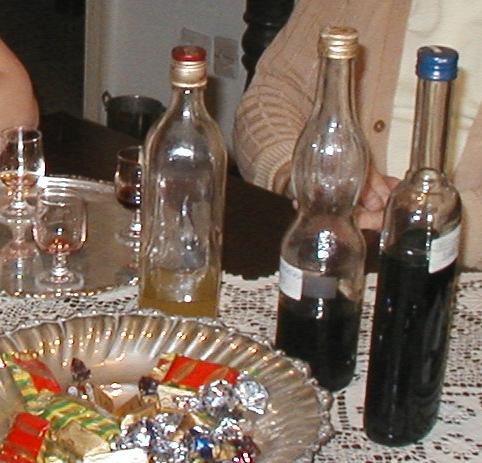
Salvatore introduced us to his wife, who spoke no English. She greeted us kindly, with a knowing resignation that led us to believe we were not the first strangers her husband had brought home for a visit. After a short time she brought a silver tray with small glasses, and three bottles of liqueur with hand-written labels taped to them. After that, she left us to visit, and we didn’t see her again except to say goodbye.

Salvatore told us about his sons. One had followed him into the teaching profession, and the other was handicapped in some way, and required special care.

“Please try the drinks I made,” he urged us, and poured dark liquid from a tall bottle. “It is made from hazelnuts,” he said of the first one. A small taste was enough of that. Next came cherry liqueur, burning a deep red path down our throats. Salvatore set that aside, clearly eager to get to his last offering.

“I make this from my own recipe. It’s like limoncello,” he said.
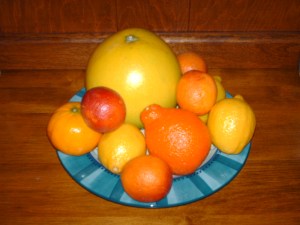
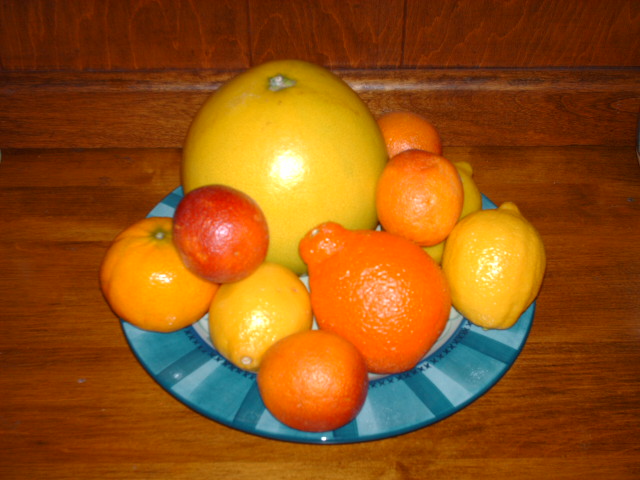
Mixed citrus--from Wikimedia Commons

Mixed citrus–from Wikimedia Commons

We knew limoncello, and enjoyed it, but his drink was more orange colored than any we had tried. And more delicious! He smiled with satisfaction at our response. “It has not only lemons. I make it with oranges, lemons, and tangerines. My own recipe.” He beamed as we sipped the golden nectar. “I grow the fruit right here,” he said, gesturing toward the verdant courtyard.

“Do you share your recipe?”

“Of course!”

As he went to get paper and pen, I thought to myself, of course he shares his recipe. He is a man who shares his whole life, openhanded and openhearted with friends and strangers alike. He scratched out the recipe, with careful instructions, and we visited some more, went out on the balcony to see the garden, looked at paintings on his walls and photos of his sons.

As the afternoon wore away, we reluctantly excused ourselves to go back to the hotel. Our heads swirled with the stories, but more than that—Salvatore’s life itself was vibrant with generosity, joy, patience.

More than eight years later we still think of him and marvel. Who would have thought that the strongest image of life we encountered in Italy was an elderly, nearly toothless man who earned his living teaching a ‘dead’ language? Salvatore—that name means ‘savior’ and Salvatore’s spirit of vibrant life seems just what the world needs. Someone willing to do good in the face of ridicule, to foster young lives (human as well as plants), to remember the past and look to the future, and to share generously with strangers.

Maybe you are as eager to have Salvatore’s limoncello recipe as I was. I’m sharing it here, just as he wrote it for us.

1. You must take two ripe lemons, two oranges, and two tangerines (six in all);

2. Peel them completely;

3. Clean all the peels from the so called “pane”, that is the “bread” which is the white material between the peel and the fruit;  with your left hand you maintain still the peel by means of a table fork while with your right hand you liberate the peel from the white part, that is the “bread”, till the peel becomes rather transparent;

4. Put all these peels in one liter of liquor-alcohol and leave in a well closed glass container for about one month or more, if you prefer.  The fruit must not be placed in the container:  you eat apart [eat that separately];

5. Dissolve 1 kilo of sugar in one liter of hot water and mix with the alcohol after having taken away the peels.  At last you fill and keep in a well closed bottle.  The liquor is good to drink after two or three months. [Could he have meant “for two or three months”?]

Salute!

Re-blog: Sheep kabobs!

Here’s a regional Italian food I’d like to try! We never eat mutton, on rare occasions eat lamb (which I love) so I am intrigued by the sheep-kabobs. Reblogged with permission. Thank you, Maple and Saffron! Check out their blog at http://mapleandsaffron.wordpress.com/

Unknown's avatar

Here’s a regional Italian food I’d like to try! We never eat mutton, on rare occasions eat lamb (which I love) so I am intrigued by the sheep-kabobs. Reblogged with permission. Thank you, Maple and Saffron! Check out their blog at http://mapleandsaffron.wordpress.com/

View original post

Re-blog: Italian Christmas traditions, the American way!

Christmas is in full swing where I live, and in most of the world where it is celebrated. Today I’m sharing another blog I found, and I’ll let “Una Mamma Italiana” tell you about her Christmas traditions:

http://unamammaitaliana.blogspot.com/2011/12/italian-christmas-advent-traditions.html

And now I’d like to hear what you do to give your Christmas an Italian touch. I’ve posted before about my family tradition of making torcetti, and will be doing that when my sister arrives from out of town. My daughter has already made hers, across the country. What about you? Please comment!

Christmas_postcard_from_Bressanone,_Bolzano,_Italy,_1931

Food for the feasts of Italy

Celebrating Italy: the tastes and traditions of Italy revealed through its feasts, festivals and sumptuous foods (English and Italian Edition)

I began looking for food topics to post about for today, and ended up buying this book. I wanted something about food traditions surrounding the Feast of Santa Lucia, December 13. In our family, our oldest daughter, starting when she was nine or ten, dressed in white with a crown of candles (battery operated!) and delivered freshly baked Orange Danish rolls to us in bed. We usually thought of the celebration through the lens of my husband’s Scandinavian roots. But she was, after all, a Sicilian girl.

I’m looking forward to cooking my way through Carol Field’s beautiful book of Italian festivals and their foods, and you are sure to hear more about them as I go along!

To allow you time for your Christmas preparations, I’m keeping this short. Enjoy the journey through Advent, to Christmas.

Time to make torcetti

My Italian great-grandparents, the source of my torcetti tradition. Josephine (Gualtieri) and Francesco Arcuri.

With December approaching, my Italian thoughts always turn to torcetti, the Italian pastry I grew up with. So for this “fifth Friday” bonus post, I’m giving you the recipe again, via my original torcetti post last year.

I’m also including a link to another blog with a torcetti recipe–however, it is in Romanian. I could not resist sharing it because of the beautiful finished product. I have never used chocolate on mine, but might try it after seeing this.

Do you have an Italian Christmas tradition–food, religious observance, family activity–that you love? Please tell me about it in the comments!

More about rapini…

I recently discovered that “rapini” is by far the most popular search term that leads people to my blog. I find it a little baffling, however here’s another blogger’s rapini recipe, to give all those “rapini” searches another place to land. Check out the nuovastoria blog for more on life in the Italian south.

nuovastoria's avatarnuovastoria

The weather is changing in Martina Franca. While we’re not swimming in flood waters like the unfortunate residents of Venice, our skies are grey and the wind is whipping down our cavernous city streets, prompting a spontaneous show of woolly scarves and winter coats. There’s only one thing to do: make pasta.

View original post 964 more words

Ravioli con la zucca: Lessons in cooking and Italian

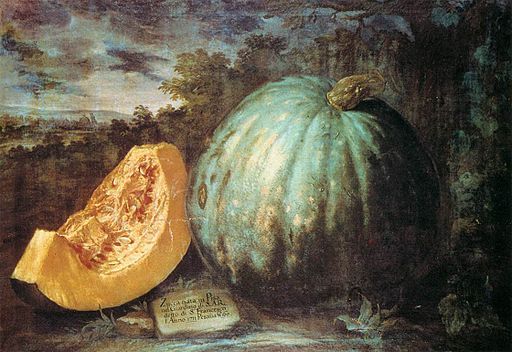
The Pumpkin, late 17th century by Bartolomeo Bimbi

I’ve been dealing with pumpkins this week, and the stores are overflowing with them. I have lots of pumpkin puree in my fridge and freezer, so I found a way to use some of it, and I’m sharing it with you. Cook up that zucca and make this for dinner! With many thanks to the Italian Food Net, which presents this cooking lesson in Italian with English subtitles.

http://www.italianfoodnet.com/eng/video/pumpkin-ravioli

Now be honest, can you cook this way? I’m distracted in so many ways–the Italian language in my ear, conversion from metric to whatever my ‘normal’ is called, the impossibly clean kitchen, and the friendly and attractive Italian chef who wants to help me cook up something delicious.

Aside from looking up recipes, have you learned to cook something by watching video instructions online?


Help me, Blogiverse! I’m losing my figs!

Is there any hope for these figs? I have a honey fig that grows two crops a summer, but my summer hasn’t been long enough for the second crop to ripen. (It rarely is long enough, but this year there are lots of late figs.) The leaves are fading and dropping off, but there are dozens of figs that haven’t ripened. Does anyone have tips for getting them to ripen after picking them? Or what if I cut the branches and put them in water in the house? Or… ??? Fig experts, please help!

This fig tree was a gift from my mother after we visited Italy. Fresh figs were a revelation to me, as I had never lived where figs grow. I’d love to salvage them if they can be used. Take a look at this wonderful concoction and see if your mouth waters!

Do you like figs? How do you like them best? Please leave a comment!

UPDATE!  Good news/bad news. There is a way to ripen the figs, but I have missed the time frame for it!

My friend Karen sent me this on Facebook: