I blogged about Garibaldi a few months ago–and he’s in the news again, 137 years after his death. Kyle, thanks for including this in your daily news post!

Kyle's avatarKyle's Daily Bulletin

The body of Giuseppe Garibaldi, a 19th century military leader, will be exhumed after doubt was raised as to whether or not his tomb actually contained his body.  There are fears that the tomb, located in Sardinia, may have been vandalized, and the real body removed and replaced with a fake.

Culture Minister Lorenzo Ornaghi has backed a request by Garibaldi’s family for his body to be exhumed.  Now that authorities have given their approval, the process can begin.  Giuseppe Garibaldi played a crucial part in Italy’s unification, as he was successful in numerous military battles.  He is still loved in Italy, with statues and memorials in his honor found throughout the country.

View original post

Book Review? It’s your turn!

The fourth Friday each month is when I usually post a book review of something related to southern Italy. But this week, it’s your turn!

What has been your favorite book dealing with or set in southern Italy? Please share in the comments section. Any genre is welcome–fact or fiction, memoir, children’s books, poetry…. do tell!

I’d love your recommendations for books I might review. And after you’ve shared, enjoy the summer weekend with a good book.

Pacentro’s annual barefoot race

Not too many years ago, the annual “Irrigation Festival” where I live in Washington state celebrated its 100th year. It is touted as the longest running continuous community celebration in our state, and we celebrated along with our neighbors. And when I grew up in Alaska, my family made the annual trek to Seward for the July 4th Mount Marathon footrace, in the midst of Independence Day revelry. I like community celebrations with some history.

Pacentro towers at dusk

So when my friend Cesare invited us to Pacentro (a place whose castle towers would have been reason enough) for their annual celebration which included a footrace, we were happy to go.

Pacentro is perched on the east side of the wide valley wall south of Sulmona in the central Apennines. We drove up the stony ridge, already crowded with cars, and squeezed into one of his typical, impossible, parking spots. By this point in our travels, I had been immersed in Italian for about a month, and understood more and more of the conversation around me. Cesare and his wife led us to a street overlooking the valley to the south. On the opposite hillside, a large Italian flag appeared to be spray painted on a large rock, marking the start of the race course.

An alleyway in Pacentro, filled with flowers.

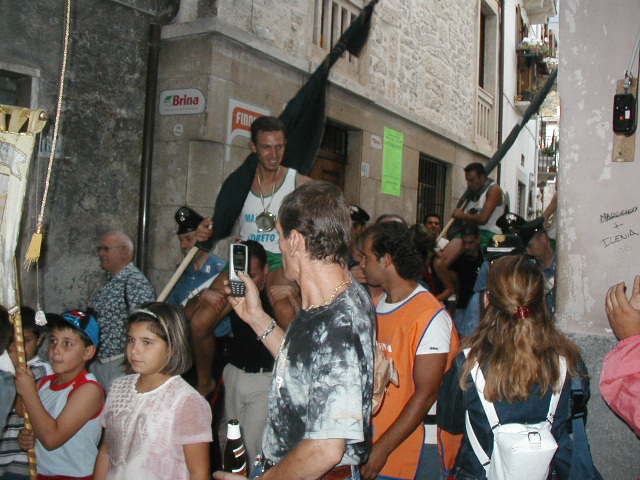
A public address system, strung up to a high eave, broadcast tinny announcements that could be heard for several blocks. As the racers climbed the hill to the starting line, Cesare told about the origins of the race, when gypsies camped outside the city saw an enemy approaching, and ran barefoot down the hill, across the valley, and up to the hilltop town of Pacentro to warn them, allowing the town to fend off the danger. In honor of the “Zingari”, or Gypsies, who saved Pacentro, the annual Corsa degli Zingari, (Race of the Gypsies), is celebrated every year. It has become a coming-of-age ritual for the young men of Pacentro. The prize seems odd–a bolt of cloth. But this was the fabric used to make his first suit of clothes as a man, and young men still compete vigorously for the title, running barefoot across the rough terrain.

A band greets the runners.

As the two or three dozen racers got in place, fireworks echoed in the valley, and the noisy crowd grew around us. I struggled to hear the announcements, and to understand them. But I was sure I had misunderstood when the announcer welcomed everyone to the 556th running of the Corso degli Zingari. Wait… 556th? That puts it back into the early 1400s. Really? Yes, Cesare assured me, I had heard him correctly.

I was still absorbing the historical shock when the ringing of bells signaled the start of the race. We watched them run down the rocky, forested hillside, disappearing into the pines, and reappearing to the cheers of viewers around us. By the time they begin to arrive in the town, within fifteen or twenty minutes as I recall, they are blistered and sometimes bloody. From the finish line, racers are paraded through the narrow crowded streets on the shoulders of their friends.

The victors are paraded through the streets

We stayed for a while, walking through the narrow, medieval streets and admiring the towers before heading back to Sulmona as the sun set . My sense of history had been properly tweaked, a reset button in my brain changing just a little bit how I viewed the “longstanding” Irrigation Festival (only 117 years old this year) and the Mount Marathon race in Seward (where they wear shoes, for Pete’s sake!).

To see a glimpse of Pacentro and the race, here’s a video from 2009. If you plan to be in Italy in September, you might enjoy attending this very much off-the-beaten-track event.

Sarah at Nomadderings gives an update on the devastation of L’Aquila in the second half of this post. Her comments bring an ache to my heart again for this lost city.

nomadstable's avatarNomadderings

Day 6 began 1200 meters up to learn about lentils. We parked the bus and ventured down a dirt road to see wild pea and lentil crops and learn about the ancient agriculture of the region. Back on the bus we wound our way up into the mountains to explore incredible vistas and watch nomadic sheep herders bring their flocks into the high valleys.  And eat meat…lots of meat. On sticks.  That we got to grill ourselves…sweet!  Bikers, RV’s,  travelers from around the world and families from the region all converged on this odd little place to eat meat. Meat brings people together, indeed. Arrosticini is the traditional mutton skewers eaten in this region. The place we stopped had rows of narrow grills, dishes of salt and lots of hot coals. Off to the side was a local farmer who brought in fresh peaches, figs and watermelon…grilled meat, beer and…

View original post 282 more words

Small world stories: My friend Wakana

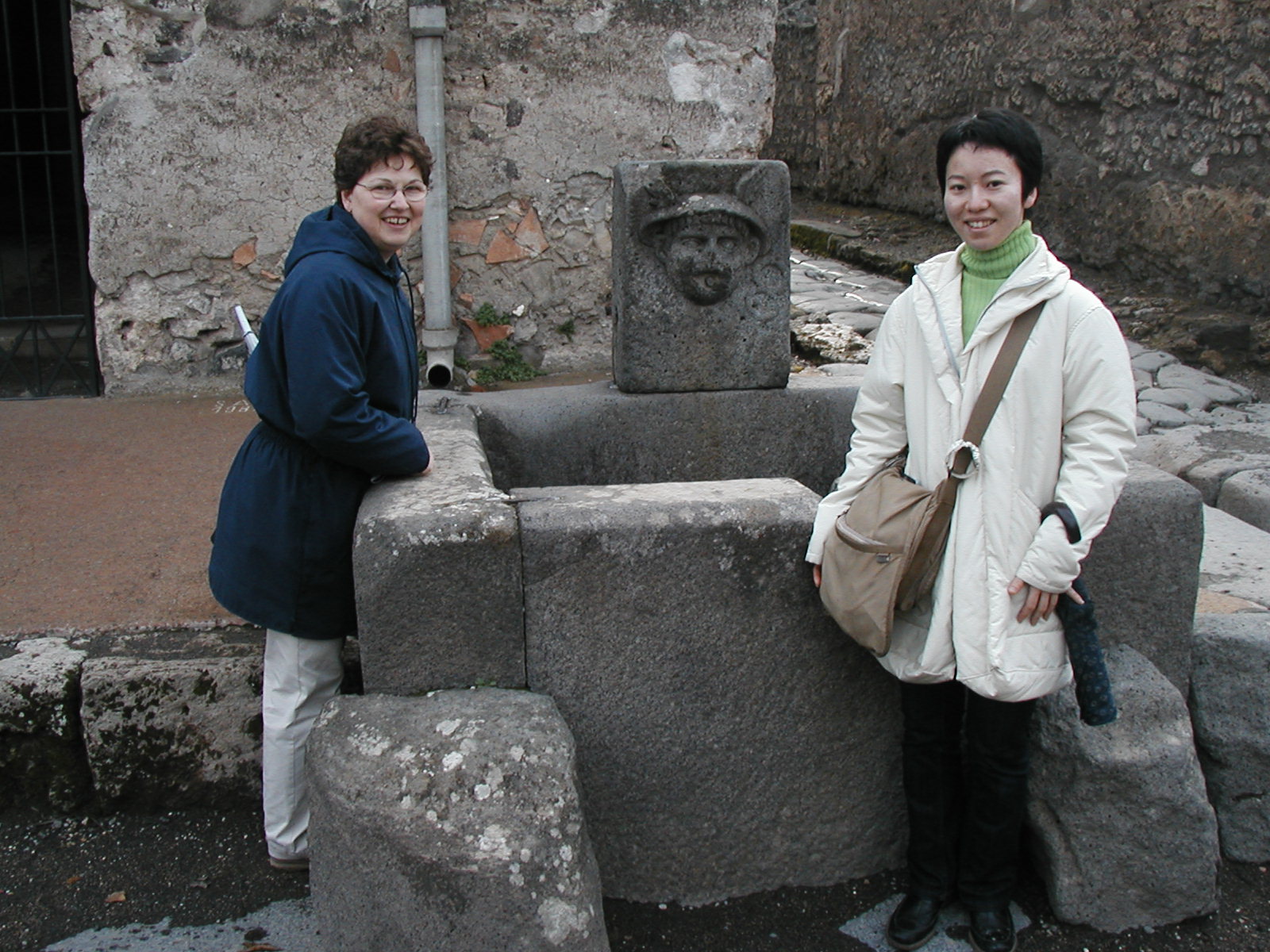
Wakana and I in Pompeii

During my first Italian class in Sorrento, I had one classmate, a Japanese woman my daughter’s age who spoke very little English. And because I spoke no Japanese, we communicated entirely in Italian for two weeks. Wakana was friendly and fun, and our teacher, Elena, guided us through conversations about topics I would not have thought possible to discuss considering our limited language skills.

But we did. I learned about the annual ceremony in her town in which the local god statue is taken from the temple and washed in the ocean. She learned about my town’s annual Irrigation Festival, and when she didn’t recognize the Italian word irrigazione, I explained with a combination of words and charades, about digging ditches from a river to make small rivers to water the farms. We talked about the men in our lives, our reasons for studying Italian, and personal goals. She was interested in architecture and design. I was writing a novel.

With Elena, left, and Wakana at Positano

Our classes met in the morning, and we had most afternoons free, so during our second week we launched out into some sightseeing together. The February rain didn’t hinder us from taking in Positano with our teacher, riding the public bus around the hair-raising cantilevered roadway hanging off the cliffs of the Amalfi coast. The next day, Wakana, Vern, and I went to Pompeii together on the train. With no teacher to provide language mediation, we did the best we could in Italian, and I provided English translations to Vern as needed.

Wandering Pompeii with Wakana

Then, as we wandered toward the Villa of the Mysteries, we passed near a Japanese tour group with a guide. We paused at a little distance as Wakana listened with interest. When they moved on, she turned to me and gave me what she could of the spiel, in Italian. I took that and shared it with Vern in English. We kept near enough to hear more about Pompeii for the next half-hour or so, in our own touristic version of the old parlor game of  “Gossip”.

A couple of days later, Vern and I headed off in a rented car, and we heard no more from Wakana–until about two years ago, when I received her ‘friend’ request on Facebook. We exchanged comments occasionally, and this spring, she contacted me. She was coming to the Seattle area to take some art glass classes, and asked for help finding a place to stay for six weeks between two classes. So this month, she is at my house. We are sightseeing together again–this time on the Olympic Peninsula in Washington. This time, we are speaking in English, and she is learning new verb forms and idioms, and seeing the irrigation ditches for herself.

With Wakana in July 2012

I love living in a time and place where these connections can be made in the first place, and kept alive with ease thanks to technology. Do you have a small world story to share? I’d love to hear about it in your comments!

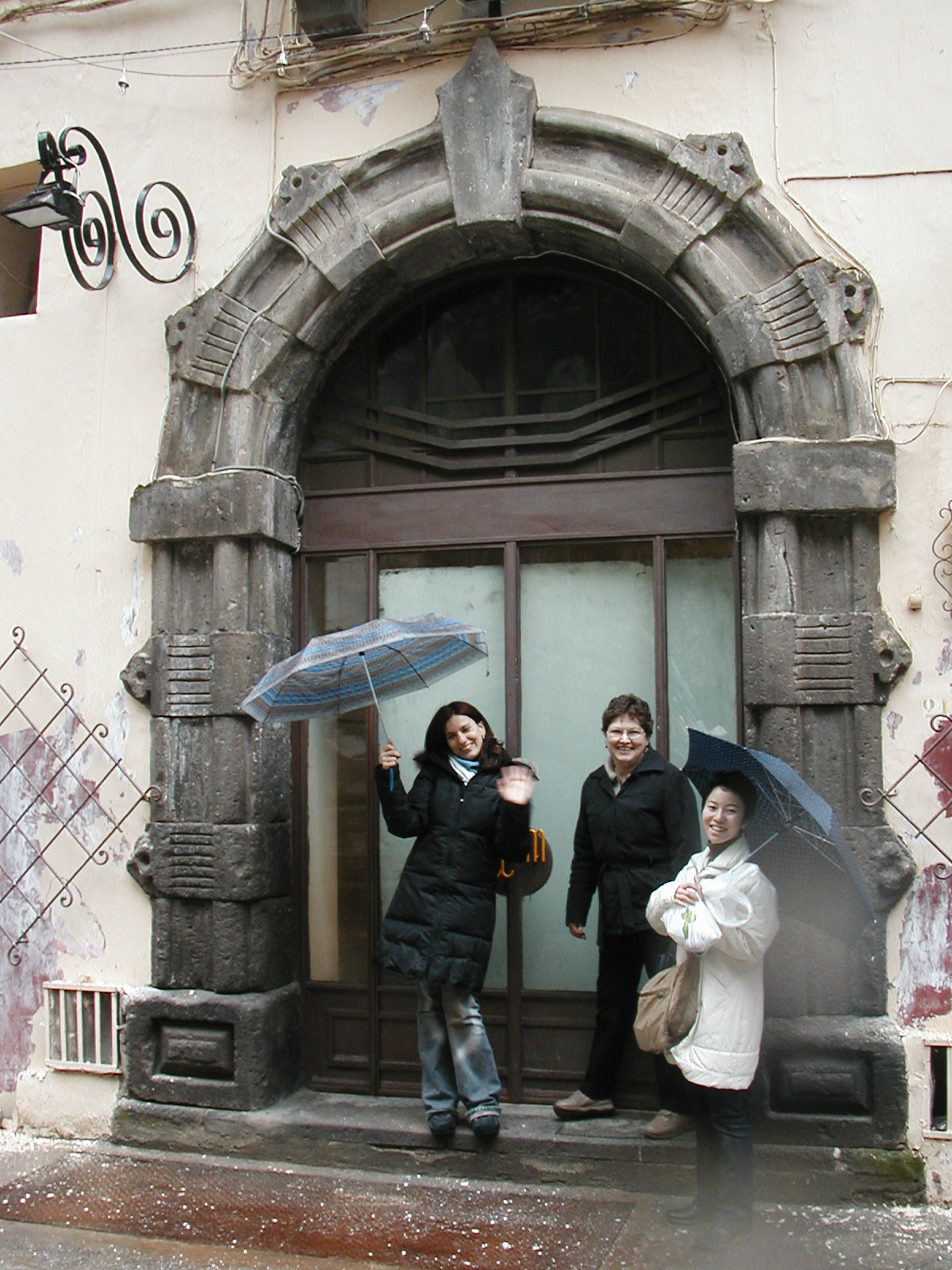
The only time I visited the Gargano, a severe rain forced me to buy an umbrella in a village shop. We didn’t make it to Vieste, but this post from Kimberly Sullivan has inspired me to put it on my list.

kimberlysullivan's avatarKimberlySullivan

A photo doesn’t lie and Vieste, this lovely, perched seaside town located in the Gargano peninsula (the spur of the Italian boot) in the region of Puglia, honestly  is this picture-perfect.

The area has ancient origins, evidenced by the 3rd century tombs and Ancient Greek vases discovered around the town. The town and the entire coastline suffered numerous attacks by Saracen and Ottoman invaders in the 16th and 17th centuries.

Dotting the coastline are numerous, impressive watchtowers, which once served to warn the population of invaders arriving by sea.

More recently, this little fishing village has developed as a popular tourist site. Vieste is a wonderful holiday spot.

The town itself is filled with picturesque streets and lovely views over the sea.

There are many restaurants in the old town center and a colourful daily market off of Via dei XXIV maggio, in the new town. Stock up…

View original post 299 more words

The search for bad wine

Our experimental procedure.

During a two month stay in Italy, my husband and I enjoyed a glass of wine with many of our meals. We rented ‘self-catering’, or kitchenette apartments in some places, and bought our own groceries, so had the opportunity to buy bottles of wine from local shops and markets in many parts of southern Italy. And it was so inexpensive!! We were very happy with the $4 and $5 bottles, and pleased we were getting such nice wine at that price.

But what was the $3 wine like? We didn’t want to drink the Italian equivalent of Annie Green Springs or the vinegary Chianti I recalled from my youth in Alaska. We decided to give it a try.

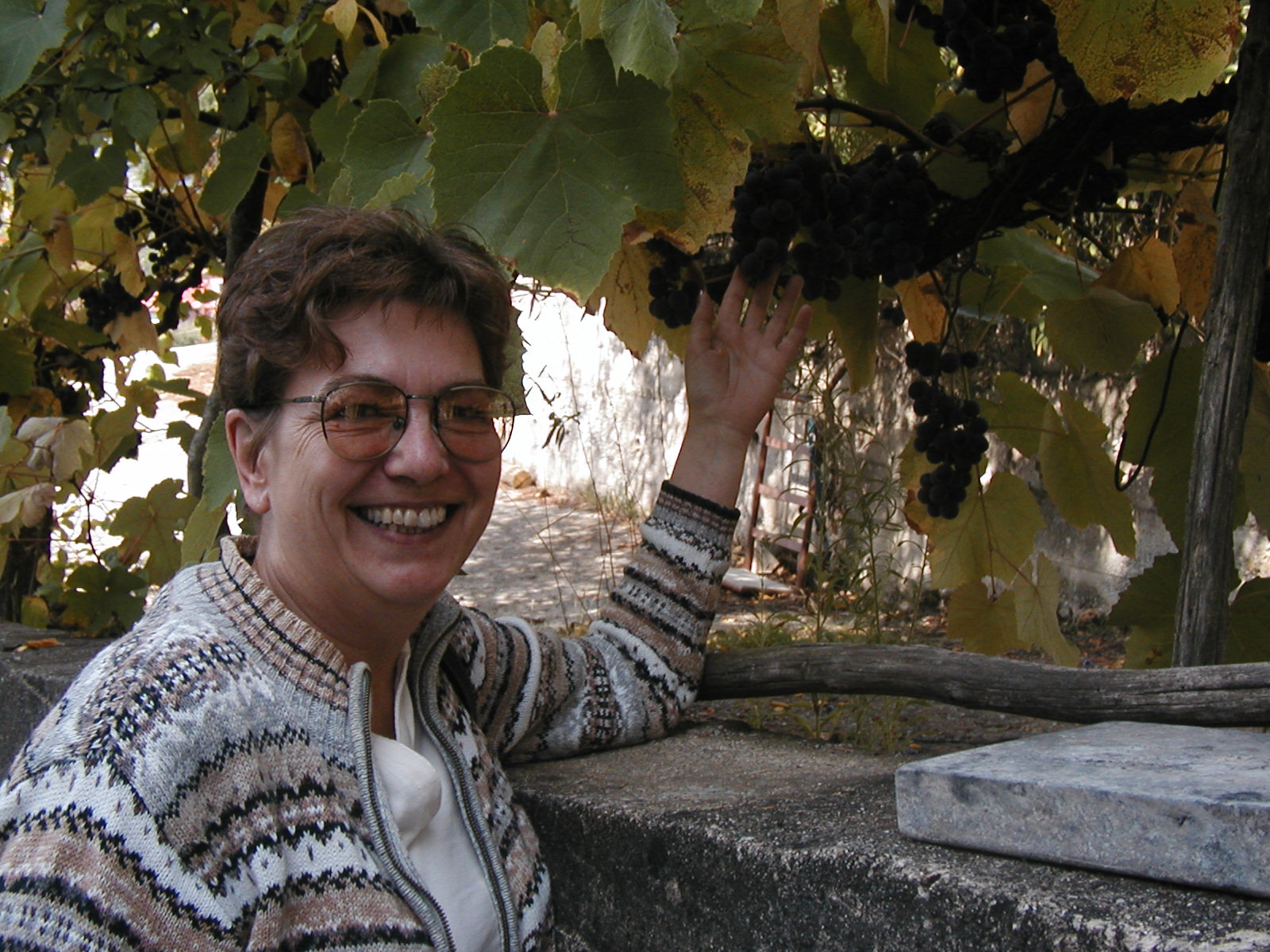
My sister, Marlie Johnson, checks out some Calabrian grapes on the vine.

The $3 wine was perfectly acceptable, so, hey, why not try the next one down?

We carried on with our experiment, right on down to the$1.50 bottles and found every one to be at worst tolerable, and sometimes surprisingly good.

The brand, you ask? They year? Sorry, I’m not talking about brand name wines. In little shops we found locally made wines not produced for export. I imagined them being made in the ‘cantina’ in the walk-out basement of a farmhouse at the edge of town, whatever

The cantina in a private home in Sinalunga, Tuscany.

town we were in, put up in giant casks. Maybe they grew the grapes in a local vigna, or maybe they bought them at the market or a roadside stand, where crates of grapes were stacked for sale in the fall.

We concluded, after many happy hours of experimentation, that Italians do not tolerate bad wine.

Stefan gives some tips for a better Caprese salad, an example of simple and delicious authentic Italian food, and I’m going to try some of these soon!! Does anyone else warm the fresh mozzarella over a bowl of hot water? I have to try it!!

StefanGourmet's avatarStefan's Gourmet Blog

Insalata Caprese is almost too simple to blog about, but I do have some interesting tips to provide. At the risk of writing the same thing over and over, this dish is a classic example of Italian cuisine that relies completely on the quality of the ingredients. Use the best flavorful ripe tomatoes you can find, fresh fragrant basil, the best extra virgin olive oil you can afford, and last but not least the best mozzarella you can afford (and find!), preferably buffalo mozzarella.

Real fresh buffalo mozzarella is very hard to find outside of Campania, the region around Naples in Italy where it originates. I’ve had it a few times when I was visiting the region. Because of the freshness it is outstanding and has a completely different texture from the same mozzarella after a day in the refrigerator. When driving around in Campania, there are mozzarella producers all…

View original post 485 more words

Poetry: “Italian Reasons”

It’s the fifth Friday, time for a surprise, a different topic, a break from the usual routine. I wrote this poem in 2002. I’d love to hear your thoughts on it.


Italian Reasons


InL’Aquila, in a square near the university

The students gather, drink caffe corretto,

And deal endless hands of scopa.

Late at night they stumble home in clusters,

One by one left here and there, until the mountain night claims silence

Briefly, then the morning traffic starts to rumble here and there.


Zio Guido’s dark wine leaves me dizzy,

With a morning headache, and I know no more

Than I did about why one brother went toArgentina

And the other toNew York.  Italian reasons,

Like a rain out of season, flowing through the dusty streets

And out of sight between the ancient stones.


My uncle shows me how to play the kings and take the sevens. 

Between supper of pizzetta and the strategy of scopa,

He tells me how he brought the sheep

Down the backside of the Maiella in the fall

When he was twelve.


That year sticks in his memory,

Because in the end, at the bottom of the mountain,

He found his mother weeping.  The brothers

Who had seen him off in April

Were gone.  Zio Guido shares the truth

As he knew it.  I tell him my father’s truth

As I know it.  They aren’t the same, like two sides

Of a coin, whose value we don’t yet know.


In his car we speed through valleys and tunnels

To the near-abandoned village of his youth

As if showing me the very house will prove him right.

Parked outside the crumbling walls, Zio Guido stares hard,

Reliving a scene like a silent movie. “You see?” he asks. 

I see his pain, a pain that masked

The hopes and dreams for which his brothers left him

With their bewildered mother, angry father.


Driving home he grips my arm,

And reclaims, in some small measure, the brother of his youth.

A tear runs to his mustache for shelter.  I pat his hairy hand.

My father told me stories of little brother Guido, the shepherd boy. 

He had his reasons.


Rain has wet the dusty road toL’Aquila.

The city lights shine in clearer air.


by Sandy Frykholm, 2002.