Guest Blogger: Pro tips for Italian Genealogy

Jenny Tonks

I’m delighted to welcome Jenny Tonks as my guest blogger this week. Jenny is an Accredited Genealogist for Italian research. She works as an adjunct professor of Family History at BYU-Idaho and teaches high school biographical writing classes. She is also a memoir reviewer for a literary agent in New York. I ran across Jenny’s genealogy website when I was doing some of my own research, and found helpful ideas there for my family research. If your travel plans include searching for Italian roots, you’ll want to see what she has to share!

Today Jenny shares some of her early lessons in Italian genealogy:

One of my most memorable trips to Italy involves not the food, the scenery, the fashion, or the people. It involved stacks and stacks of paper!

I’m talking about my first visit to a diocesan archive.

I was a college student and former resident of Italy at the time, finishing up my degree in Italian Family History at BYU. What I learned in that archive changed my career. It also helped me solve many Italian family mysteries over the years!

Why the Diocese?

When looking for Italian ancestors, there are two basic sources that I consult most often: Italian government records and Catholic church records. Most of these records are available in the United States as microfilms that can be rented through FamilySearch.org.

The government records are great, but they only go as far back as the early 1800’s for most towns in Italy. Church records, however, can go back as far as the 1500’s in Italy.

Getting at government records is easy—government offices are expected to make their data available to the public.
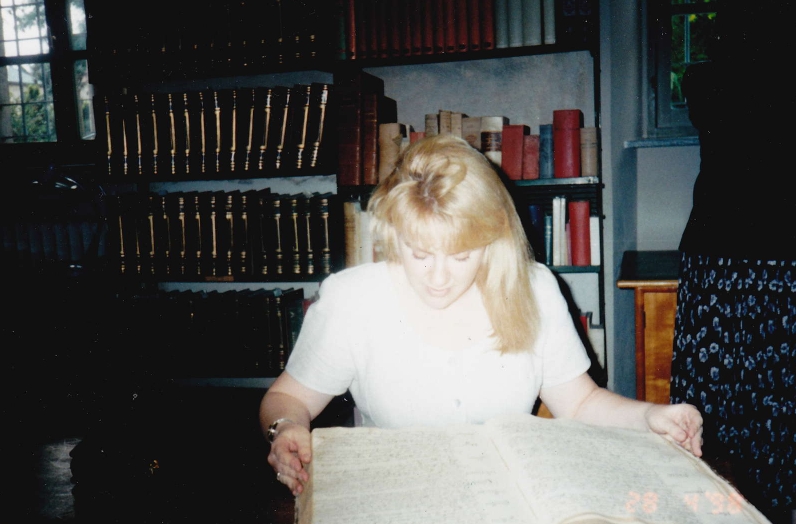
Jenny Tonks with ledger of 1800’s baptisms at the Diocesan Archive of Novara, Italy

But getting my hands on parish records? Not so easy!

I’ve been turned away by more than a few priests who either refused to grant me access to their church records, or who never responded to written, faxed, emailed, or telephoned requests for ancestral information.

But I don’t hold it against them—churches aren’t expected to turn over information the way government offices are. And why should they? Why should busy parish priests have to stop whatever they’re doing every time an American researcher or tourist comes to town, wanting something for the old scrapbook?

In many cases, I’ve found sparsely staffed parishes simply to busy/apathetic to admit me into their archives or respond to my written requests for ancestral information. They’re too busy tending to their flocks, and I understand that.

No problem—I can always go to the diocesan archive!

Generally speaking, I have found most of the clergy who work in these archives to be passionate historians that enjoy looking up ancestors and sharing historical information. They are also more tech-savvy than your typical small town priest, so more willing to photocopy, scan, or email me information.
About the Archives

Typically located at the curia vescovile (seat of a diocese), diocesan archives store:

  • § Copies of their parishes’ birth, death, and marriage records
  • § Diocese-level records not available in parishes—

Stato delle anime (church census records)

Visite pastorali (records of pastoral visits to families in the diocese)

–Ordinations (files on those who became priests or nuns)

–Land records (Italians often donated land to the Church at death)

–And much, much more!

So when I can’t get information about an Italian American client’s ancestor from a parish in Italy, I contact the curia vescovile or the archivio diocesano (diocesan archive).

How to Research a Diocesan Archive

FamilySearch.org has films of diocesan archives for the cities of Parma, Rome, Trento, and Catania that are available to researchers in the United States. They are updating their holdings daily, so to find out if diocesan records are available in the US for your ancestral town, ask the experts at the FamilySearch Italy Genealogy department, via their Facebook page or their research Wiki.

Researchers handling stacks of marriage files in the diocesan archive at Novara, Italy

The day I first visited a diocesan archive, I discovered a key to identifying one’s Italian ancestors that has helped unlock the secrets to many Italian pasts. If ever I can be of help to you, you can tweet me, friend me on Facebook, or send your questions to my Ask a Genealogist site, where I give free research advice.

In bocca al lupo! 

Food: Planting Italian

I’ve been doing some gardening during the last few days. Little sprouts of a salad garden are rising from a back-porch pot. Leaves are peeking up where I dropped peas in the ground last week. I love seeing things grow, and getting to eat them when they are ready–tomatoes warm with sunshine, feathery herbs chopped up on greens, or tossed with pasta.

And what would I be growing if I lived in Italy? Maybe something from Franchi Seeds.

Do they Santa Anna green beans taste any different than, say Blue Lake green beans, or the tomato San Marzano 2 from Romas grown at your local farms? I’d love to hear from anyone who has grown comparison crops, or who uses seeds from Italy in your gardens. Please comment and enlighten us!


Book Review: The Espresso Break by Barbara Zaragoza

First off, I wish I’d had this book the first time I visited Naples! I will definitely be using it the next time. I’ve looked in at Barbara Zaragoza’s blogs now and then: The Espresso Break and Naples (Napoli) Guide, and I’m glad to have her info about Naples compiled in book form.

The subtitle promises “Tours and Nooks of Naples, Italy and Beyond”, and I would say the book delivers. The major highlights are covered, in greater detail than many books offer, and then come the hidden corners of Naples that you would never find on your own, like Mauro the glove-maker’s factory, and Japanese restaurant recommendations.

Barbara has also included some practical travel information about safety, driving, staying healthy, and using public transportation. Her advice on greeting Italians is spot on: A little Buon giorno will take you a long way in Italy!

The great detail and variety of information make up for the lack of color photos, as I always appreciate color in a guidebook.

After seeing nearly three pages devoted to the subject of trash in Naples, I laughed out loud at Barbara’s defense of the city’s dirtiness. Why is the city so dirty? “Neapolitans have preserved so much of their past that the buildings almost by necessity tend to blend into the natural look and feel of the ancient ruins.” Naples is just natural, and she suggests that other cities seem un-naturally clean. Well, my mom and I had a good chuckle over this, but I must say, please don’t let the city’s reputation for dirt and grittiness stop you from making a visit! I compare it to the gritty vibrancy of lower Manhattan–a sign of life!

The book includes lots of detail on the ancient sites around Naples and legends connected to them. She also includes a section called the “Odious Women Tour” which includes goddesses, queens, prostitutes, and revolutionaries.

Considering that many travel guides offer just a few pages to the entire south of Italy, this book is a treasure for visitors to the Naples region. If you have a day, or several, to spend in Naples, this book will help you fill your time well.

Anagni: Walk through the city with me..

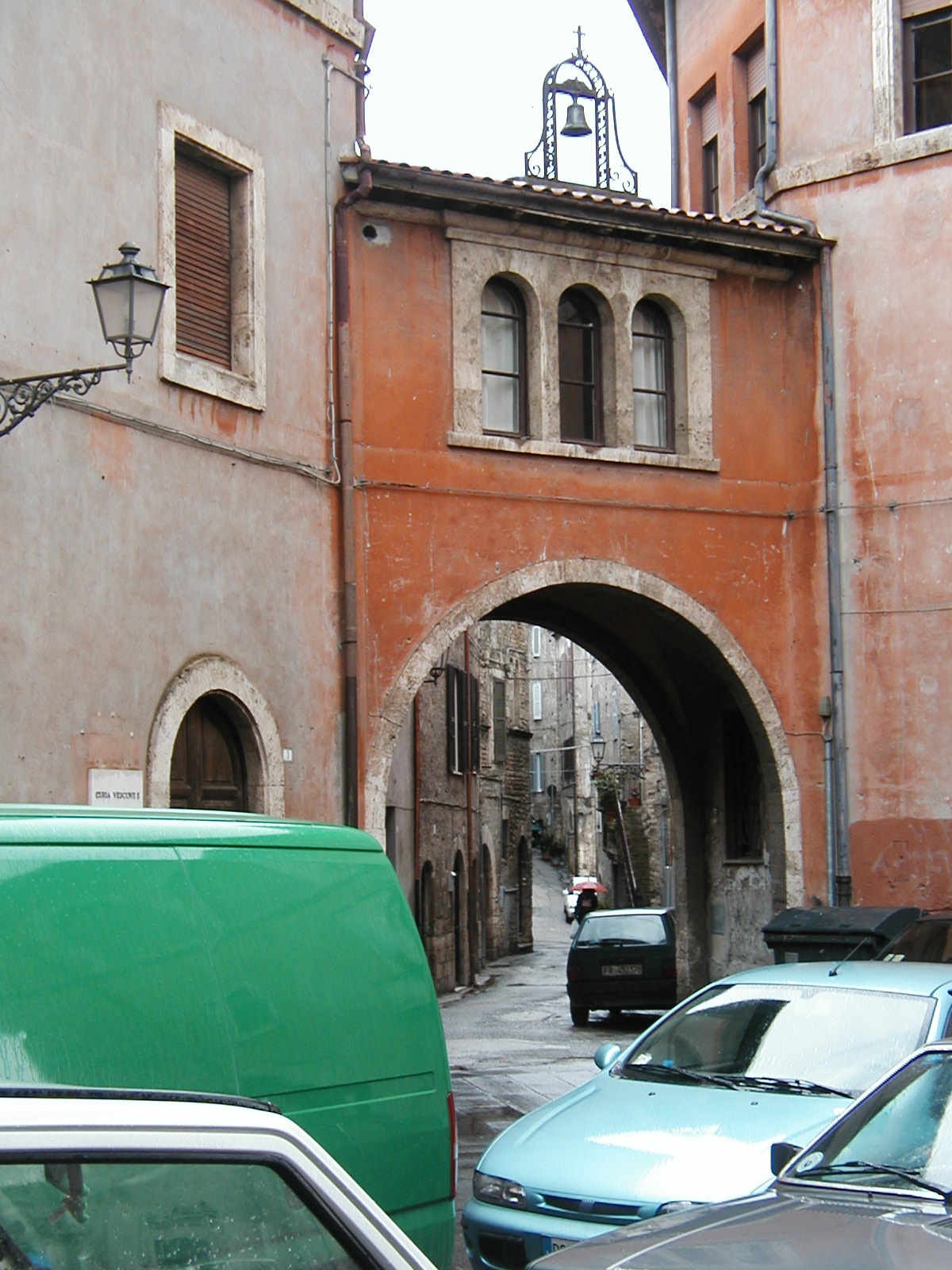
This entry gate to the city of Anagni looks like a great portal for time travel to me. And it’s easy to feel you’ve been transported to the medieval era in Anagni, as so much of that period is preserved.

The city has very ancient origins, and was part of a confederation attacked and defeated by Rome in 306BC. Since that time, Anagni has been an ally of Rome, and a strong supporter of the Roman church. It became an important city during the Middle Ages, and in one 100-year span covering the 13th century, four men from Anagni were elected pope.

On an outer wall of the city’s cathedral hangs a statue of the most famous of those popes, Boniface VIII. You can see it in the upper right corner of this photo.

Boniface’s palace is open for tours, and as we walked through it I could imagine the lavish furnishings this wealthy, powerful man might have enjoyed there. Today the contents are quite sparse, but there are remnants of the thirteenth century paint on some of the walls, in a pattern that reminded me of wallpaper.

The city is open for auto traffic, with many one-way streets and tight spaces. I was glad we found a parking spot outside the walls, and walked through the narrow lanes. Walking also allowed us to take in more of the atmosphere, even though the chilly rain dampened us a bit.

The cathedral has beautiful Cosmati tile work on the floor, and the crypt is decorated with Romanesque/Byzantine frescoes in brilliant color and very well preserved.

The modern buildings surrounding it stand in stark contrast to the medieval center of Anagni. I recommend a visit for history lovers, and anyone interested in medieval buildings and design.

The Grand Tour: An Italy of the past

File:South west prospet of mount Vesuvius - September 1747 issue of The Gentleman's Magazine.jpg

[Illustration from the September 1747 issue of “The Gentleman’s Magazine]

“A man who has not been to Italy is always conscious of an inferiority, from not having seen what it is expected a man should see.”  Samuel Johnson said it, and Joseph Spence, at the age of 31 in 1730, set off from Oxford to see what a man should see. Spence was a commoner with little money, but through the connections of friends, arranged to travel with Lord Middlesex, the 19-year-old son of a duke. The rakish lord drank his way through Europe for a couple of years, while the Oxford don spent his time developing a passion for Italian opera.

In 1737, Spence accompanied John Morley Trevor to the continent, eager to return to Italy. However, Trevor turned out to be a dull companion, and they did not make it to Italy, because Trevor was recalled to England before the end of the year.

In 1740, Spence was asked to accompany another young nobleman, Lord Lincoln, to Italy, where Lincoln was to attend the Royal Academy at Turin. As his governor, Spence oversaw the improvement of Lincoln’s fragile health and guided him out of an affair with an unsuitable partner, returning him to England better prepared for his future.

Spence kept a journal, and wrote numerous letters to his mother while traveling. Here are excerpts from letters to his mother describing his first visit to Naples:

In going to Naples we often passed old Roman roads, in many places all laid with large smooth stone and as entire still as the pavement of a great hall, though near two thousand years old. ‘Tis to me the most surprising thing of art which we have seen abroad. This noble pavement, sometimes for miles together, is bordered with myrtles and a hundred other evergreens, and on each side of it you see perpetually the ruins of old tombs and monuments, for the Romans always buried by great roads (perhaps to put people in mind that this life is but a journey, and that in this world we are not properly at home).

There are sometimes orange-trees in the road, and at Mola, a little seaport on the way to Naples, all the orchards were full of them just like apple-trees with us. Within about thirty miles of Naples we came into a vast plain, the richest soil and the best cultivated in Italy: whence the Italians call it ‘Campagna Felice’ or ‘the happy country’. It was soon after that we discerned the top of the famous Mount Vesuvius, and the smoke which it perpetually flings out looked at that distance like a cloud gilded with the sun.

Naples is one of the most delicious sea-ports in the world: it lies down a sloping ground, all in a large half moon to the sea. The shore on for a great way humours the same shape of a half moon. In one side of it, about six miles on the left hand from Naples, is Vesuvius, and on the right the grotto of Pausilippo and the tomb of Virgil…

It was with a great deal of impatience that I waited for the morning when we were to go up Mount Vesuvius, which was heightened by my seeing it every morning. The tops of the houses are all flat at Naples and as smooth as a floor; they often set them out with flower-pots and orange-trees, and ’tis their usual place for diversion on summer evenings. From the top of our house we had a most distinct view of Vesuvius, and I used to run up there every morning the first thing I did, to see whether he increased in his smoking or not.

At last the morning came: four mile we went along the beautiful shore of Naples in chaises, which were then quit from the rising and badness of the way, for horses. These carried us two mile more, and then the way is so steep and bad that you are forced to quit even them and be dragged up the two last mile by men who make a trade of it…. Two of these honest men get just before you, with strong girdles on; you take hold of the girdles, and then they draw, and you climb up as fast as you can. Both they and we are forced to rest very often, and then tug and trudge again…. In some of the resting places here we felt the earth hot under us as we sat down…. The last stage is infinitely the worst. ‘Tis all loose crumbling earth in which your two draggers and you sink every step almost up to the knees, beside which it often yields under you, and ’tis often impossible not to slip back half a yard…but eagerness to get to the top when so near makes it the less troublesome. When there, you have a ragged rocky edge all round a vast cauldron of perhaps half a mile deep and a mile round, all full of smoke. The wind every three or four minutes clears away the smoke, and then you have a view of it. It sinks irregularly and raggedly all down on the inside. There are several places in it that look of a fire-colour, blueish, greenish and principally yellow…

One of my guides was an extraordinary honest fellow; I was got very intimately acquainted with him in our journey uup. He told me that ‘to be sure the devil lived in that hill’, and wished very heartily that all the Frenchmen were in there with him. Upon my telling him that we are all Frenchmen, he said he was sorry for it, but it could not be helped….

When the wind blew away the smoke from between the crags of the opposite side of the cauldron, we had a veiw of a beautiful piece of country, green fields, meadow-grounds, etc. thick set with houses; on the right hand appeared a part of the delicious bay of Naples: ’twas but turning the head, and we had a full view of all the city and bay.

Spence’s writings are collected in a book edited by Slava Klima entitled Joseph Spence: Letters from the Grand Tour published in 1975.

Watch for a BONUS re-blog of a modern day view of Vesuvius.

Strange things at the fish market

A September day in Naples brought us to this fish market, and a lot of unfamiliar seafood to look over. It reminded me of a meal we had in Sorrento with our host, Maria, when we were studying Italian. She was very pleased to have a special meal of fish for the first Friday of Lent, telling us it was ‘seppia’. I had no idea what that was, and even looking it up in my Italian-English dictionary didn’t help. I didn’t know what a cuttlefish was. She showed me a covered pot in the sink, and then lifted the lid.

AAKKK!

The ugliest creature I ever ate stared up at me.

Now tell me, does that look like food to you?

Well, we ate it for dinner, and it was very good. Maria was an excellent cook, and we enjoyed many good meals during our two weeks in her home, but that was the most shocking one to me.

A walk in the woods, near Scigliano, Calabria

We walked east on Via Roma toward the hairpin turn that leads to the Roman bridge, and at the turn, headed up the rough track that leads to the Church of the Madonna delle Timpe. Beyond the church, the track narrows to a footpath, and hopscotches a stream humming down the valley. Walk along with me…

All this beauty on a warm fall afternoon! Don’t be afraid to get off the beaten path and enjoy a walk in the woods in Italy.

Italian Roots: Some ideas for finding them

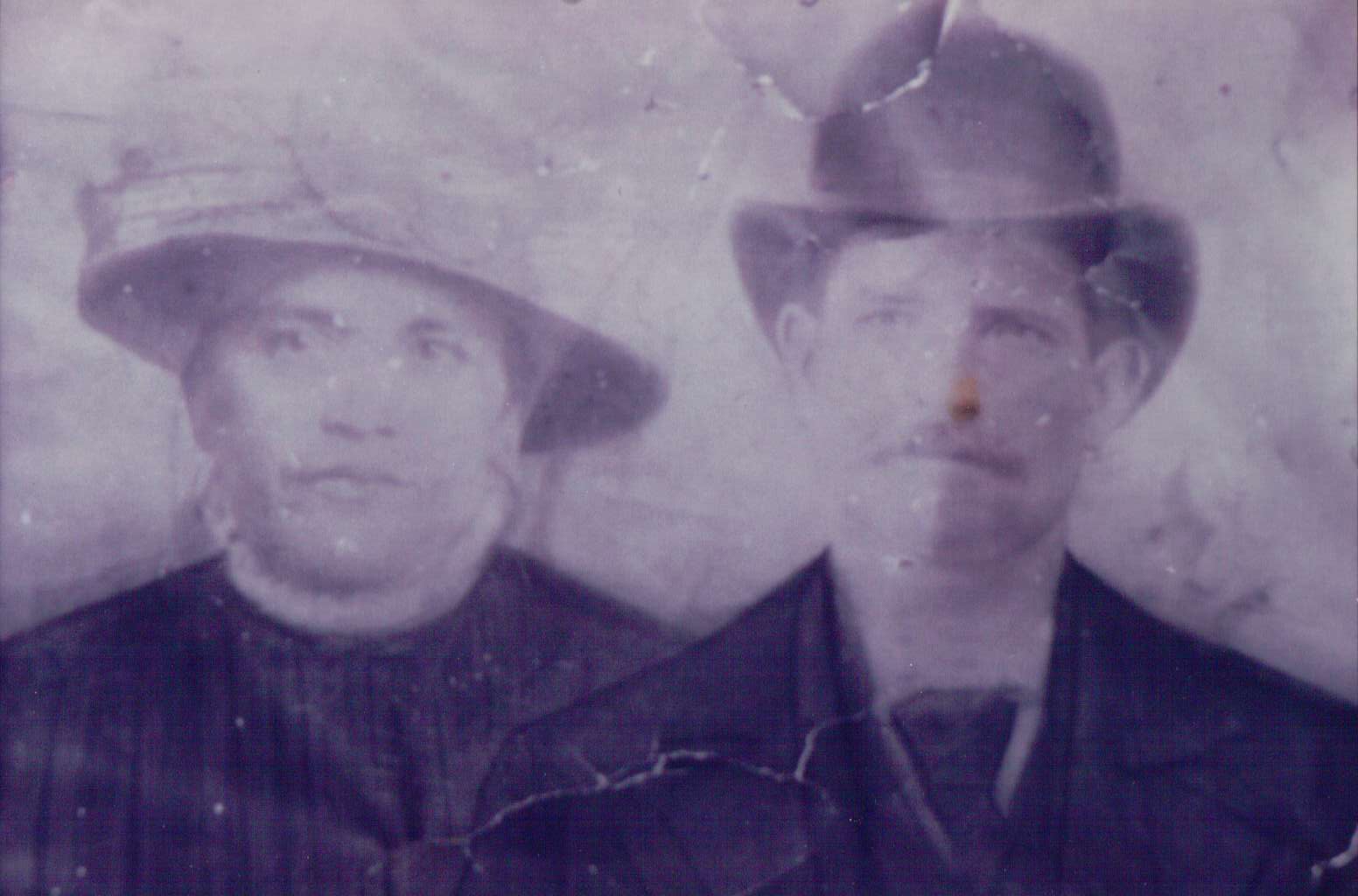
Josephine and Francesco Arcuri, my great-grandparents from Calabria

Tracing Italian ancestry can be a challenge, and records online for genealogy in the Italian South are sparce. The subscription research website Ancestry.com recently added new records for Italian genealogy in America: records from the Sons of Italy (Order of the Sons of Italy in America, or OSIA). These new records are added to others already on Ancestry, which include civil registrations (birth, marriage, death) from several cities in Sicily, and a few southern cities on the mainland.

An internet search turns up thousands of references to Italian genealogy, and connecting online is a great way to pool research efforts with distant family members. I’ve recently been corresponding with a distant cousin across the country who is digging into our Italian roots. I’ve been able to share results of my past research, even though I am not actively researching at this time.

Who would have imagined a few years ago that today we would have a television series dedicated to genealogy? A couple of episodes of “Who Do You Think You Are?” may set your own genealogical wheels in motion to learn more of your heritage–whether it is Italian or not. And this week PBS launches a new series by Henry Louis Gates called Finding Your Roots. His previous shows, African-American Lives and Faces of America are available for viewing online at PBS, and might stoke the fires of your own search for your roots.

Bocce: Italy’s own ball game

Has bocce ball ever been an Olympic sport? Maybe it should be! It started with the ancient Greeks, and came to southern Italy with them, where it has stuck fast. The French adopted it as boules–and could bocce be the distant ancestor of the bowling alley across town?

The Italian tradition of bocce is kept alive in St. Louis. Milo’s Bocce Garden is a tavern in The Hill, the Little Italy of St. Louis, which bills itself as the “sports center of The Hill” in neon lights. Milo’s installed bocce courts in the 1980s and maintains an active tournament schedule. But bocce was alive and well on the Hill long before that, as the following video reveals.

Reading about olives

Can I suggest some reading about olives? I’m offering a smorgasbord.

Here is a link to an online piece called “Graft and Corruption: On Olives and Olive Growing in the Pre-Modern Mediterranean” about the history and practices of olive growing. From the website of the Maxwell Institute of Brigham Young University, this is the introduction to a larger work, but covers lots of interesting history of olive cultivation.

A search on Amazon for “olives” turns up thousands of books (including those by authors named Olive, of course), with a lot of interesting titles. Many, like Olive Oil: Cooking, Exploring, Enjoying,  deal with using olives and olive oil in cooking. Others, like the Olive Production Manual, are practical guides to growing olives. One particularly caught my eye, because I enjoy reading memoirs. Olives, by Mort Rosenblum, has positive reviews and looks like fun to me. Have you read it? If so, throw in your two cents in the comments!

Happy reading!