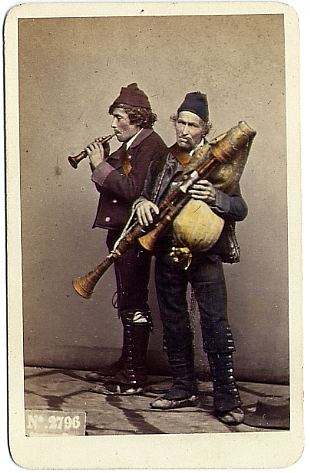
Who knew Italy had it’s own version of the bagpipes, and a Christmas tradition surrounding them? I’m referring you today to another article in the British magazine “Italy” online, which explains the history of the zampognari, shepherds who came down from the mountains to spend Christmas with their families, and stopped at shrines and nativity scenes to play their carols.
The instrument itself is strange looking, with the air bag sometimes shaped alarmingly like the lamb or sheep it was probably made from. And like Scottish bagpipe music, a little goes a long way for most people.
Are you ready for a visit from the zampognari? Play the video:
I’m delighted to welcome Tinney Heath to the blog today. Tinney is the author of A Thing Done, a novel set in 13th century Florence, and a fellow blogger at http://www.historicalfictionresearch.blogspot.com. Today, Tinney takes us to Sicily.
“We might have been in the Nuovo Cinema Paradiso, but instead of flickering images projected in black and white, we watched knights in shining armor stride across the stage, less than 3 feet tall, their colorful plumes bouncing and their shields clanking. Backstage a tenor sang out ‘Allarme, allarme, allarme,’ gruff voices challenged menacing Saracen warriors, and the puparo’s [puppeteer’s] wooden sandal stomped out a battle rhythm, as one by one the pupi [puppets] crossed swords with the infidel, lopping off heads and splitting torsos, or took a swipe at a passing dragon to rescue a damsel in distress.”
Charlemagne’s knights
That’s Mary Taylor Simeti, longtime resident of Sicily and the author of On Persephone’s Island and Travels with a Medieval Queen, describing a traditional puppet show in Palermo in 1964.
The show that night was one of 271 installments of the Paladini di Francia, a serialized story loosely based on the 11th century French epic poem “Chanson de Roland.” It tells of the adventures of Charlemagne and his knights as they battle against Saracens, sorcerers, dragons, devils, monsters, and occasionally each other. The Charlemagne tales are the mainstay of this art form, though other traditional stories can also be seen, including shows based on Shakespeare, Homer, and the Bible.
The Franks, ready for action.
The handcarved puppets, of dense chestnut or cypress wood, have expressive painted faces and realistic glass eyes. Each puppet character has its unique clothing, armor, coat of arms, and a distinctive style of movement, making them easy to identify.
Shows are played against elaborately painted backdrops, and to the accompaniment of music, often from a barrel organ or a player piano. Dialogue is spoken by the puppeteers and usually improvised; certainly there were moments while watching a show in Palermo that I wished I could understand Sicilian dialect, because judging from the reaction of the locals in the audience, I had managed to miss something very funny.
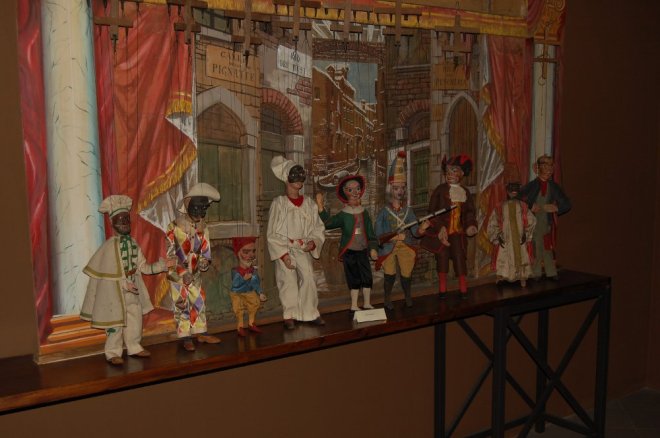
Commedia d’arte, with puppets
Simeti observes that each show includes two things. One is a council, to show characters talking together and let the audience get to know each one and the values he or she personifies. Once we know who the good guys and the bad guys are, it’s on to the second element: the battle scenes, which occupy most of the show. Battles are vivid, colorful, and violent, and characters are slain, often spectacularly. Puppets doomed to this fate are constructed so as to lose limbs or a head in battle, or even to split completely in two.
Depending on which Sicilian tradition they come from, puppets can be around 3 feet high (Palermo) or closer to 5 feet (Catania). Palermo’s smaller puppets have articulated knee joints, which the Catanian marionettes don’t, and they are capable of sheathing and unsheathing a sword, thanks to an ingenious and intricate system of strings, rods, and wires. It can take years to learn to manipulate a marionette to its full potential.
A peek backstage.
Although Sicily’s tradition of marionette theater took on its present form in the 19th century, Sicilian puppetry actually goes much farther back. The chivalric legends may have been acted out by puppets as early as the 16th century, and in fact Simeti tells us that Sicilian puppeteers performed in Athens in Socrates’s day. Sicilian puppets are said to have fascinated Goethe, Anatole France, George Bernard Shaw, and Mario Puzo, and the great Italian semiotician and novelist Umberto Eco was appointed to serve on the board of Palermo’s Museo Internazionale delle Marionette (where all the photos in this post were taken). This traditional art form has a venerable past, but the question now seems to be, does it have a future?
It’s been pronounced dead before. First the cinema, then television, were said to herald its demise, and indeed, many theaters have closed over the years. Families boasting multiple generations of proud puppeteers have had to go into other lines of work. It is probably the tourist trade that keeps the remaining theaters in business. But in 2001, UNESCO declared Sicilian puppetry part of the “Oral and Intangible Heritage of Humanity,” and has set in motion training programs for puppeteers, festivals, and awards, in an effort to keep this rich tradition alive.
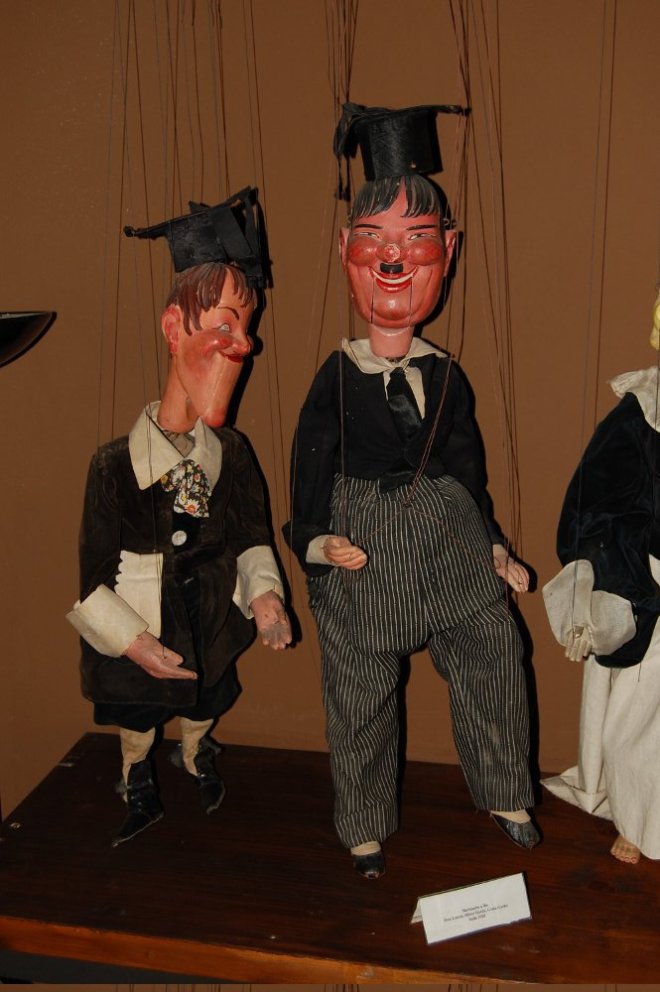
Laurel and Hardy in Palermo.
When my husband and I visited Palermo, our rented apartment was part of the magnificent palazzo that had been the final home of the great Sicilian novelist Giuseppe di Lampedusa, author of Il Gattopardo (The Leopard). The palazzo is now owned by the author’s adopted son, Gioacchino Tomasi, Duke of Palma and a well-known musicologist and theater director, and Tomasi’s wife, Duchess Nicoletta Polo, a renowned expert on Sicilian cuisine who teaches cooking to tourists and whose recipes appear in cookbooks and cooking magazines.
The Duchess told us that when her husband was in New York as a cultural attachė, they decided to import both puppets and puppeteers and produce an authentic Sicilian puppet show for a small New York audience made up mostly of diplomatic personnel from many different countries. Children were, of course, especially welcome. A Chinese diplomat who was unable to stay for the performance dropped off his small daughter, a tiny porcelain doll of a child, and anxiously asked Nicoletta to keep a close eye on the little girl in case she was frightened by the clamor of the swordfights. The child settled comfortably on the Duchess’s lap at first, but once the action began, within seconds the porcelain doll was bouncing up and down excitedly, screaming, “Kill him! Kill him!”
We saw another puppet-child interaction in Palermo that charmed us. After the show, members of the small audience – only seven or eight of us – were standing backstage watching while a puppeteer demonstrated his marionette for us. A little boy, maybe four or five, was utterly fascinated, and Puppet Orlando was just about his height. The puppeteer made Orlando draw his sword and wave it about wildly while the child giggled, and then suddenly Orlando dropped his martial posturing, lurched up to the boy, and gave him a big hug, to the delight of everyone.
You can find many videos of Sicilian puppet shows on YouTube. Some are quite slick and professional, with educational commentary. To give you a taste, though, I’ve chosen this one, taken from the audience, because it captures the feeling of being at one of these shows, and makes it clear how much the audience is enjoying it.
Tinney Heath’s historical interests can best be described as
Dantecentric: if Dante lived it, wrote about it, or consigned it to the
Inferno, it’s fair game. When not writing about Dante’s Florence, she
spends a lot of time playing medieval and early Renaissance music with
her husband on a variety of early instruments. She loves to travel to
Italy for research (not to mention art, music, and pasta). Her
background is in journalism. To learn more about her work, see her
website: www.tinneyheath.com
Christmas is in full swing where I live, and in most of the world where it is celebrated. Today I’m sharing another blog I found, and I’ll let “Una Mamma Italiana” tell you about her Christmas traditions:
And now I’d like to hear what you do to give your Christmas an Italian touch. I’ve posted before about my family tradition of making torcetti, and will be doing that when my sister arrives from out of town. My daughter has already made hers, across the country. What about you? Please comment!
I began looking for food topics to post about for today, and ended up buying this book. I wanted something about food traditions surrounding the Feast of Santa Lucia, December 13. In our family, our oldest daughter, starting when she was nine or ten, dressed in white with a crown of candles (battery operated!) and delivered freshly baked Orange Danish rolls to us in bed. We usually thought of the celebration through the lens of my husband’s Scandinavian roots. But she was, after all, a Sicilian girl.
I’m looking forward to cooking my way through Carol Field’s beautiful book of Italian festivals and their foods, and you are sure to hear more about them as I go along!
To allow you time for your Christmas preparations, I’m keeping this short. Enjoy the journey through Advent, to Christmas.
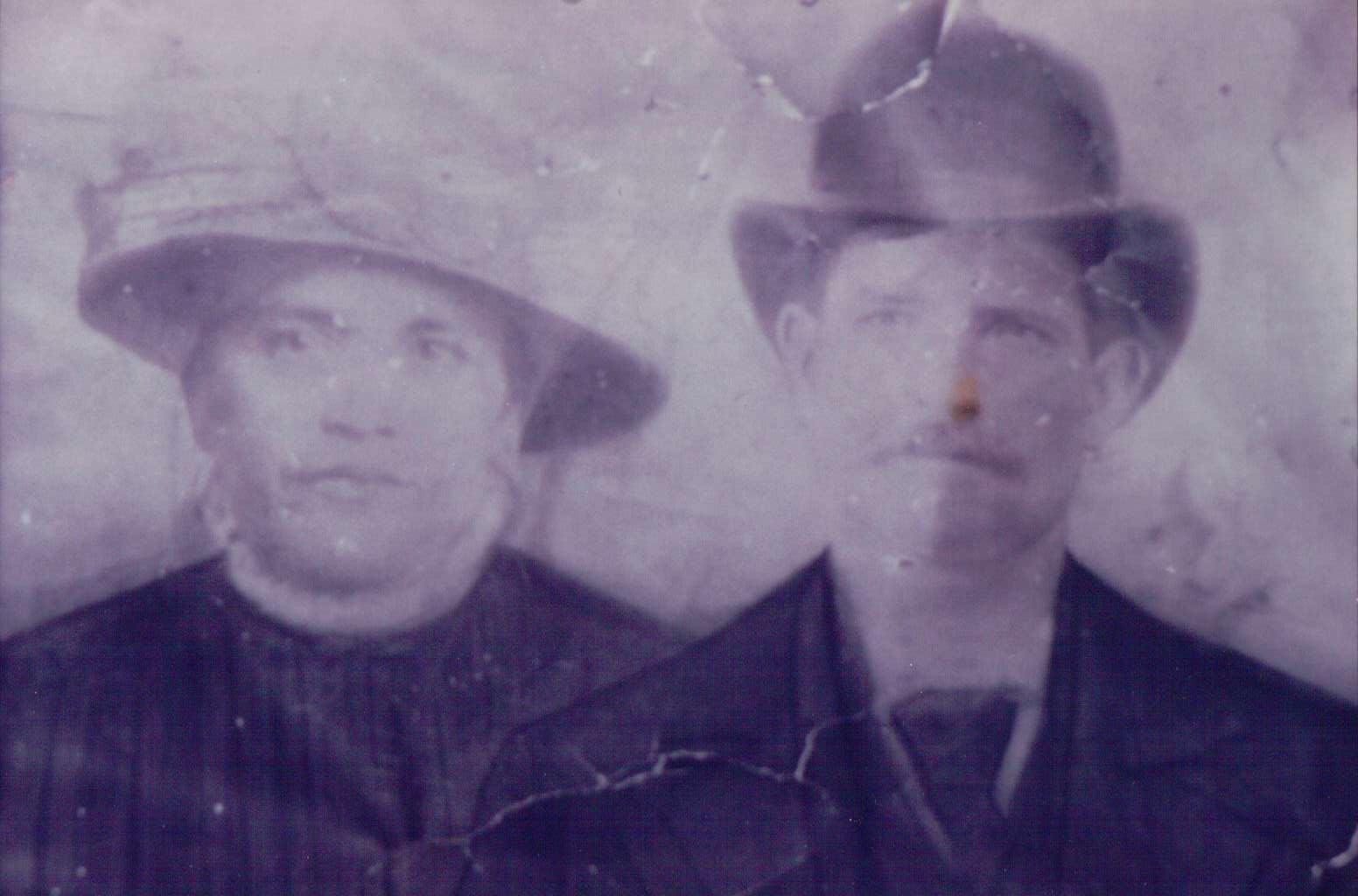
My Italian great-grandparents, the source of my torcetti tradition. Josephine (Gualtieri) and Francesco Arcuri.
With December approaching, my Italian thoughts always turn to torcetti, the Italian pastry I grew up with. So for this “fifth Friday” bonus post, I’m giving you the recipe again, via my original torcetti post last year.
I’m also including a link to another blog with a torcetti recipe–however, it is in Romanian. I could not resist sharing it because of the beautiful finished product. I have never used chocolate on mine, but might try it after seeing this.
Do you have an Italian Christmas tradition–food, religious observance, family activity–that you love? Please tell me about it in the comments!
Harbor panorama of Bisceglie, Puglia (from Wikimedia Commons)
Another blog I follow (on a completely unrelated topic) posted yesterday on their Facebook page that they are creeping up on 50,000 followers, and encouraged them to share with their friends, to put them over the top, with just a couple hundred to go.
Well, here I am down in the small time. Likely today I will hit 10,000 total page views in the entire 18-month life of this blog. And I have… well, let’s say fewer than 100 followers.
So today I am borrowing from the toolbag of the big-time blogger mentioned above, and urging you, my wonderful readers, to share my blog with any Italophiles you know, your fellow Sons of Italy members, a friend planning a trip to Italy, your neighbor with an Italian sounding last name, heck, anyone you know who drives a Fiat or a Ferrari. Or a Ford, because I’m not at all picky.
I would especially love to have your suggestions for topics to cover related to the Italian south, in the areas of food, travel, history, and books or movies to review.
I’m thankful for all of you, and wish you all a Happy Thanksgiving!
The Italian government has decided to abolish several provinces with smaller populations, combining and redefining them, as part of a streamlining effort to save money. Not everyone is happy about it. This article from the Guardian (UK) gives some of the reasons.
The number of Italian provinces has almost doubled, from 59 when Italy became a nation in 1861, to 109 today. The reorganization of provinces will take place in 2014, and affects provinces throughout the country. Last month the English language version of Italy’s Corriere de la Sera ran this article about the axing of 36 provinces.
The provinces are not to be confused with regions, the better-know subdivisions of Italian government. For example, Calabria is a region with five provinces. However, after reorganization, the provinces of Catanzaro, Crotone, and Vibo Valentia will be combined into one, leaving Calabria with three provinces.
The functions of provincial level governments include planning and zoning, police and fire protection, and transportation matters such as car registration and road maintenance.
Some proposals have called for the complete abolition of provinces, with the regions taking over all the governmental functions. Others want to protect the unique cultural or historic character of a place, such as Benevento, which is scheduled to throw its lot in with Avellino despite Benevento’s ancient Samnite history.
These changes are likely to spark some protests around the country, and are expected to be challenged in court. However for most visitors to Italy, the impact is expected to be minor. Look around and see history in the making.

 I’m delighted to welcome Tinney Heath to the blog today. Tinney is the author of A Thing Done, a novel set in 13th century Florence, and a fellow blogger at














 The Italian South