
Vern and I were awake at 4 AM yesterday and about 6:30 decided to go out for a look around while the day was still cool–by which I mean 77 degrees or so. We headed for Sst. Mark’s Square, passing only a few pigeons in the narrow streets. Approaching the archway into the square, the morning haze was bright with early sun. First an Asian girl, then a solitary man, then a scattering of others came into view–photographers all, repositioning themselves for one shot after another of the domes, the clock tower, the great winged lion, gilded by the sunrise. The hordes who fill the square by day and night were still abed. The only other souls about were two men sweeping the pavement with twig brooms, gathering the discarded butts and candy wrappers, plastic water bottles and ticket stubs, into piles. They called out to one another as they worked, but my ears aren’t yet tuned to Italian to know what they said. We crossed to the waterside where gondolasrocked gently in their blue covers, and looped south past the little Kaffeehaus before turning back into the narrow streets toward our apartment. Now a few signs of commerce appeared–not yet an open bar (we had hoped to find a coffee) but men pushing hand trucks piled heavily with cases of bottled water or boxes of eggplant, tomatoes, lemons, headed to a restaurant. The trash man came, picking up plastic bags set ot for him. And as we walked along one canal, a boat with a large metal tank collected sewage through a fat flexible hose. We neared our apartment, and passed a couple of sleepy tourists in the restaurant of a large hotel, picking at their breakfast. Finally, by 7:30, the world was coming back to life.
This was so unlike our experiences in other Italian cities off the tourist path. There, they have business to conduct, shops to open, and they gather early for a quick espresso and a glance through the newspaper along the way. But here, the tourist rules, and seems almost to have become the reason for Venice’s existence. Strangers gather to view her history, and there’s money in it. But no real reason to be up at 7 AM.
Italy
How to live in Italy

Look at that beautiful boot! Image from Wikimedia Commons.
Maybe you want to go to Italy, not as a tourist, but as a resident. I recently found a website which seems packed with valuable information for “expats”. If you imagine moving there, here’s some reading that will help you leap in with your eyes open.
FYI, temperatures in Naples are in the 70’s recently–but so is the humidity.
The online magazine International Living also has many articles about aspects of living in Italy.
FYI, according to the website numbeo.com, the median cost of a three-bedroom apartment in downtown Cosenza is 700 Euro/month (about $910 USD). Outside the city, it’s closer to $500.
A Google search for “living in Italy” returns more than half a million results, so no shortage of information out there. You’ll also find many expat bloggers, and finding one in the region or city you are most interested in can give you a more personal window on life there. To close, here’s a link to one of them, a post on living in Italy by one of my favorite bloggers, Michelle Fabio of Bleeding Espresso, who lives in Calabria.
Readers, do you know of a useful website for someone interested in living and working in Italy? Post about it, with a link, in the comments, please.
Thinking of hiring some Italian family research?
Here’s a video from ItalyMondo, showing some of what is involved with a family history search in Italy. I’m hoping for some similar experiences in Calabria this summer–If only my Italian were as good as the man in this video!!
What family research adventures have YOU enjoyed in Italy? What about research on Italian roots, conducted outside of Italy?
Book Review: The Irish and English in Italy’s Risorgimento by Mary Jane Cryan
 In 2011, in recognition of the 150th anniversary of the unification of Italy–the Risorgimento–author Mary Jane Cryan produced a book about the Irish and English who participated in the process.
Yes, this is one of those niche interest books–and perhaps a very small niche. Only 200 copies of the book were produced, and they can be ordered from the author. But the book is ideal for uncovering the fine detail desired by, for example, a historical novelist or writer of narrative history.
Perhaps you, like me, were unaware that any Irish or English participated in the unification effort in Italy. The Irish mostly joined forces behind the Roman Catholic church and the pope, whose control of central Italy was threatened, though a few supported Garibaldi. For the English, who for more than a decade had hosted a number of well-known Italian exiles, Garibaldi was a hero.
Cryan describes the experiences of both groups, as documented in personal and official correspondence, news reports and editorials, and other contemporary sources. In addition to key players, Cryan includes the experiences of a wide variety of people who participated in various ways–soldiers, journalists, wives, fund-raisers. The views of these participants, mostly outsiders but actively involved, add color and interest to the book.
Did I say color? There are great color illustrations too!
Cryan’s sources include material brought to light in recent years, and the book has end-notes, appendices, and bibliography.

Mary Jane Cryan
Mary Jane Cryan has lived in Italy since 1965. From “About the Author”, Cryan “has been an international educator, journalist, and guidebook writer. She is the recipient of numerous awards for her contributions to historical research and cultural promotion…” Study of the Risorgimento is not new to her; it was the subject of her own doctoral thesis in 1985.
The book is for sale through Cryan’s website, Elegant Etruria, which includes articles on travel, history, and antiquing. She also offers services in travel consultancy and excursions.
Urban planning, old school.
Check out this article from Italian Notebook on 3,000 year old urban planning, still at work in Naples. Photo also from Italian Notebook!

Festive travels in Italy
Travelers to Italy often plan most of their visits around those “must see” tourist attractions like the Coliseum in Rome, the leaning tower in Pisa, and the ruins of Pompeii. Italy has enough of these to occupy many months of vacation time.

Italian Landscape with a Country Festival by Francesco Zuccarelli (18th c.) Image from Wikimedia Commons
But there’s more to Italy than the typical tour itinerary includes. And one consideration might be local festivals. Just like local festivals here in the U.S. (and probably wherever you live), the festivals in Italy usually include booths with food vendors, special entertainment, and an atmosphere of excitement.
An internet search for “festivals Italy 2013” ended in frustration. The information was too general, and often too limited to a particular area. So I began a search including the name of a region, and found much more of interest. For example, through this link for Abruzzo:
http://www.craftsmenofabruzzo.com/index.php?option=com_content&view=article&id=53&Itemid=62
I found festivals throughout the year in towns large and small–ranging from a Trout and Shrimp Festival to a Bonfire Festival, to a snake-handling event with Roman origins. You might notice that this is the business website of a construction company in Abruzzo, but what a great service they have added for the English speaking traveler! Even a referral for an English speaking auto mechanic. Bravi, Craftsmen!
There are festivals for all kinds of interests: food (of course!!), religious holidays, history, music, and many more. You many belong to an organization with members in Italy you can connect with through a local festival in their town. And just as visitors to my town learn a little more about it if they attend our annual Irrigation Festival (going on this week, by the way), you can absorb some more Italian culture by enjoying a festival there.
So tell me, readers, have you attended a festival in Italy? Share about it in the comments, please!
The Baroness will see you now: Family history

Just looking at this Italian birth record should convince you to hire a professional for Italian genealogy! Image from Wikimedia Commons.
I’m getting revved up for my trip to Italy in a few months, and one of my preparations this time will be to have some genealogical research done for me before I get there. My Italian language skills aren’t adequate to do it myself, and my knowledge of the systems of records in Italy is even worse. Some relatives are pooling resources with me to hire the help, and I’ll share the results when I get home.
I was preparing for an earlier trip to Italy when Anna Maria responded to a post I made online, seeking my Italian relatives. She is one!
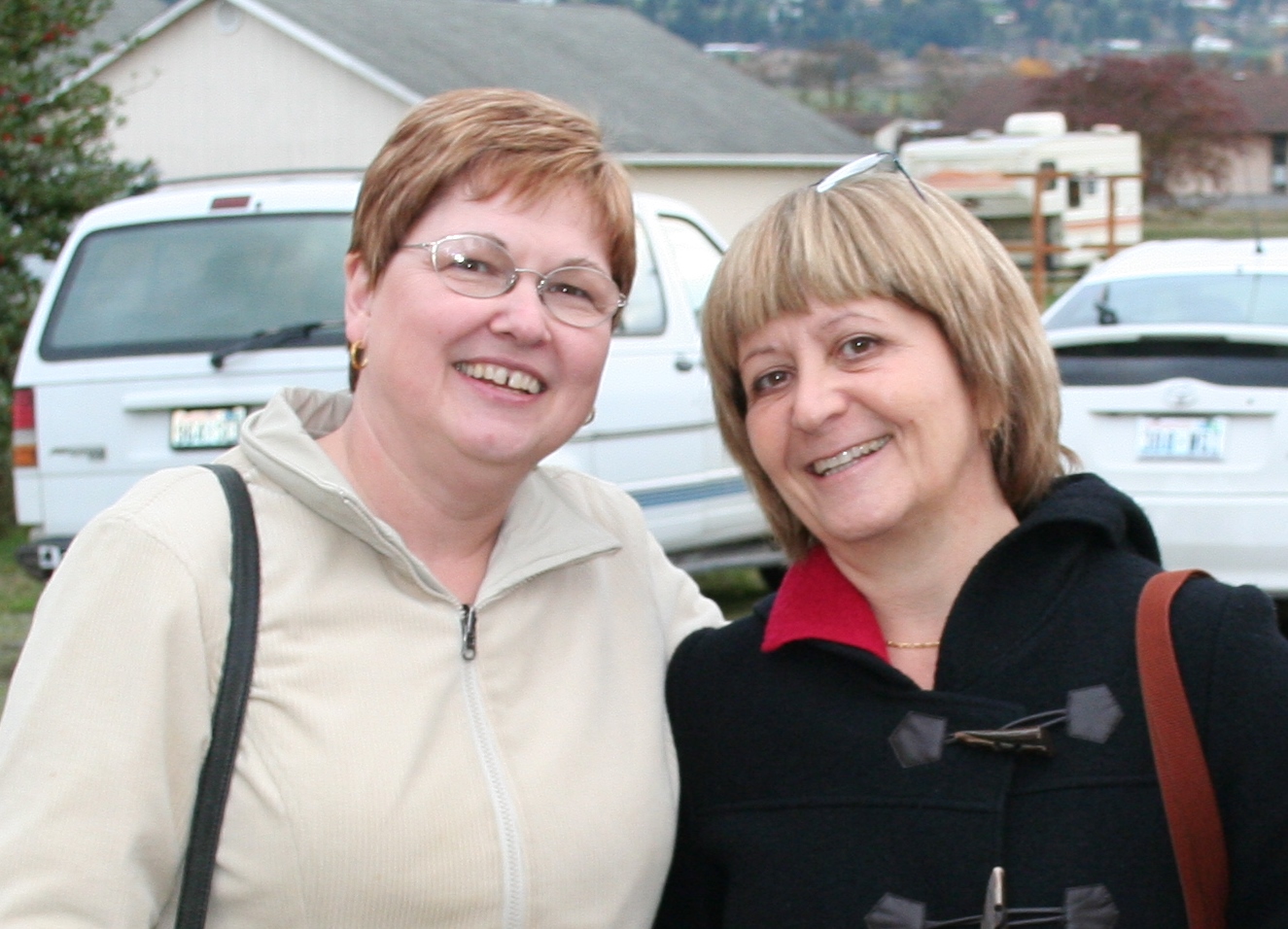
The last time I saw cousin Anna Maria (right) was 2009. I’m looking forward to seeing her again this summer!
We met in person in Italy, and she came to my home a few years later, but I have not been able to document our family relationship. For now, we are just “cugini”, cousins. One of my goals is to discover the family lines that connect us. This year, I’m looking forward to spending Ferragosto, that ancient Italian holiday, with Anna Maria and other family members in our ancestral village.
We have learned a few things about our Italian roots as my sister and I have researched over the years. Some are in the category of family legends.
1. Josephine Gualtieri was an old maid at 21 when she determined she would marry any man who asked her. The man who asked was Francesco Arcuri,
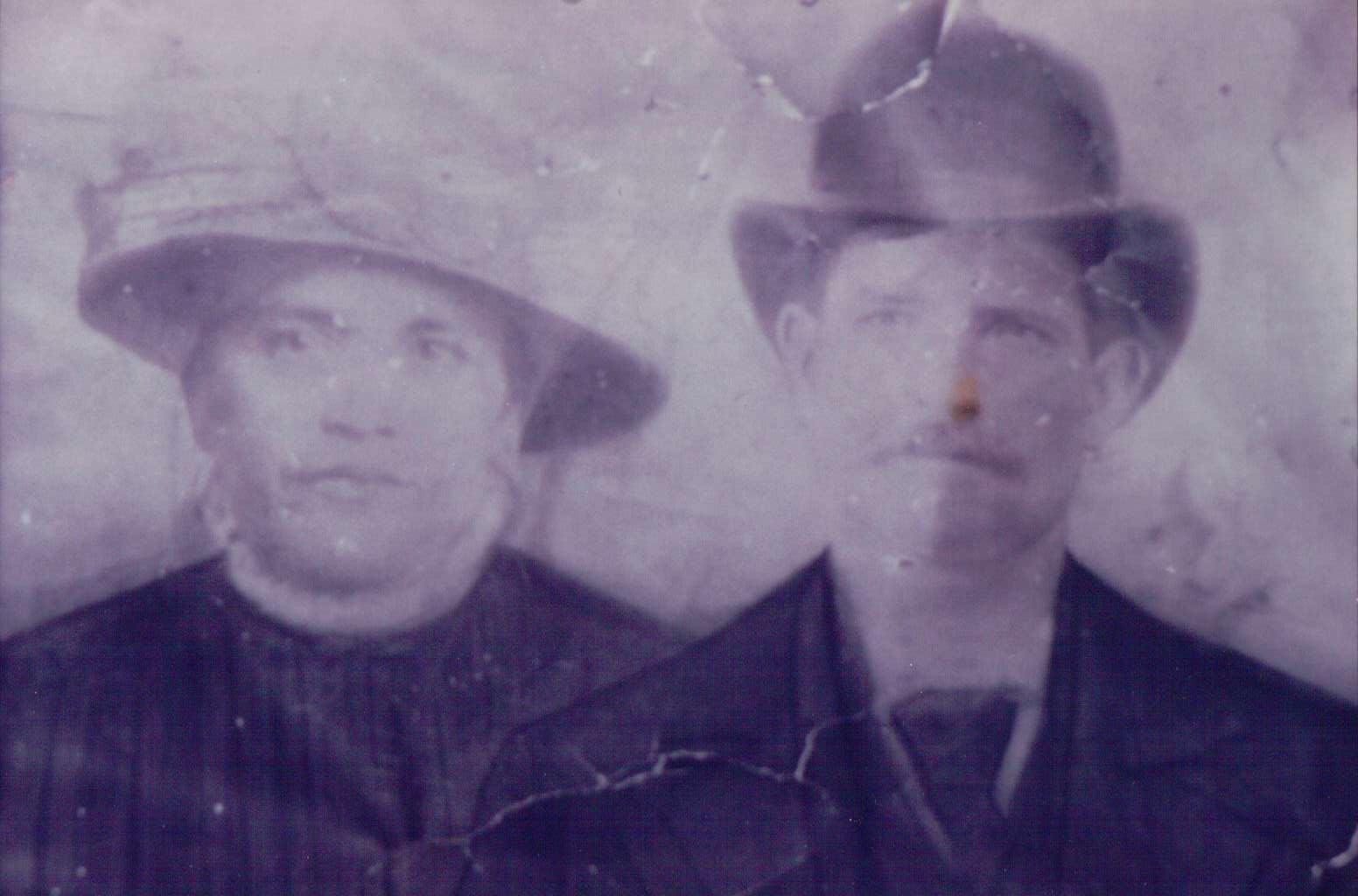
Josephine and Francesco, about 1910 in New York
a man already 50 years old, and three years older than Josephine’s father. We learned that Josephine’s mother had died and her father remarried. Did she not get along with her stepmother? What other factors shaped her life?
2. There is a Palazzo Gualtieri in Josephine’s home town, which (we were told) was gambled away by an ancestor. While “Palace” is somewhat of an overstatement in describing the derelict building, I’d be interested to learn more of that story!

My mom, Win Perman, at the door to the Palazzo Gualtieri in Scigliano.
3. Raffaele of the B&B Calabria in Scigliano gave me a book about the history of Scigliano–in Italian, of course! However, I have been able to determine that at one time there was a “Baron Gualtieri” in Scigliano. I’d really love to know who he was and how he might be connected to my family line. And can I now start calling myself a Baroness? Please??
Looking for Italian roots?
I discovered an Italian genealogy research outfit today, and thought I’d share a link. Initially I emailed Cherrye at My Bella Vita about some research interests because I know she does Heritage Tours in southern Italy. She referred me to Roots in the Boot, and I was very excited to find their website and the services they offer.
You can find suggestions for research compiled on websites like Italiamia.com’s page about genealogy, and there’s a lot to learn at ItalianGenealogy.com.
Have you found useful websites for Italian family history? Please do share in the comments!
Another opportunity to have a castle!
Here’s an article from The Telegraph (UK) about a new effort in Italy to reduce debt–and delight tourists like me! Not only castles, either.
Cross-cultural adventure: Regional railways in Italy

My sister Marlie boards the regional train to Scigliano–JUST KIDDING! We saw this ‘retired’ rail car in the station at Cosenza.
Vern and I watched Italy stream by through the train windows on our way from Rome to Sorrento. We were excited to begin our Italian language classes, and just plain delighted to be in Italy. Sure, it was February and cold and damp, but I’d lived most of my life in Alaska, where June is liable to be colder than February in Italy.
In Naples, we needed to change trains. At Garibaldi station, we were directed to a long corridor, more like a tunnel, which led to a platform for the Circumvesuviana railway, much smaller than the main station. Having rarely traveled by train, the large timetable posted on the wall mystified us. I asked for help from a woman nearby, another traveler, but wasn’t sure she understood me. She waved in the direction of a train, and we boarded it.
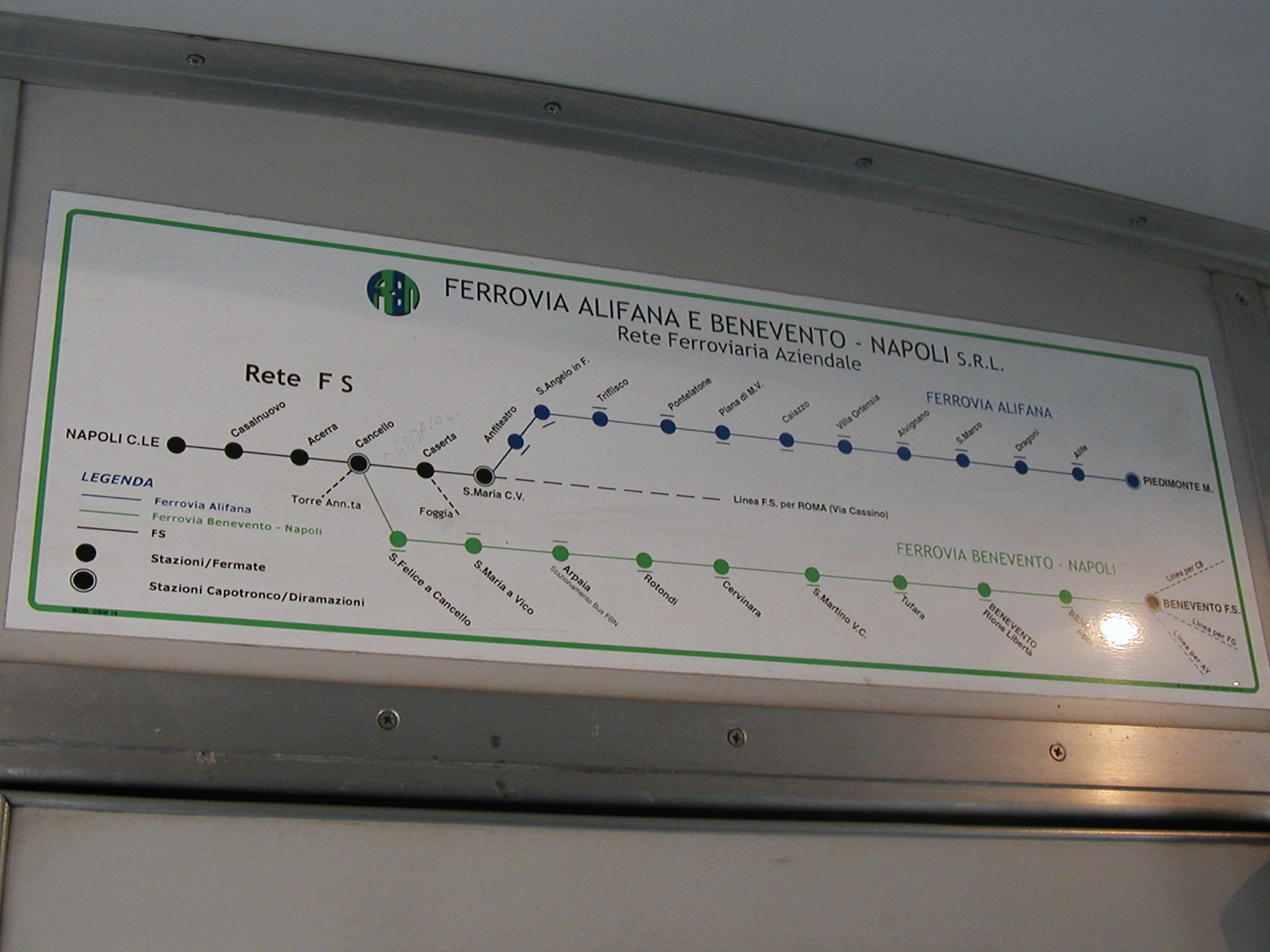
The schedule for another regional train system. We rode to Piedimonte for a Saturday evening event , and discovered that the train did not operate on Sundays. We had an extra day at the end of the line.
With standing room only, I sat on a suitcase as the train chugged out of Naples. We were the only passengers with luggage–somewhat surprising since Sorrento is such a tourist destination. The little train stopped at a couple of stations, and a man nearby overheard us talking about Sorrento. He didn’t speak English, but assaulted us with a barrage of Italian dialect of which I understood nothing. Nothing of the words, anyway. But he was clearly urging us to go back and take a different train.
We declined. Our conversation was attracting the attention of several other passengers, but none offered any help. This seemed to be a commuter train, and a few people got off at each station. Eventually, after failing to persuade us, the man who wanted us to go back also left the train, shaking his head in frustration.
It was clear to us by this time that the train had left to coast and headed inland. The cone of Mt. Vesuvius rose up on our right, and small farms and vineyards fell away to the left. This was not the route to Sorrento. We asked a couple of other people if they spoke English–no one did, except for a few words. But one man took pity on us, and struggled along with my poor Italian.
Yes, we were on the wrong train. Ma, non ti preoccupare. Don’t worry. We could get off at his stop, and another train from there went back to the coast, where we could resume our journey to Sorrento. What about our tickets? Don’t worry.
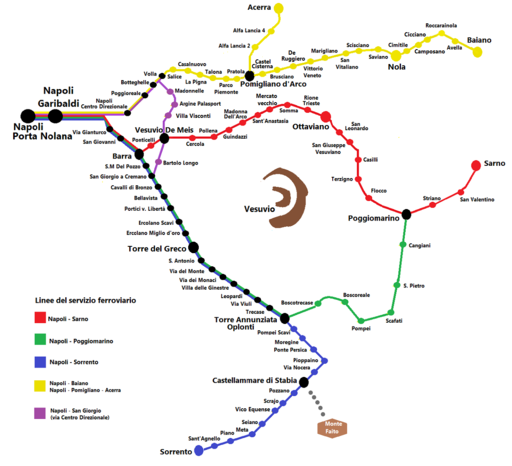
Map of the Circumvesuviana rail lines showing our circle tour of Mt. Vesuvius on the way to Sorrento. This is the same train line that goes to Pompeii.
And he was right. Nobody asked about our tickets. We were soon on the train to the coast, and then on to Sorrento–an hour or two later than we expected, but laughing at our mis-adventure already.
That was our first experience with the regional railways of Italy. The Circumvesuviana line operates in an area that attracts many tourists, and has an English language option on its website. This is not true of all the regional railways. A few months later, we traveled from Cosenza to Scigliano on the Ferrovie della Calabria (Their website has some great photos of their vintage passenger cars.) for a delightful hour surrounded by high school students on their way home from school and fascinated to see American tourists on their train. By this time my Italian was much improved, but most of them wanted to practice English phrases on us.
What can you expect on the regional trains? Far fewer English speaking employees, so be prepared. Generally inexpensive fares–but then the trips are shorter too. The train cars are quaint, rustic, still in service after many years. No sleek, high speed modern trains, no dining car. But a great place for cross-cultural adventure, so don’t be afraid to try one!
 The Italian South