One of my relatives is planning a visit to Sicily, so I’m re-blogging this post about Sicily from type1traveler. Share your own favorite memory or strongest wish related to Sicily.
Reflections on Catania from a Wannabe Sicilian « type1traveler.

One of my relatives is planning a visit to Sicily, so I’m re-blogging this post about Sicily from type1traveler. Share your own favorite memory or strongest wish related to Sicily.
Reflections on Catania from a Wannabe Sicilian « type1traveler.
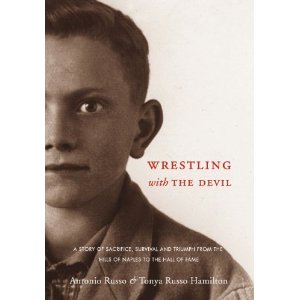 Tony Russo was ten when his family put him on a boat in Naples, Italy with a suitcase full of salami and cheese, headed to America. Leaving behind his parents, brother and sister, grandparents, and the village that was his world, he arrived in New York to stay with relatives–strangers to him, mostly–who didn’t have the means to take him in.
Russo’s struggle to survive in this alien world, his longing for his family, and his determination to be reunited with them, all draw the reader into his story. As Russo fought his way through his junior high years, a coach saw his potential as a wrestler, and changed the direction of his life. How did this boy go from the hills near Naples to a Hall of Fame? Read his story!
Russo’s memoir, capably co-written with his daughter, Tonya Russo Hamilton, will engage those who love stories of overcoming adversity, as well as those who value athletics and the character-building influence of good coaching. You might enjoy the publisher’s story about the book signing at the book release party in Russo’s hometown of Newberg, Oregon.
I’ve written in previous blog posts about Italian-Americans and their contributions to American life. This book continues that theme, and I recommend it to you!
Could this be any more beautiful??
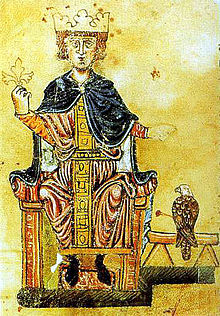 One of the most fascinating people in the history of the Italian south, Frederick II, is a figure of contradictions. An orphan, emperor, crusader, excommunicate, expert in falconry and author of an innovative legal code. Born in 1194, Frederick’s father was Holy Roman Emperor Henry VI, and his mother, Constance, was heir to Sicily, a kingdom which at that time included the southern half of the Italian peninsula.
Here are a few things Frederick is best known for:
His birth:Frederick was born in a public square near Ancona, Italy as his mother traveled south from Germany. She chose this public birth to forestall any doubts about her son’s origin. His father died when Frederick was two years old, and his mother died when he was four; Pope Innocent III became his guardian, overseeing his education and his kingdom during his childhood.

The birth of Frederick II
Crusading: In 1228, after several delays which resulted in his excommunication, Frederick went on crusade. Because he was excommunicated, the local authorities and military orders refused to help him, but Frederick opened negotiations with the sultan Al-Kamil. The two agreed to a truce, and to Frederick’s coronation as King of Jerusalem in March of 1229. Though he never established an effective rule over Jerusalem, his success was admired by some leaders in Europe, though the church was further antagonized by his actions taken without church support.
Legal reforms: The Liber Augustalis, also known as the Constitutions of Melfi, which Frederick promulgated in 1231, set in place a great reform from the feudal system previously used in his kingdom and much of Europe. The reforms made the king’s rule sovereign, required royal permission to carry a weapon, restored Roman “equality before the law” for all citizens, forbade independent city-states which were common in the north of Italy, and set up provincial governments answerable to the king. Although the new laws also made heresy illegal, at the request of the pope, the church frowned on the statute putting the clergy under civil authority.

Castel del Monte, Apulia
Castle design: In 1229, Frederick commenced the construction of a castle of his own octagonal design. Castel del Monte was completed shortly before his death in 1250, and remains the source of some debate as to its intended purpose. Many say it was built as a hunting lodge. It remains today a beautiful landmark in the Apulian countryside.
Writer: During the 1240s Frederick wrote a treatise on falconry, a scientific book with detailed illustrations, dedicated to his son Manfred. Titled (in Latin) “The Art of Hunting with Birds”, the book includes Frederick’s own observations and experiments, and is organized with scientific precision. 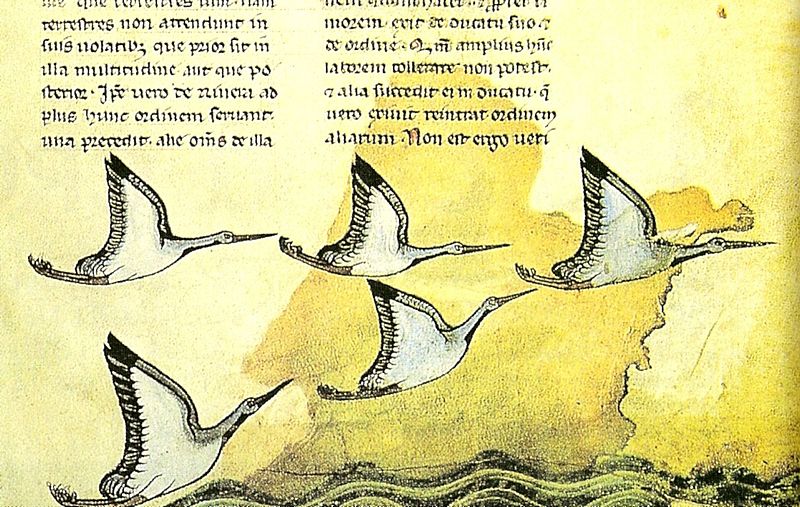
Frederick loved Sicily and spent little time in his German realms. He is known as a patron of the arts and sciences, and a man ahead of his time. If all this has whetted your appetite, there’s plenty written about him. For a historian’s view of his life, I recommend David Abulafia’s biography, Frederick II: A Medieval Emperor. If you prefer fiction, you might try Cecelia Holland’s book Antichrist: A novel of the Emperor Frederick II.
Sarah Nicholls shows the joy and verve and gritty liveliness of Naples, and I have to share it with you! And don’t just look at the pictures, because her writing will transport you there, right into the traffic and noise under the steaming cone of Vesuvius.
Jenny Tonks
I’m delighted to welcome Jenny Tonks as my guest blogger this week. Jenny is an Accredited Genealogist for Italian research. She works as an adjunct professor of Family History at BYU-Idaho and teaches high school biographical writing classes. She is also a memoir reviewer for a literary agent in New York. I ran across Jenny’s genealogy website when I was doing some of my own research, and found helpful ideas there for my family research. If your travel plans include searching for Italian roots, you’ll want to see what she has to share!
Today Jenny shares some of her early lessons in Italian genealogy:
One of my most memorable trips to Italy involves not the food, the scenery, the fashion, or the people. It involved stacks and stacks of paper!
I’m talking about my first visit to a diocesan archive.
I was a college student and former resident of Italy at the time, finishing up my degree in Italian Family History at BYU. What I learned in that archive changed my career. It also helped me solve many Italian family mysteries over the years!
Why the Diocese?
When looking for Italian ancestors, there are two basic sources that I consult most often: Italian government records and Catholic church records. Most of these records are available in the United States as microfilms that can be rented through FamilySearch.org.
The government records are great, but they only go as far back as the early 1800’s for most towns in Italy. Church records, however, can go back as far as the 1500’s in Italy.
Getting at government records is easy—government offices are expected to make their data available to the public.
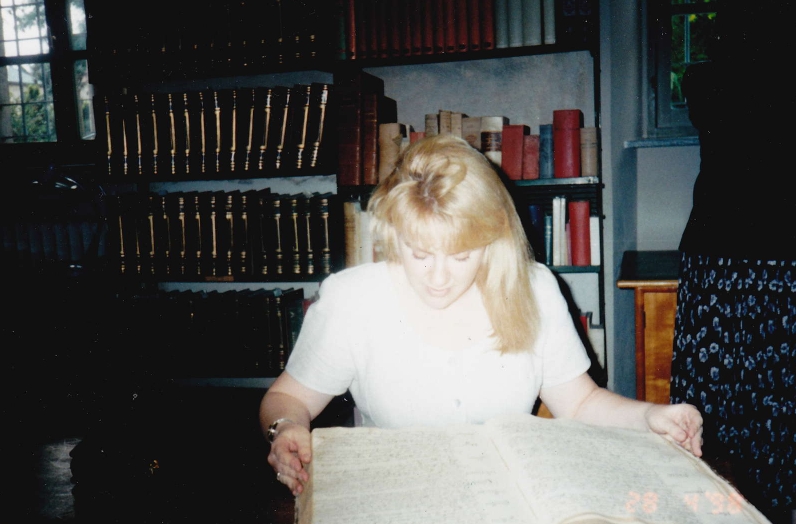
Jenny Tonks with ledger of 1800’s baptisms at the Diocesan Archive of Novara, Italy
But getting my hands on parish records? Not so easy!
I’ve been turned away by more than a few priests who either refused to grant me access to their church records, or who never responded to written, faxed, emailed, or telephoned requests for ancestral information.
But I don’t hold it against them—churches aren’t expected to turn over information the way government offices are. And why should they? Why should busy parish priests have to stop whatever they’re doing every time an American researcher or tourist comes to town, wanting something for the old scrapbook?
In many cases, I’ve found sparsely staffed parishes simply to busy/apathetic to admit me into their archives or respond to my written requests for ancestral information. They’re too busy tending to their flocks, and I understand that.
No problem—I can always go to the diocesan archive!
Generally speaking, I have found most of the clergy who work in these archives to be passionate historians that enjoy looking up ancestors and sharing historical information. They are also more tech-savvy than your typical small town priest, so more willing to photocopy, scan, or email me information.
About the Archives
Typically located at the curia vescovile (seat of a diocese), diocesan archives store:
—Stato delle anime (church census records)
—Visite pastorali (records of pastoral visits to families in the diocese)
–Ordinations (files on those who became priests or nuns)
–Land records (Italians often donated land to the Church at death)
–And much, much more!
So when I can’t get information about an Italian American client’s ancestor from a parish in Italy, I contact the curia vescovile or the archivio diocesano (diocesan archive).
How to Research a Diocesan Archive
FamilySearch.org has films of diocesan archives for the cities of Parma, Rome, Trento, and Catania that are available to researchers in the United States. They are updating their holdings daily, so to find out if diocesan records are available in the US for your ancestral town, ask the experts at the FamilySearch Italy Genealogy department, via their Facebook page or their research Wiki.

Researchers handling stacks of marriage files in the diocesan archive at Novara, Italy
The day I first visited a diocesan archive, I discovered a key to identifying one’s Italian ancestors that has helped unlock the secrets to many Italian pasts. If ever I can be of help to you, you can tweet me, friend me on Facebook, or send your questions to my Ask a Genealogist site, where I give free research advice.
In bocca al lupo!
Here’s an Italian food I haven’t tried! Sounds YUMMY.

Above, my grandparents’ hometown of Scerni, in the province of Chieti, in the Abruzzo region of Italy.
The irony did not escape me. There I was, at a holiday weekend picnic/barbecue in a relatively affluent town in New Jersey, surrounded by friendly and interesting and educated people — in a setting and surroundings where my Italian immigrant grandmother would have felt like she’d landed on another planet…if she even knew or believed in the existence of other planets, seeing as she believed the moon landing and moon walks were faked.
(She also believed in the evil eye. And once, when we made a family trip to upstate New York and visited a place called Howe Caverns, we actually convinced Grandma DiGiovanni to take an elevator down into the caverns. We even got her to get into the flat-bottomed boat which took visitors on a ride on the cavern’s underground river…
View original post 480 more words
I’ve been doing some gardening during the last few days. Little sprouts of a salad garden are rising from a back-porch pot. Leaves are peeking up where I dropped peas in the ground last week. I love seeing things grow, and getting to eat them when they are ready–tomatoes warm with sunshine, feathery herbs chopped up on greens, or tossed with pasta.
And what would I be growing if I lived in Italy? Maybe something from Franchi Seeds.


Do they Santa Anna green beans taste any different than, say Blue Lake green beans, or the tomato San Marzano 2 from Romas grown at your local farms? I’d love to hear from anyone who has grown comparison crops, or who uses seeds from Italy in your gardens. Please comment and enlighten us!
I loved reading about Zac’s adventures in Calabria, and his photos! Had to SHARE!

I spent the last few days sans Internet, in a hostel on the south-western coast of Italy. Without the use of much technology I was able to turn my mind off. Some would say this would mark the start of my most recent decent into madness. But rather, it would seem to have started before we arrived on the hillside that would be our home for five days.
Pass the time. For the traveler, a time honored way to pass the time arrives as a book. While in Roma Termini, I was presented with an opportunity to purchase a book, written in Italian. With an upcoming stretch of time I would be spending in solitude and, without the distraction of Internet- I bought one of my favorite stories. La Metamorfosi by Franz Kafka has brought me great joy, as I stumble through the pages (there are many words which I…
View original post 370 more words
 First off, I wish I’d had this book the first time I visited Naples! I will definitely be using it the next time. I’ve looked in at Barbara Zaragoza’s blogs now and then: The Espresso Break and Naples (Napoli) Guide, and I’m glad to have her info about Naples compiled in book form.
The subtitle promises “Tours and Nooks of Naples, Italy and Beyond”, and I would say the book delivers. The major highlights are covered, in greater detail than many books offer, and then come the hidden corners of Naples that you would never find on your own, like Mauro the glove-maker’s factory, and Japanese restaurant recommendations.
Barbara has also included some practical travel information about safety, driving, staying healthy, and using public transportation. Her advice on greeting Italians is spot on: A little Buon giorno will take you a long way in Italy!
The great detail and variety of information make up for the lack of color photos, as I always appreciate color in a guidebook.
After seeing nearly three pages devoted to the subject of trash in Naples, I laughed out loud at Barbara’s defense of the city’s dirtiness. Why is the city so dirty? “Neapolitans have preserved so much of their past that the buildings almost by necessity tend to blend into the natural look and feel of the ancient ruins.” Naples is just natural, and she suggests that other cities seem un-naturally clean. Well, my mom and I had a good chuckle over this, but I must say, please don’t let the city’s reputation for dirt and grittiness stop you from making a visit! I compare it to the gritty vibrancy of lower Manhattan–a sign of life!
The book includes lots of detail on the ancient sites around Naples and legends connected to them. She also includes a section called the “Odious Women Tour” which includes goddesses, queens, prostitutes, and revolutionaries.
Considering that many travel guides offer just a few pages to the entire south of Italy, this book is a treasure for visitors to the Naples region. If you have a day, or several, to spend in Naples, this book will help you fill your time well.


 The Italian South