Book Review: Strega Nona’s Gift

The most recent in Tomie dePaola’s long series of Strega Nona books, Strega Nona’s Gift (Nancy Paulsen Books, 2011) describes the many festivals connected to Christmas celebration in Italy. In her Calabrian village, Strega Nona cooks her way through the season, cheering up the townspeople when they need it with her own happy magic. Big Anthony wants to help, but can’t seem to stay out of trouble. By the end of the celebration, though, he sets thing right.

This beautiful picture book is a great way to share Italian Christmas traditions with young children. The colorful and varied illustrations are in classic dePaola style, as charming to adults as to children.

Tomie dePaola has written and/or illustrated nearly 250 books during a career of more than 40 years. He is likely the best known Italian-American writer for children, and in 2011 was honored with the Laura Ingalls Wilder Award for his contribution to children’s literature. Strega Nona: An Old Tale Retold, published in 1975, won the Caldecott Award in 1976, and several other Strega Nona books round out the story of the old lady who uses her magic to take away warts, give people good dreams, and many other kindnesses.

So early bird Christmas shoppers, this is your heads-up. If you know young children you want to share Italian traditions with, this book may be the perfect opportunity.

History denied me: Old stuff I can’t figure out.

Exploring Sorrento on foot, Vern and I followed a road that crossed a deep ravine. Looking down, among the thick undergrowth, I saw a ruin, a former mill or factory, it appeared, covered in creepers and moss.

That kind of thing just gets my head spinning. What was it? When was it built? Who worked there? Why was it abandoned? I’m sure that some research could turn up the answers to these questions, but I had higher priorities at the time. Still, that picture catches in my imagination now and then.

The trouble with Italy (and of course there are other places) is that it is filled with these bits of time gone by, wherever you go. Bits of ancient columns built in a new(er) stone wall. Arched “doorways” forty feet above the beach on a cliff face. Roman mosaic fragments dug up during remodeling.

Sometimes when I see such things, a story simply comes to me, and I wonder how close to the truth it might be.

Black wool stockings, or Winter travel in Italy

We arrived in Sorrento in mid-February to begin two weeks of Italian language school at Sorrento Lingue. We’d packed for a month in a mild winter climate.

Too mild, it turned out.
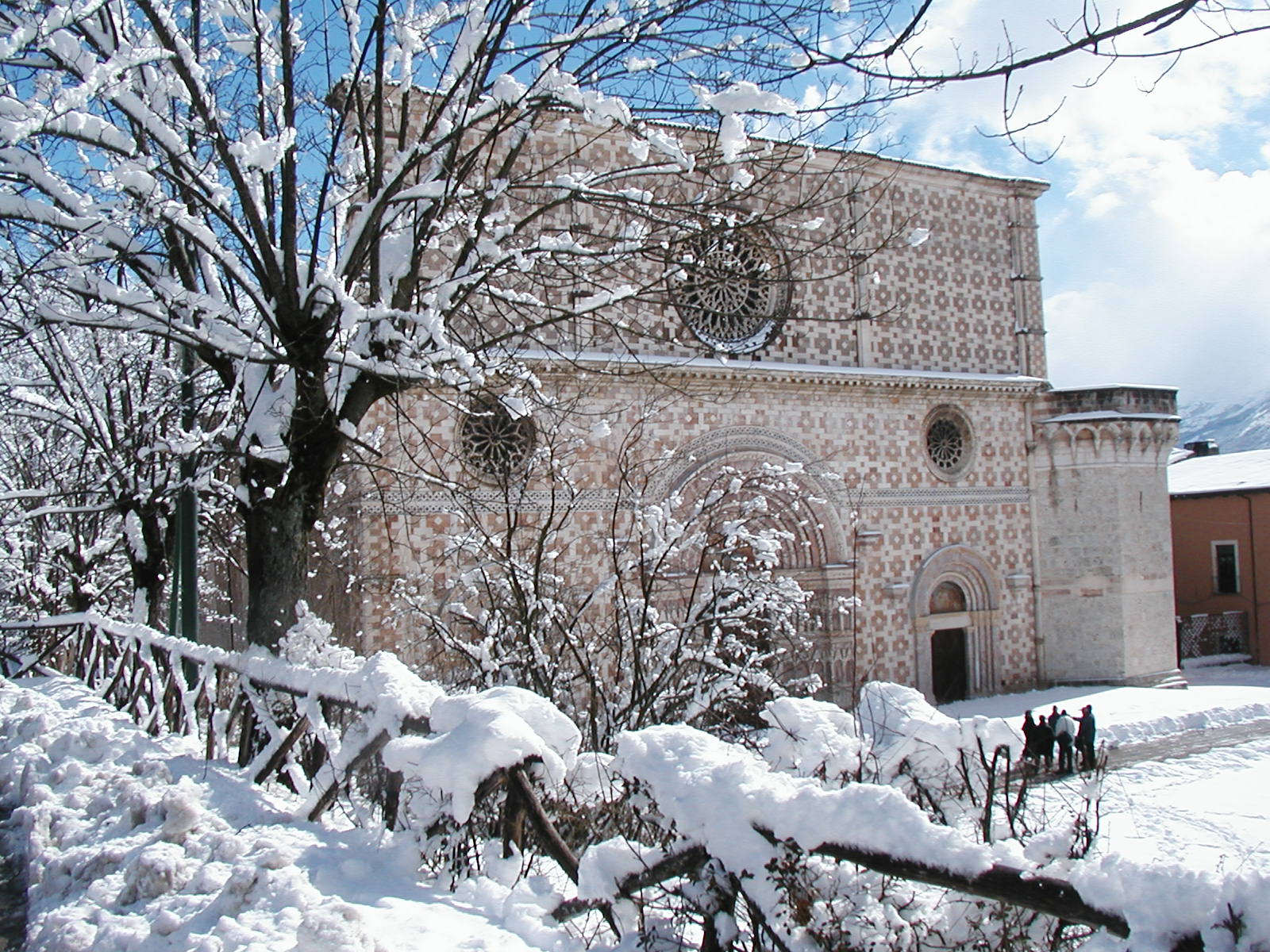
Basilica di Santa Maria di Collemaggio in the snow.

Our host family’s apartment, with its icy marble floors, was not heated to the level we Americans are accustomed to. My first purchase in Sorrento was a pair of black wool tights, which I wore almost every day, with my other clothes. With additional socks, and a sweater under my warm coat.

It’s one thing to bundle up when you go outside–after all, I grew up in Alaska, and I know what winter cold is like. But it seemed nearly as cold inside as out, and we were bundled up inside and out.

Granted, it was mid-winter. We had several very windy days in Sorrento, and a few with rain. We walked several blocks every day to our class, and on our free afternoons we walked all over the city. We walked a couple of miles each way to see the ruined villa at Capo di Sorrento, and took trips to Pompeii and Positano.

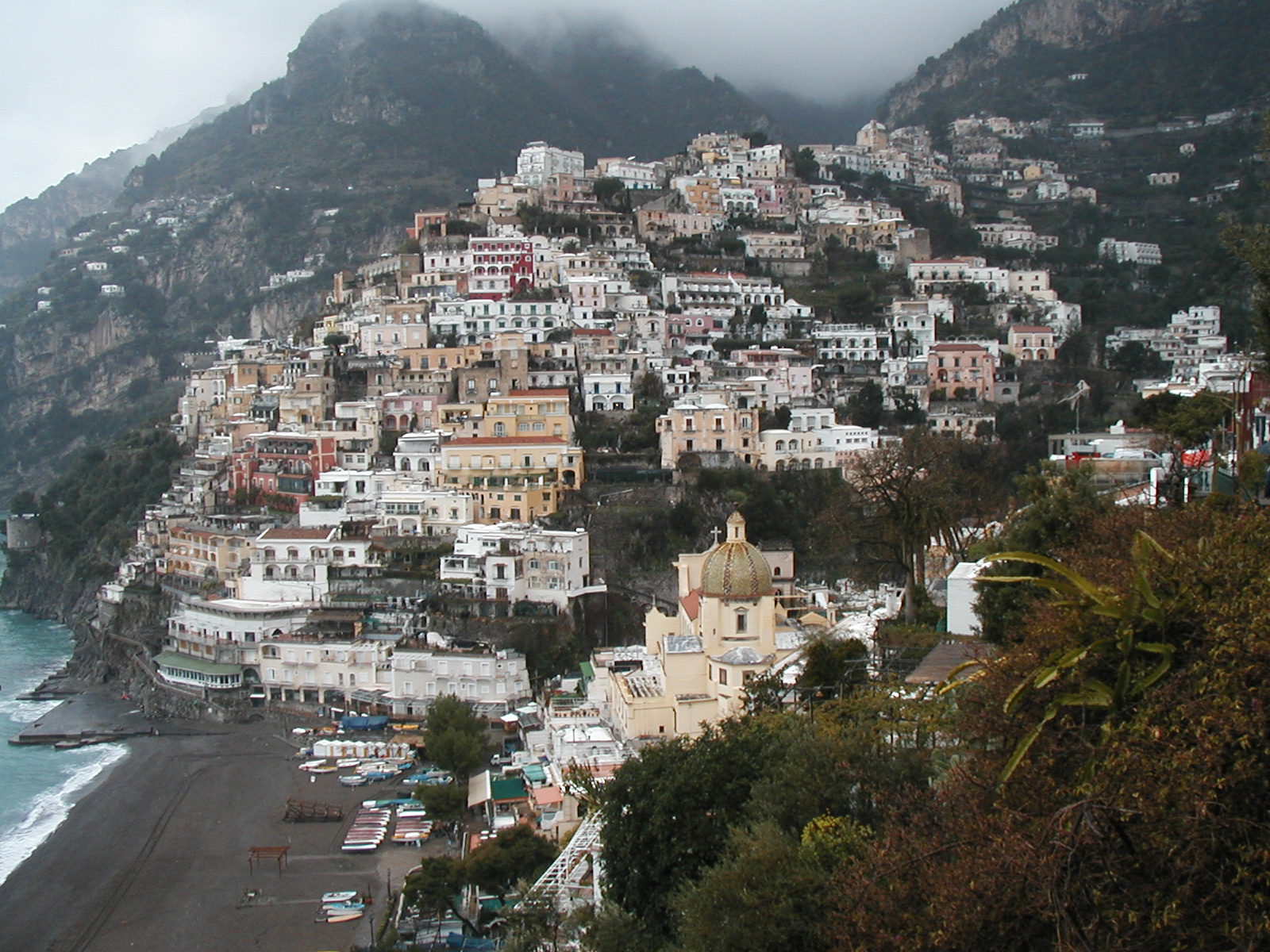
Clouds hanging low over Positano.
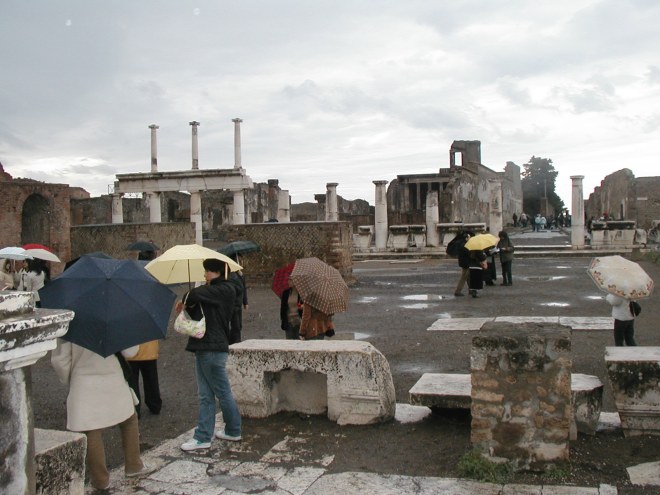
Umbrellas were the order of the day in Pompeii.

But I’m afraid in all my planning, in spite of knowing that we were traveling in winter, my brain retained the images of sunny Italy, warm Italy, cappuccino on the terrace Italy.

After two weeks in Sorrento–two weeks in those wool tights–we picked up a rental car and headed to L’Aquila. It’s farther north, yes, and a higher elevation, in the central Apennines. A beautiful, historic city (until April 6, 2009), one I was very eager to visit. Weathermen in military regalia on TV had forecast possible snow, so we insisted on getting chains with the rental car, and sure enough, snow began to fall by mid-afternoon as we climbed into the mountains.

But we Alaskans were not daunted by a little snow, and we carried on. As the snow accumulated to three, then four inches, with no sign of letting up, we pulled to the side of the road under an overpass to put on the chains while there was still some daylight.

The chains did not fit.

The thought of another couple of hours in failing light on curving mountain roads gave us pause. We had a lovely hotel room waiting in L’Aquila, and were eager to be in it. But how long would it take us if the snow continued?

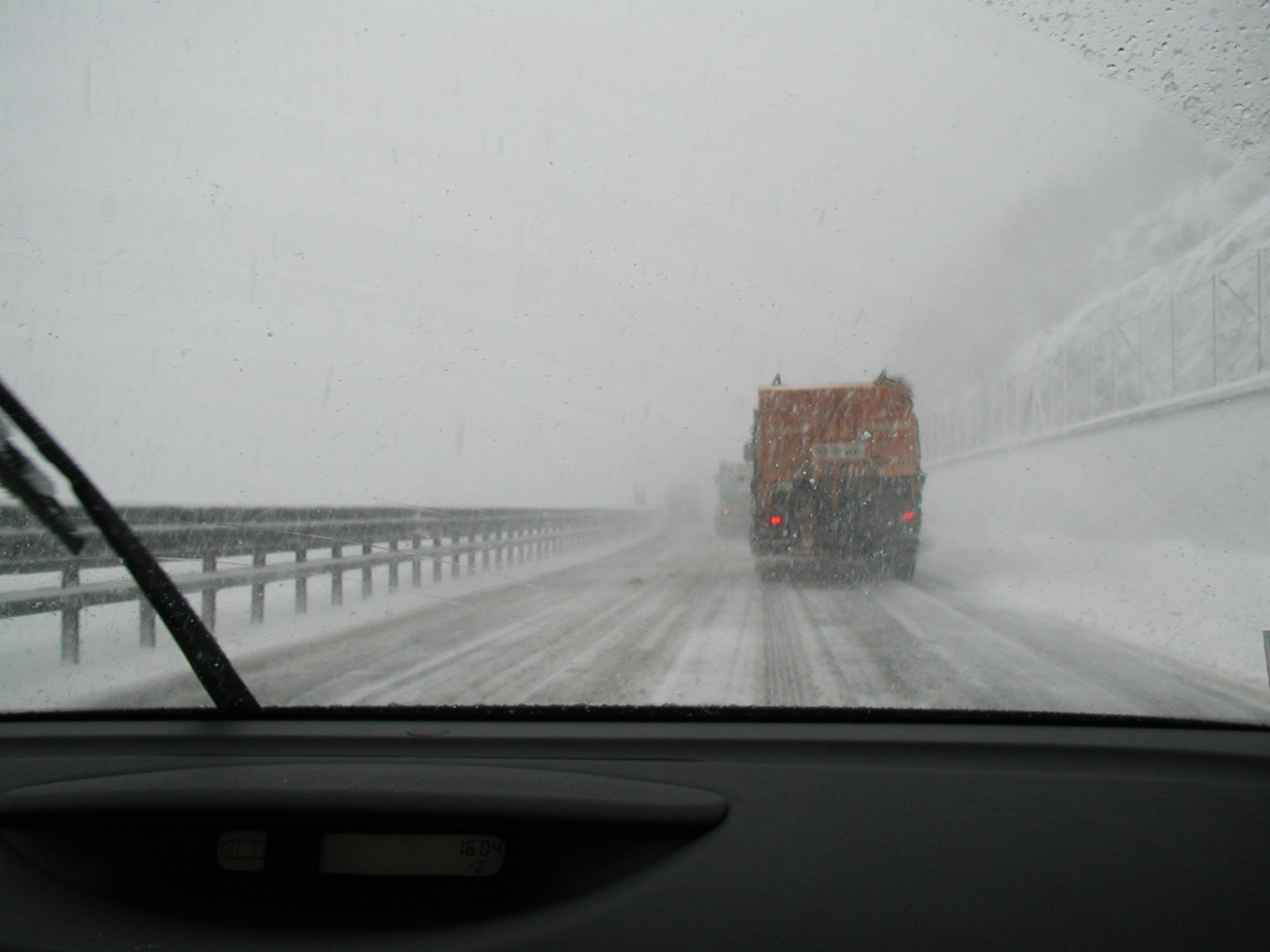
As we pondered this question, the rumble of a large vehicle on the overpass caught our attention. It slowed, and then appeared on the ramp and pulled onto the highway in front of us. A snowplow! As we folded our maps and prepared to pull out behind him, another plow came down the ramp. And another!

Following our caravan of snowplows.

With high hopes that one of them would go to L’Aquila, we pulled out into the thin slush in their wake, and followed them at about 40 mph all the way to our destination. Other cars passed us, but we simply followed. It was our first day of driving in Italy, and a memorable experience!

So for anyone planning a winter visit to Italy, I will say: By all means, go, see the sights, the pasta and wine are just as wonderful in winter, but take your black wool stockings! You are likely to need them.

Wish I had a Nonna and Zia living in a beautiful Italian village! Thanks for sharing this–I love the area around Sulmona.

jlisi05's avatar0nmylist

We’re officially on to the third and final leg of our epic European trip – visiting my Nonna and Zia in Pettorano sul Gizio, named one of the “most beautiful villages” in Italy!

Though I’m sure most of my (very few!) dear readers have already seen photos of every nook and cranny of Pettorano, today Patrick and I discovered a new area: a park and some trails around the old water-powered mills (mulini) at the foot of the mountains. Check out the great views of the town that we got from down below.

View original post

How to make (and say) bruschetta

Various toppings for bruschetta at http://www.myrecipes.com.

I love a good bruschetta, but have to admit, I have been reluctant to prepare it myself. My biggest fear has been getting the bread wrong–not crispy enough, or too charred, or soggy from too wet a topping. Camille Parker of Camille’s Dish has given me a little confidence, and with tomatoes now growing in abundance, I am going to try it. Here’s a video lesson on making bruschetta–and I love that Camille pronounces it the Italian way. She’d probably get in trouble with her 92-year-old Sicilian grandfather if she said Broo-shet-a like most people do in America!

I had the best bruschetta I’ve ever tasted in America in the most unexpected place. Not in Little Italy somewhere, or even in my mom’s kitchen, which is a great place for Italian food. No, right in the heart of the midwest, at Johnny’s Italian Steakhouse next to the Radisson Hotel at Des Moines, Iowa’s airport. No kidding. My sister and I went back twice when we visited Iowa last year, and would have been happy to make that appetizer our entire meal. I didn’t get the recipe from them, but my sister recreated it at home with goat cheese, finely diced roma tomatoes, garlic, a little basil, olive oil. Yum. Okay, now I’m hungry!

Are there Italian foods you’ve been afraid to make yourself? Something you wish you’d tried cooking sooner? A great bruschetta combination you’ll share with us? That’s what the comments are for!

“The Viagra of the poor”? Here’s a fun blog post about Calabrian hot peppers and spicy food. Thanks, DUTCHgoesITALIAN!!

dutchgoesitalian's avatarDUTCH goes ITALIAN

The product that is loved the most in Calabria is the Peperoncino, the so called hot chili pepper. In every house you will see peperoncino hanging from the ceiling, and in every dish you will taste it. Oh yes, i calabresi like it hot!

You name it and they use peperoncino; chocolate liquor with peperoncino, gelato al peperoncino (oh yes you can have this type of ice cream in the coastal town Diamante), pasta dishes with peperoncino, sausages with peperoncino, grappa al peperoncino and so much more…

I just mentioned the coastal town Diamante which is located 27km south of Praia A Mare. At the entrance of this town a red statue of the capsicum will welcome you to let you know that Diamante’s true symbol is the peperoncino. To honor this hot jewel the Peperoncino Festival is held every September. This celebration includes concerts, dances, film reviews, street theater and a competition to find the person capable…

View original post 147 more words