August vacation in Italy

I can’t say I wasn’t warned. I’ve heard lots of advice about avoiding the August heat and August holiday, Ferragosto, celebrated on August 15, was established by the Roman emperor, Augustus, in 18 BC (according to Wikipedia). The date also marks the Roman Catholic celebration of the Assumption of Mary, widely marked with religious processions in Italy.

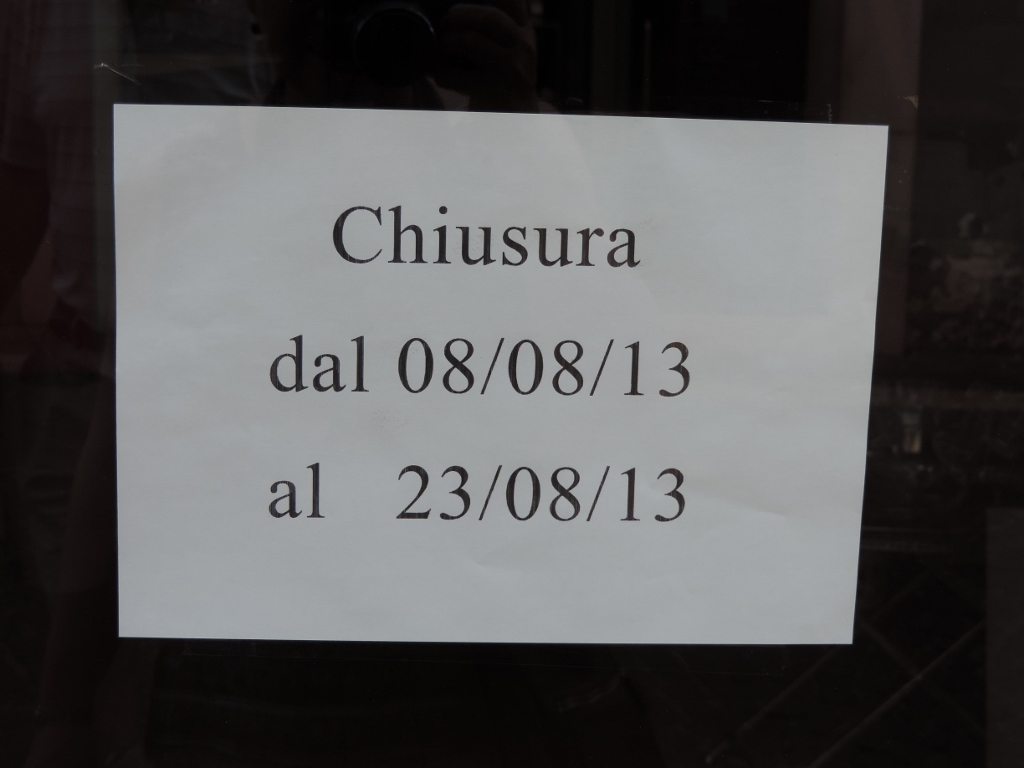
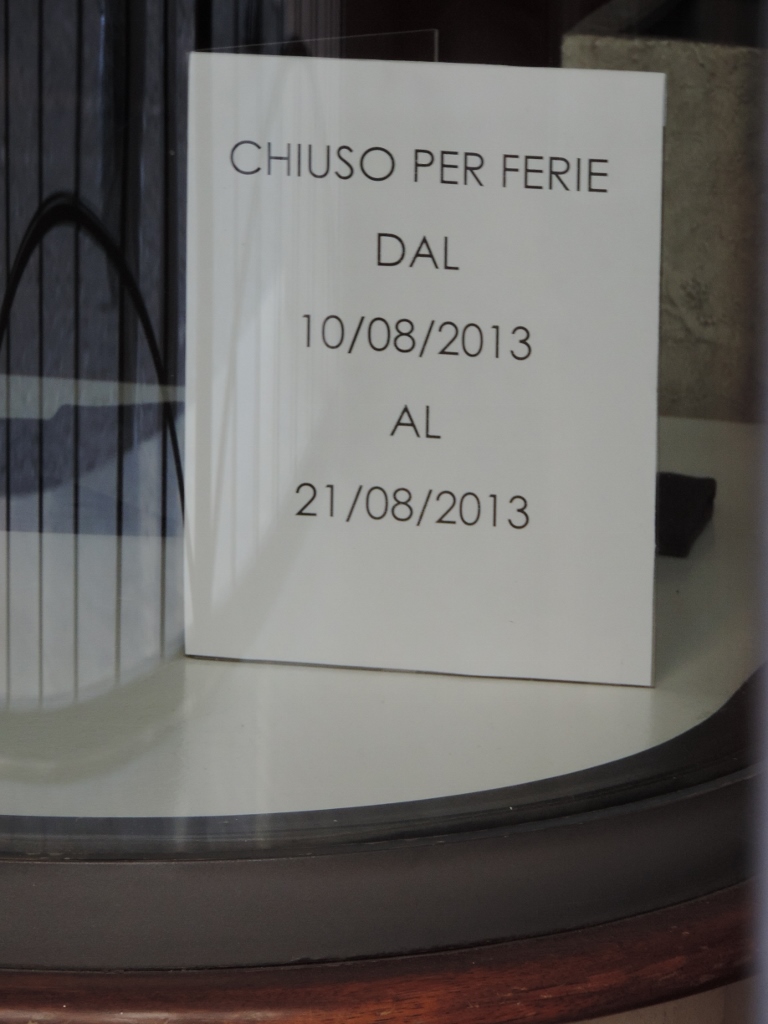
The August heat is just too much for me, reason enough to find a cooler month to visit. But why avoid the holiday celebrations? Here are a few visual aids:

DSCN0595 (1024x768) DSCN0592 (1024x768) DSCN0593 (1024x768) DSCN0594 (768x1024) DSCN0596 (1024x768) DSCN0597 (1024x768)

Yes–many businesses are closed for the full week, and often longer, even up to a month. All these signs were along one street in Caserta, where we stopped on our way to Calabria.

In August, families gather, those who have moved away come back to visit in their hometowns. Big family dinners are held, and even those who don’t celebrate the religious holiday take pretty seriously the Latin origin of Ferragosto, a phrase that mean’s “Augustus’ rest”. It’s the Italians’ time to take a break.

So what did five Americans do in Calabria for Ferragosto? We joined a lot of Italians at the beach at Squillace Lido for the day, rented a couple of umbrellas and five chairs for a few hours. By three in the afternoon we were in Soverato having lunch at a seafood place near the beach. They served a special Ferragosto menu, four courses at a set price of 18 Euros per person. Salad of octopus with potatoes, tomatoes, parsley, lots of olive oil. Then mixed seafood lasagna. Then a big swordfish steak (again, heavy on the olive oil). And for dessert, watermelon slices.

By 6PM we were in our ancestral village to see the religious procession with our distant cousin. This was very interesting, and far outside my own Christian tradition. Following a service in the church, the statue of Mary, with a couple of cherubs hanging on, was carried on a circuit through town and back to the church. We visited afterwards with my cousin’s family.

Outside the church, as we waited for the statue to be carried out, my cousin greeted nearly everyone who came by–people she has known most of her life, even though she grew up in Rome and lives in Denmark most of the time now. Scigliano is her home town, and she returns every August, reconnecting with aunts and uncles, cousins and schoolmates, and reconnecting with the church and the meaning it brings to her life.

There are plenty of tourists in Italy in August, non-Italians playing at the beaches, lakes, and in the mountains. But it is clearly an essential Italian family time. As we watched the Virgin carried aloft through the streets, I wondered if my great-grandmother Giusseppina watched the same thing when she was a girl, 125 year ago. I wonder how she felt on the first August she spent in America, far from her village and if she felt keenly the cutting of those family ties–the ties I am trying to rediscover with my cousins in Italy.
Death at a distance

On our last evening in Venice, I learned that my beloved Aunt Phyllis passed away.

My mom’s oldest sibling, Phyllis was always a woman of heroic proportion to me. She hosted family holiday gatherings throughout my childhood in Alaska, bought me books to encourage and inspire, took me shopping for clothes as a teenager, and accompanied me on my first visit to the Oregon Shakespeare Festival. She wrote, and encouraged me to write as well. We had the same favorite college English professor–when she was in her early forties and I in my early twenties.

By 2005, when her only daughter died, she was showing signs of mental lapse. In 2007, her only son was terminally ill, and her need for help was clear to everyone but her. She was diagnosed with Alzheimer’s disease. I helped her move near me, and petitioned the court for guardianship. In those first years, I took her out to coffee, shopping at WalMart, and to the casino to spend $10 in a slot machine every few weeks. When she needed a reminder to push the same button every time the machine stopped, we quit going to the casino, and just visited at the assisted living home where she lived. I brought her flowers from my garden, treats to keep in her room, and bought her the toiletries and clothes she needed.

She ran out of money, and about three weeks ago was qualified for help from Medicaid, which started on August 1. During the previous few months she had declined in most of her functions–limited to a wheelchair and talking more nonsense.

So I left on my Italian sojourn hoping that the emergency numbers I left at the care home wouldn’t be needed.

Justin called on August 9 to tell me it looked like the end was near, and again within a couple of hours to say she was gone. My mother was with her, and is taking care of details (most were arranged in advance, years ago) which couldn’t wait for my return.

I am told to continue my vacation, others are taking care of everything. But it is very surreal, being here, and thinking how different things will be when I return. She loved travel, and in recent years told people she had been all over the world, even driven to Africa. So I am continuing on, ready to visit our ancestral village in a couple of days. My outlook is more sober. But I am full of life, part of that a legacy she left me and our family.

So I continue not only sober, but grateful for her part in my life. Tomorrow I will visit the royal palace at Caserta, and think how she would have loved it.

Morning in Venice

Vern and I were awake at 4 AM yesterday and about 6:30 decided to go out for a look around while the day was still cool–by which I mean 77 degrees or so. We headed for Sst. Mark’s Square, passing only a few pigeons in the narrow streets. Approaching the archway into the square, the morning haze was bright with early sun. First an Asian girl, then a solitary man, then a scattering of others came into view–photographers all, repositioning themselves for one shot after another of the domes, the clock tower, the great winged lion, gilded by the sunrise. The hordes who fill the square by day and night were still abed. The only other souls about were two men sweeping the pavement with twig brooms, gathering the discarded butts and candy wrappers, plastic water bottles and ticket stubs, into piles. They called out to one another as they worked, but my ears aren’t yet tuned to Italian to know what they said. We crossed to the waterside where gondolasrocked gently in their blue covers, and looped south past the little Kaffeehaus before turning back into the narrow streets toward our apartment. Now a few signs of commerce appeared–not yet an open bar (we had hoped to find a coffee) but men pushing hand trucks piled heavily with cases of bottled water or boxes of eggplant, tomatoes, lemons, headed to a restaurant. The trash man came, picking up plastic bags set ot for him. And as we walked along one canal, a boat with a large metal tank collected sewage through a fat flexible hose. We neared our apartment, and passed a couple of sleepy tourists in the restaurant of a large hotel, picking at their breakfast. Finally, by 7:30, the world was coming back to life.
This was so unlike our experiences in other Italian cities off the tourist path. There, they have business to conduct, shops to open, and they gather early for a quick espresso and a glance through the newspaper along the way. But here, the tourist rules, and seems almost to have become the reason for Venice’s existence. Strangers gather to view her history, and there’s money in it. But no real reason to be up at 7 AM.

Venezia!

First trip in a long time without a laptop so I’m learning to post from smartphone, nook, and friend’s iPad, and using my new WiFi enabled camera. But I don’t want the learning curve to interfere with the blessing of being in Italy. Bear with me. We woke to bells ringing from a nearby church–the best alarm clock I’ve heard in ages.

Book week: Meet Gino Calabrese

Astrologos.1531aIt’s the fourth Friday of the month, the time I usually post a book review. But not this week.

Instead, I am introducing Gino Calabrese, a phony Seattle astrologer, originally from Little Italy in St. Louis. He’s also a character in the novel I recently finished, now in the hands of a few select beta readers. I’ll be submitting to an agent this fall, after a little more fine tuning.

I predict you’ll like Gino–an adventurous guy with Sicilian roots, whose birthday sailing trip with an Italian cousin lands him somewhere he never expected to be, facing the Black Death, an amorous teenage girl, and 650 years between him and home.

Gino loves ancient history, but he’s a little rusty on the medieval years in Italy, something that might be more helpful in his predicament. And that tattoo his mother didn’t like, the Greek symbol for Gemini? He never imagined the trouble it would cause.

Wish me luck–publishing is a crazy business these days. But I’d love to have you all meet Gino on the printed page someday!

The abbey built by “my” pope!

I spent several years researching Pope Celestine V, and wrote a novel in which he was a significant character. Don’t bother looking at Amazon–it remains unpublished.

Touring the abbey, September 2004

Touring the abbey, September 2004

One of the most exciting days during my research in Italy was visiting the Abbey of the Holy Spirit, which was founded by Pope Celestine in the late 1200s. At the time of our visit, nine years ago, the abbey was in the middle of an extensive renovation, and was closed to the public. However, with the help of an Italian friend, I was given a tour guided by the architect who had worked on the restoration from its beginning.

At that time, we picked our way through construction debris and materials, plastic draping, and electrical cords. The paintings on the walls were just emerging as a blanket of grime was removed.

But most meaningful to me was a visit to the crypt–probably the oldest section of the abbey, because much of the existing construction was done after a devastating earthquake in the early 1700s. Long strings of construction lights left shadowy corners in the crypt, and dust from the restoration work covered the floor. The architect pointed out a fresco picturing the future pope, Peter of Morrone, with a group of monks.

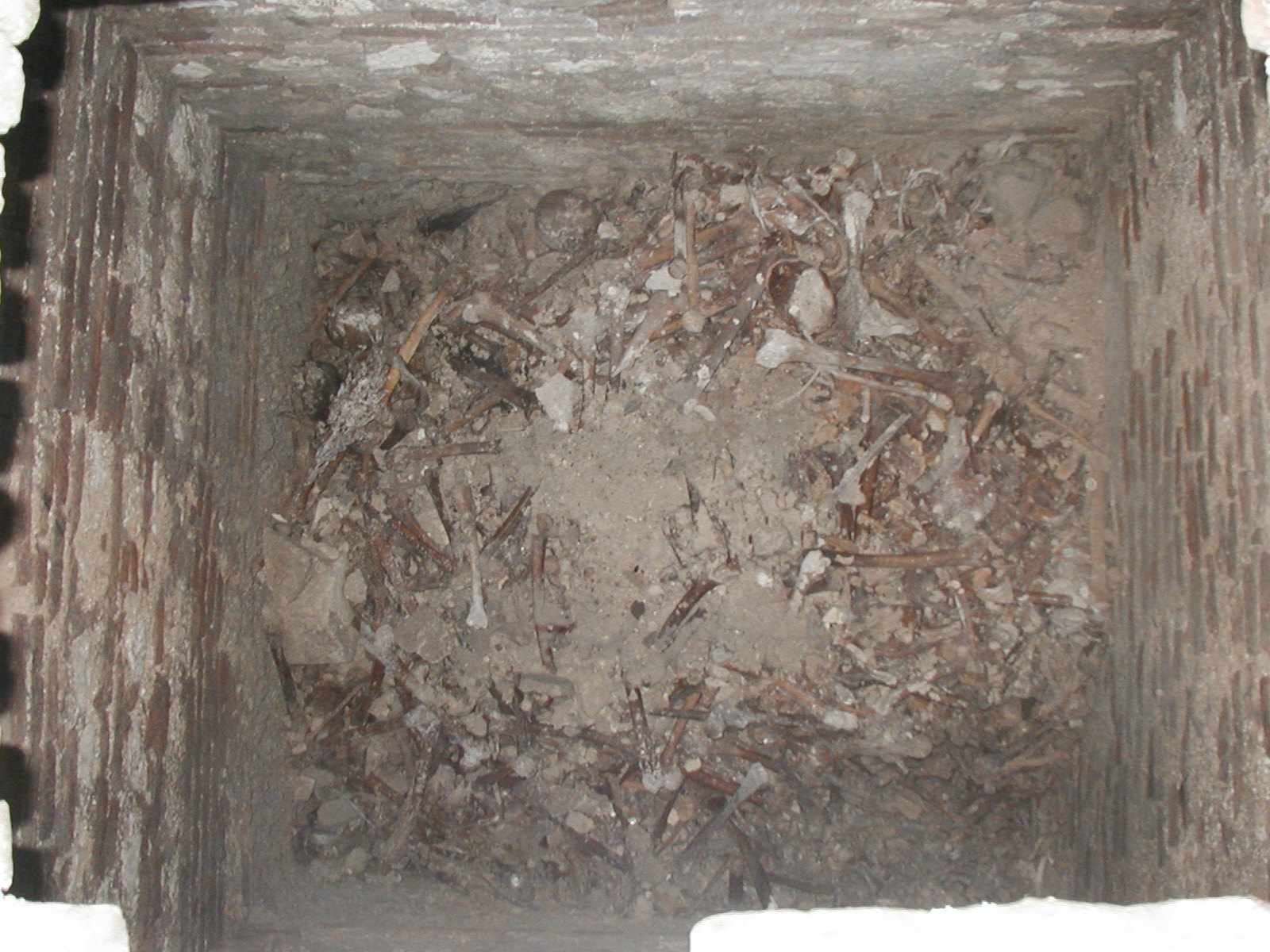
I noticed a large panel of concrete in the floor with an iron ring set into it. When I asked what it was, the architect and my friend placed an iron bar through the ring and lifted the panel to one side. We peered in, but the poor lighting revealed nothing. Then my husband aimed his camera down the hole, and the flash went off.

The ossuary of the Abbey of the Holy Spirit

The ossuary of the Abbey of the Holy Spirit

The resulting photo is my favorite of our travels, an image that awes me to this day. We were looking into the ossuary, the place where monks’ bones were laid to rest. Amidst the dust, the human bones are visible, bones of men who served God hundreds of years ago. The monastery was closed more than 200 years ago, so the remains we saw were from the 18th century and earlier.

Today, the restoration is done, and the results are beautiful! Here is a video tour, narrated in English, of the Abbey and a couple of other nearby sites.

Have you visited a monastery? Is there a particular one whose history intrigues you? Tell us about it in the comments!

Book giveaway! to celebrate my trip to Italy next month

royalty-free-photo-antique-book-pile-375x500A while back I reviewed Chris Harrison’s  memoir Head over Heel–you can read the review here

I’m making another visit to Italy next month, and to celebrate, I’m giving away my copy of Head over Heel to some lucky blog reader. To enter, please comment, either here on the blog, or on my Facebook page. Tell me where in southern Italy is your favorite place–or the place you dream of going.

Please share the giveaway info with your friends, and good luck!