Bari’s colorful past

I once mentioned to a friend that I would love to visit Bari. His brows shot up. “No you don’t,” he assured me.

He had been to Bari some years earlier, and found it less than enchanting.

But it isn’t Bari today that attracts me, as much as Bari’s history. When I mentioned Bari to my friend, I was thinking of the port where thousands of crusaders launched their sea journey to the Holy Land. Nearly 2,000 years ago the Emperor Trajan rerouted the Appian Way to Bari, bringing it to prominence as a Roman port and commercial city. Today it is southern Italy’s second most important city, with a university, two modern harbors, and a metropolitan population of more than a million people.

Statue of Saint Nicholas in Bari's basilicaThe relics of Saint Nicholas rest in Bari, secreted out of his native city of Myra (part of modern-day Turkey) in 1087 in the midst of an invasion. Accounts of the event vary, but ultimately the saint’s relics were brought to Bari, where a basilica built in his honor is considered by some to be Bari’s most important building, built in the 12th century. A festival held each May celebrates the arrival of the relics. This is the fourth century saint who has morphed over the ages into Santa Claus.

Bari’s port also saw a significant slave trade in the early Middle Ages durin Byzantine rule, when slavic captives were sold to the Turks and others in the eastern Mediterranean. About five hundred years of Byzantine rule gave way to Norman rule in the late 11th century.

Bari Vecchia, or Old Bari, was for many years a good place to avoid due to rampant petty crime. Perhaps this was my friend’s experience in Bari. But this review on Slow Travel Italy describes the old city in very appealing terms.

One day I will go and see for myself!

Sulmona: A city of surprises

Surprise #1: Sulmona is easy to reach by train or by car–about two or three hours east of Rome in the central Appenines. It’s off the beaten path for tourists, but is gradually being discovered, as evidenced by dozens of reviews on TripAdvisor for lodgings, restaurants, and things to do.

Confetti flowers for sale in Sulmona (RaBoe/Wikipedia)

Surprise #2: Confetti! Not the bits of colored paper, but bits of colored candy coated almonds and chocolate, attached to wire stems and shaped into butterflies, flowers, swans, and other beautiful creations. Bouquets of confetti line the shop fronts along the Corso Ovidio, brilliant color drawing you along to find the next candy fantasy.

Surprise #3: History galore! I suppose this shouldn’t come as a surprise anywhere in Italy, but there are Roman ruins beneath the city, visible in a couple of museums attached to churches: S.S. Annunziata and San Gaetano. The city is surrounded by medieval walls, and a medieval aqueduct forms one side of the large Piazza Garibaldi.

Surprise #4: World class events! In addition to annual jousting competitions held in late July and early August, an international Latin competition celebrates the Roman poet Ovid who was born in Sulmona, nearby towns have festivals celebrating cherries, red garlic, and wine, and in Pacentro the annual Corsa degli Zingari (Race of the Gypsies) in early September has been celebrated for more than 500 years. On one visit to Sulmona we were surprised to see the Piazza Garibaldi transformed into a skating track for the International Speedskating Championships.

Medieval aqueduct in Piazza Garibaldi, Sulmona. (RaBoe/Wikipedia)

Surprise #5: Great food! We enjoyed meals at the Hostaria del Arco and Cantina di Biffi–rated number one and two among restaurants in Sulmona on TripAdvisor. Like most Italian cities, coffee shops abound, along with pizzerias and a variety of restaurants.

Surprise #6: The great outdoors! Sulmona’s valley is surrounded by national parks with lots of hiking opportunity. The mountains have remnants of ancient shepherds’ huts, along with several hermitages which are popular hiking destinations. There are also about a dozen ski areas within 60 to 90 minutes’ drive of Sulmona. The beaches along the Adriatic coast are about an hour away.

I hope you’ll try Sulmona when you plan a trip to Italy!

Food: Caciocavallo and other cheesy delights

I paused in front of the cheese display at a little market in Scigliano. “Look!” I said to Vern. A herd of little horses, shaped from ivory strands of caciocavallo cheese, were lined up in the window to amuse me, and that they did!

Those Italians really know what to do with cheese! Going to the cheese-and-sausage stores was one of my favorite shopping delights in Italy. We always found interesting cheeses, and succumbed to many temptations there. The volume of cheese alone is enough to amaze someone used to the typical American cheese shopping experience. Giant wheels of cheese cut into thick wedges, balls and chunks, fresh and aged, cheese to try with figs, meats, pasta, bread, cold or melted. I salivate at the many tasty memories.

Caciocavallo was a special delight. It normally comes in double balls, something like a snowman, with a cord around the ‘neck’ where it has hung to dry. Someday I’d love to see the process of making some of the cheese into little horses (cavalli). I really wanted to buy little caciocavallo horses as souvenirs to take home, but they were a little too perishable for that.

If you visit Italy, even if the trip is short and your time tightly scheduled, take a few minutes to find a cheese shop, and explore the abundance. Choose something intriguing, and buy a few ounces. Savor the flavor. The experience might become your favorite memory of Italy.

Book Week: Siren Land by Norman Douglas

I cannot call this week’s post a book review, because I have been unable to read the book. Have you read Norman Douglas? If so, please share your experience with me.

I want to read it. Norman Douglas’s travel books on southern Italy are said to be classics of the genre. So I bought a paperback of Siren Land (a 2010 edition of a book first published in 1911, a sure sign of a classic) and have made several attempts.

This is not light reading, not the kind of travel book for hotel and restaurant reviews.

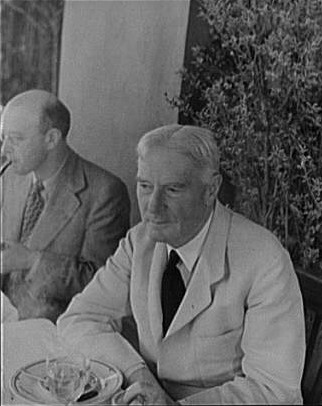
Norman Douglas in 1935

Granted, some might say I am a lazy reader, but Douglas writes dense, complex prose. He cites snippets of Latin, and uses Italian phrases, with no translation for the benefit of readers like me. He alludes to obscure mythologies and little-known historical events.

According to the introduction, Douglas said that the reader of a travel book is entitled to “all one would wish to know about the subject–features of landscape with their associative history, geology, zoology, botany, archaeology, etc.–but also that author’s ‘mind worth knowing'”. And Douglas has supplied these things, some of them in six- and eight-line sentences that require reading three or four times to disentangle the meaning from the words.

Truthfully, he lost me in the very first chapter, titled Sirens and their Ancestry. I tried to pick up on a topic of particular interest to me, his third chapter, The Siren Islets, and lasted a little longer.

His chapter On Liesure opens with this sentence: “Come, let us discourse beneath this knotty carob tree whose boughs have been bent earthward by a thousand gales for the over-shadowing of the Inspired Unemployed, and betwixt whose lustrous leaves the sea, far down below, is shining turquoise-blue in a dream of calm content–let me discourse, that is–for if other people are going to talk, as Whistler used to say, there can be no conversation–let me discourse of leisure, the siren’s gift to men.”

Who knew leisure would be such hard work? And that’s just the first sentence!

So this week, I would especially like to hear from anyone who has read Norman Douglas, with any hints or encouragements to help me through his book.


Naples from another perspective

Here’s a view of the Gulf of Naples that most visitors will never see, a view that takes in thousands of years. See what the eels and seahorses enjoy every day. I love the way this video combines past and present. It leaves me even more curious about the history of southern Italy.

Thanks to my friend Laura Vinti, who made me aware of Another Naples!

New View of Italian Roots

For this month’s travel post, I welcome guest blogger Vienna Lionberger, my daughter, with some thoughts from her recent trip to Italy:

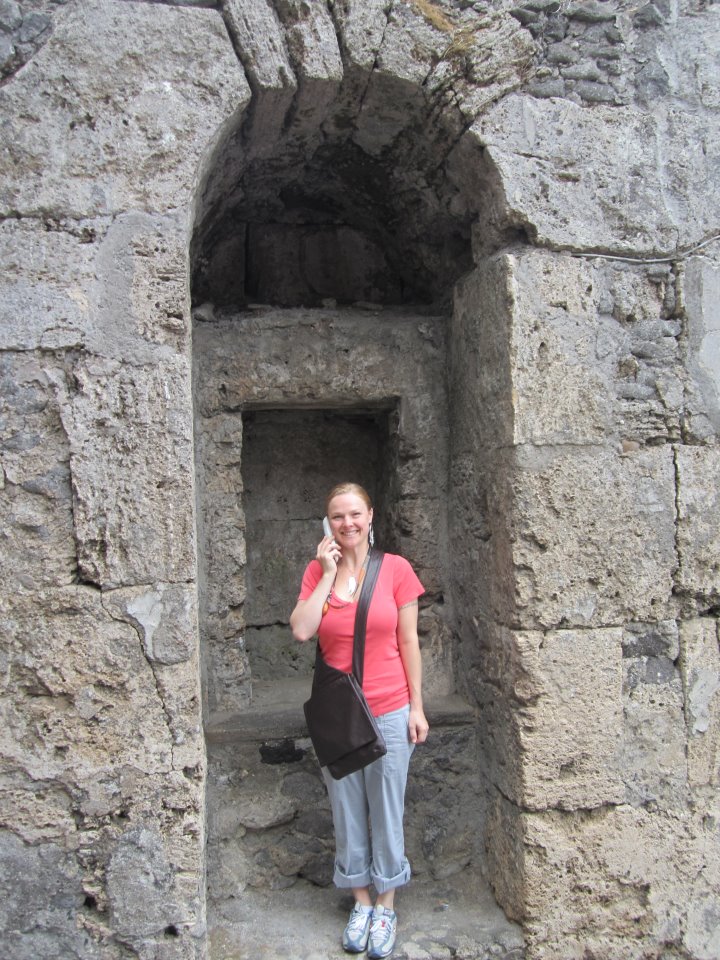
Vienna Lionberger stands guard in Pompeii

All my life I have heard about Italy. My mother has studied Italian history and language, visited Italy for a few months, and taught me to make torcetti, an Italian pastry, from her grandma’s recipe. Though I am only 1/8 Italian, it has been the predominant culture (or at least the loudest one) in my life so I have always felt more Italian than anything else.

Despite my blue eyes and blonde hair (thanks to my dad), I take great pride in telling people I’m part southern Italian, from near Cosenza. Because I have felt so Italian, I was very excited to go there for part of my honeymoon.

Our first Italian stop was at Palermo in Sicily. I have to admit, I thought I would step off that boat onto Italian land, tear up with an upwelling of emotions and start hugging people simply because they were Italians too, and they, of course, would understand and hug me back. I actually stepped off the boat into horse manure. And I definitely wasn’t going to hug the first people we saw because they were the Italian authorities and they had guns and looked like they had had just about enough of tourists for the summer. Although the feeling of belonging I had expected wasn’t there, we enjoyed taking a horse-drawn buggy tour, eating sweet pastries, then savory ones, walking through the market, and touring some Spanish ruins. Back on the boat I thought, “The other ports will be where I feel at home, since, alas I am not Sicilian but southern Italian.”

A week later we stopped at Naples. Again I stepped from the boat, certain this time

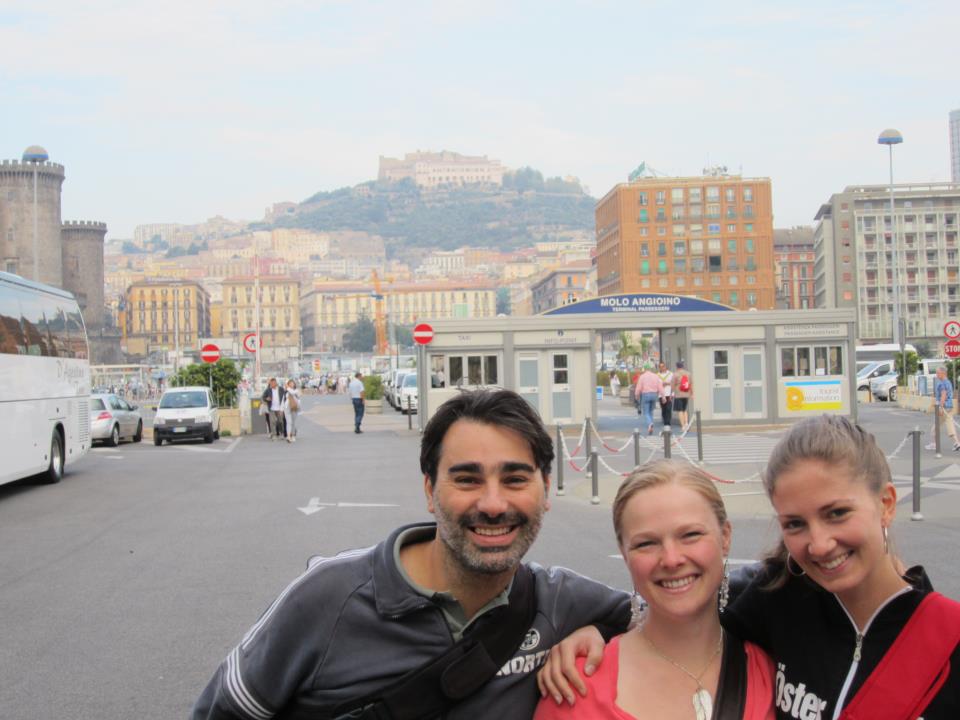
Vienna Lionberger, center, with Filippo and Julia in Naples

there would be tears and hugging. Our Italian friend Filippo met us at the dock. There were hugs, and tears came to my eyes—tears caused by the sweet, vinegary stench from piles of garbage all over the city—piles the size of a semi-truck load every couple of blocks. Filippo told us the garbage pickup was run by the “criminali” in Napoli. They let the garbage sit there for weeks until it became so unbearable that people would pay more to have it removed, basically extorting a whole city. Every couple of months the army was called in to get rid of the garbage because, oddly enough, no other garbage pickup company wanted to take over the contract.

Filippo took us to Pompeii in the morning – which was completely and totally awe inspiring. In the afternoon we went to the best Napolitano pizza place: L’Antica Pizzaria da Michele. They served only two kinds of pizza: Marinara and Margherita. I had a Margharita and never want to eat anything other than that again. We stopped for dessert and espresso, and I rolled onto the boat with a full and happy stomach, and a full camera card. But other than my stomach, I had no feeling of national pride or belonging.

At the end of the cruise, we returned to Rome to meet Filippo and his girlfriend Julia, and travel south with them to his family’s home in Benevento. We arrived late one evening. Filippo’s mother, Angela, knowing I loved mozzarella di bufala, had made fourteen pizzas mostly topped with mozzarella di bufala and tomatoes and basil from their garden. They pulled the pizzas from their brick pizza oven as we arrived. Beside the house where Angela and Dario, Filippo’s dad, live, six houses are clustered together. In these houses live aunts, uncles, brothers, cousins, grandparents, great aunts and great uncles. They all came to greet us, bring more food, sing some “country” songs with Jack, put on a magic show (seriously, a cousin did card tricks for us), drink some wine and simply just be with the family for the evening. Perhaps it was a bit livelier because there were guests, but the sense of family community coming together for the evening seemed a regular occurrence. It was a beautiful night and we went to bed satiated in every way.

The next day, a Sunday, we went to explore Filippo’s home town. The main boulevard was blockaded to cars. It looked as if everyone in town was there walking up and down the street chatting with friends, family and neighbors. No one rushed away to watch a football game or get back to work. Kids played in the fountains and ate gelato. Men congratulated one another on the big soccer win the night before. Women chatted on benches while watching their kids. The scene was an Italian version of a Norman Rockwell print.

We tore ourselves away from this slice of perfection and went back to the house, where Angela had prepared a delicious lunch. Afterward we enjoyed splashing in the full-size pool as the day got warmer. I toured the garden with Angela, who doesn’t speak English. My horrible Italian and her hand gestures allowed a little bit of communication. She showed me her chickens, the fig trees and how they got the figs from the high branches, the olive trees (not quite ready for harvest), the garden with
tomatoes, peppers, basil, carrots, broccoli, arugula, squash, strawberries, and the orchard with lemon, grapefruit, pomegranate, orange, and kumquat trees. (I have a new-found love for kumquats straight off the tree.) Kiwi vines shaded the picnic area.

As we walked she asked about my family. I told her that my mother’s family was from Scigliano near Cosenza. She grabbed my face with both hands, a big smile on her face, kissed my cheeks and said, “You Italian!” She released my face with a force that almost knocked me back, and went down the path to the kitchen to prepare us yet another meal.

Finally, the recognition I had been waiting for, but my feelings had changed. I felt less and less Italian every day as I struggled with the language and saw how different my life was from theirs. I ate my kumquats under the kiwi vines looking over the beautiful countryside thinking back on all of our Italian experiences. The thing I loved most was the feeling of family on that little farm, of being close to the land and people I love.

I am part southern Italian and I’m proud of that. I hope to go back and maybe one day even show my kids a little part of Italy, but until then I will focus on my family and being closer to them. I concluded that I shouldn’t label myself, no matter how fanciful it seems in my mind. I am a mix of many backgrounds with a flavor all my own, and that is ok.

Pompeii: Just do it!

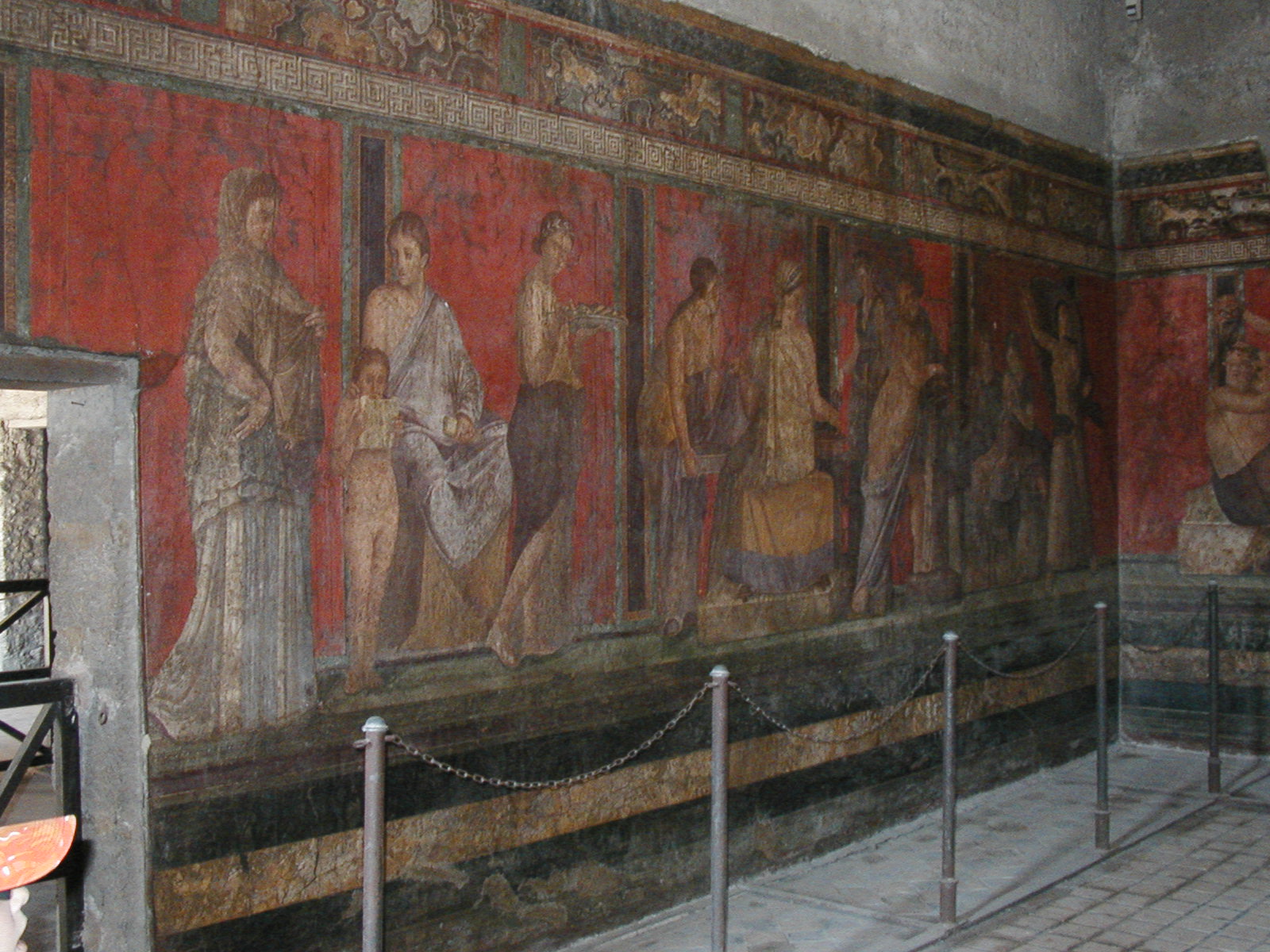
Frescoes in the Villa of Mysteries, Pompeii

Ancient history doesn’t turn my crank like medieval history does, but Pompeii is not to be missed regardless of your historical interests. Buried by an eruption of Mt. Vesuvius in 79 AD, Pompeii disappeared until its rediscovery in 1748.

Large sections of the city have since been unearthed–and I do mean large! The size of the city shocked me. Public buildings, retail shops, bakeries, a large theatre, public baths, even a brothel, and many homes now give mute testimony to the vibrant city that once was.

Bird mosaic at PompeiiA first-hand account of the eruption was written by Pliny the Younger, twenty-five years after the eruption in which his beloved uncle, Pliny the Elder perished attempting to rescue survivors. In two brief letters, he describes the earthquakes and ash, shooting flames and raining cinders, which brought terror to the entire Bay of Naples.

While Pompeii provides a fascinating view of life in a Roman era city, I was intrigued by the unexcavated areas. Ten or twelve feet above the level of the Roman streets, grassy fields bloom with daffodils in the spring, intrusions into the outline of the greater city. When I asked the staff about these areas, I was assured that they were excavating all the “important” areas, implying that nothing of significance lay in those intrusions.

How could they know?

If I were in Italy today…

An Adriatic beach in late summer, Abruzzo.

Crowds have thinned out at the beaches, but it’s still warm enough to enjoy! Grapes are beginning to ripen, and the market is filled with produce–tomatoes, lemons, tasty greens, eggplant, and the fragrance of basil. Blooming flowers cascade over walls and burst from their pots. A delightful season to enjoy the Italian south!

Even the calendar becomes a garden in Naples!

A Castle Tour to Remember: Fumone

Ever arrive at a hotel or bed and breakfast and immediately regret making the reservation? We had a close call like that when trying to cram in lots of research into a short amount of time.

The research subject was Pope Celestine V—you’ve seen his name on this blog before. He resigned as pope in 1294, and was promptly taken prisoner by his successor, Pope Boniface VIII, to prevent Celestine’s friends from claiming that his resignation was coerced. (I don’t believe it was.) Boniface sent the former pope to the castle of Fumone, on a hilltop two hours north of Naples, where he died in 1296.

We phoned the day before our visit, and a man with a fine command of the English language assured us there were tours available in English, and even overnight accommodations. As our travel times were uncertain, we decided to play it loose and didn’t reserve a room.
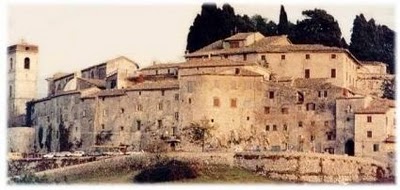
Fumone’s hilltop fortress, between Rome and Naples.

Fumone is a spectacular sample of a medieval hilltop fortress, with parking outside the walls, and narrow twisting cobblestone streets.  We parked and walked through the gates in mid-afternoon, eager to find the castle inside the fortress, and begin our tour. We enjoyed wandering through the streets, but could not find the castle entrance, nor any real help finding it, because the
town was pretty deserted.

Darkness was falling by the time we knocked—and waited—at the castle door. It looked like no one was home, but after a few minutes a light came on, and a young man of Pakistani or maybe Indian origin opened the door. When we explained we wanted a tour in English, he reluctantly invited us to step into the entryway, then yelled up the stairs to an older man of similar origin, in a language we did not understand. They argued, apparently about who would be stuck showing us around, and the older man lost, so off we went with him. He turned lights off as we left the entry, and lights on as we came to each new room, so it seemed that whatever room we were in was the only lighted room in the castle. A little eerie.

As our guide began to describe…  ?? What was he saying? We came to realize he was speaking English, but with his thick south Asian accent, pretty much everything required two or three repetitions for us to understand. Our first stop was the chapel built adjacent to the “cell” where Pope Celestine spent his last months. The chapel was built at a later date, from the room which housed Celestine’s companions during his imprisonment. On the chapel wall hangs a shadowbox style reliquary containing relics of various saints and holy objects, and in true Roman Catholic style, it contains a relic of Celestine himself—a tooth.

Then, in dramatic tones our guide says there is another very sad story connected to the castle’s history, and it is difficult for some people. Are we sure we want to see it? Yes?  He leads us to another room with a portrait on the wall of a mother and child. This woman and her husband had only daughters, and prayed for a son. They were overjoyed when their prayer was answered, but their daughters knew very well that their brother would inherit all the family’s wealth. They poisoned their brother. But the mother, unable to part with her son, kept his body preserved (we are directed to look at a closed cabinet) so she could always be
near him. Inside the cupboard we are shown a glass case holding said child, and his little wardrobe of clothes and toys stored with him.

Then there is the virgin’s well…. I’m just going to let you read about that on the castle’s website here: http://www.castellodifumone.it/italy/arx/pozzo2.htm

We no longer had any interest in lodging at the castle, even though lodging at castles is always an enthralling prospect for me. No, we completed the tour, made our way down the hill in the dark, and were glad to find a room at a dreary, cold hotel a few miles away.

Why I Love Sorrento

Medieval cloister in Sorrento--a popular wedding spot!

From my travel diary in February of 2004:  “The city is a marvel of history to me, with ancient pre-Roman walls, from the original Greek colony, with Roman walls built on top of them, the remains of several old gates, including stairs in the steep cliffs along the water. There are houses and buildings around the town from every era of the last 2,000 years! ….. We found ourselves in a narrow street where a motorcycle could barely pass us, and we had to flatten ourselves in a doorway while several cars passed, and then we made a run for the next wide spot. We came back to town near the old city walls–through a gate whose sign indicates it was made in the 3rd-1st century BC. The Antica Mura. (ancient wall) …. Ah, a sunny morning! The air is so fresh and clear, pero un po freddo, a little cold. Still, it is beautiful to see the sun on the water, birds wheeling above, palms swaying in the breeze….. Today is Carnevale in Italy (a.k.a. Mardi Gras)…here in Sorrento the streets were full of people tonight when Vern and I walked around. There is confetti among the cobbles and paving stones, and paper streamers litter the ground. The Corso Italia was so crammed with people that cars were not even attempting to pass through. People of all ages were out for the passeggiata and festival. Parents with young children dressed as Zorro, Sleeping Beauty, animal characters. Young teens were dousing their friends with shaving cream or silly string, which was also sprayed on shop windows and cars, lampposts and on the sidewalks. Music–live–played from a bandstand in the Piazza Tasso, and old couples strolled the streets together. Older men talked in groups or leaned against a wall watching the crowd–happy revelers all, it appeared. There were a few adults in costume too–we saw a pair of dalmations get into a small car and drive away.”

Is there a place in Italy that you love?  Tell me about it!