Mamma Agata Cooking School on the Amalfi Coast

Plans are solidifying for a trip to Italy next summer, and I am considering how I will spend a couple of weeks there, when what I’d really like is a couple of years!

Somewhere in the south, I want to take a cooking class. My mother did this a few years ago in Sorrento, and had a great time. The food part was wonderful, but she was just as amazed that the teacher spent half the day cooking with several students, while wearing what Mom described as a black “cocktail dress” with no apron, with no spills or flour smudges at all.

A few weeks ago I mentioned a cooking class offered in Palermo, and here is another, in Ravello on the Amalfi Coast. I love making simple pasta like this for lunch!

Mamma Agata Cooking School on the Amalfi Coast.

And here is a video of Mamma Agata at work:

How to make (and say) bruschetta

Various toppings for bruschetta at http://www.myrecipes.com.

I love a good bruschetta, but have to admit, I have been reluctant to prepare it myself. My biggest fear has been getting the bread wrong–not crispy enough, or too charred, or soggy from too wet a topping. Camille Parker of Camille’s Dish has given me a little confidence, and with tomatoes now growing in abundance, I am going to try it. Here’s a video lesson on making bruschetta–and I love that Camille pronounces it the Italian way. She’d probably get in trouble with her 92-year-old Sicilian grandfather if she said Broo-shet-a like most people do in America!

I had the best bruschetta I’ve ever tasted in America in the most unexpected place. Not in Little Italy somewhere, or even in my mom’s kitchen, which is a great place for Italian food. No, right in the heart of the midwest, at Johnny’s Italian Steakhouse next to the Radisson Hotel at Des Moines, Iowa’s airport. No kidding. My sister and I went back twice when we visited Iowa last year, and would have been happy to make that appetizer our entire meal. I didn’t get the recipe from them, but my sister recreated it at home with goat cheese, finely diced roma tomatoes, garlic, a little basil, olive oil. Yum. Okay, now I’m hungry!

Are there Italian foods you’ve been afraid to make yourself? Something you wish you’d tried cooking sooner? A great bruschetta combination you’ll share with us? That’s what the comments are for!

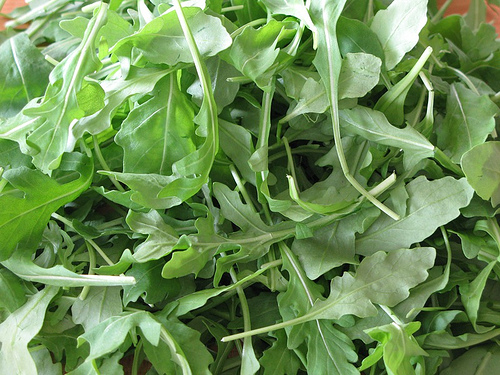
Food for thought: Is arugula too bitter for you?

Arugula is also known as rocket or roquette.

I started picking up my weekly “farm box” from Nash’s Organic Produce last month, and have already received a couple of bunches of arugula. I *love* arugula!! But I have friends who find it too bitter, just as some people find broccoli or Brussels sprouts too bitter.

Guess what? It’s genetic!


Some people have more sensitive taste receptors than other people, and this includes sweet and salty tastes as well as bitterness. These people are sometimes called supertasters. Supertasters perceive a greater bitterness in foods from the Brassica family (kale, broccoli, cabbage… arugula) although some studies have shown that the sensitivity does not correlate directly with avoidance of them.

Though the phenomenon of varying sensitivity was observed in laboratories many decades ago, only in the last ten years have scientists nailed down the genetic details. A science article in The Guardian newspaper (UK) summarizes the details nicely.

Personally, I find arugula slightly bitter, peppery, and a great base or addition to salads. I love it steamed in pasta with a light sauce (a couple of chopped fresh tomatoes sauteed with onion and garlic, and add chopped arugula for the last couple of minutes, then pour over and toss with steaming hot pasta). I also had arugula in Italy cooked in a light gravy with beef or veal, a delicious combination.

So how about you–yes or no to arugula? And if you like it, what’s your favorite way to prepare it?


The search for bad wine

Our experimental procedure.

During a two month stay in Italy, my husband and I enjoyed a glass of wine with many of our meals. We rented ‘self-catering’, or kitchenette apartments in some places, and bought our own groceries, so had the opportunity to buy bottles of wine from local shops and markets in many parts of southern Italy. And it was so inexpensive!! We were very happy with the $4 and $5 bottles, and pleased we were getting such nice wine at that price.

But what was the $3 wine like? We didn’t want to drink the Italian equivalent of Annie Green Springs or the vinegary Chianti I recalled from my youth in Alaska. We decided to give it a try.

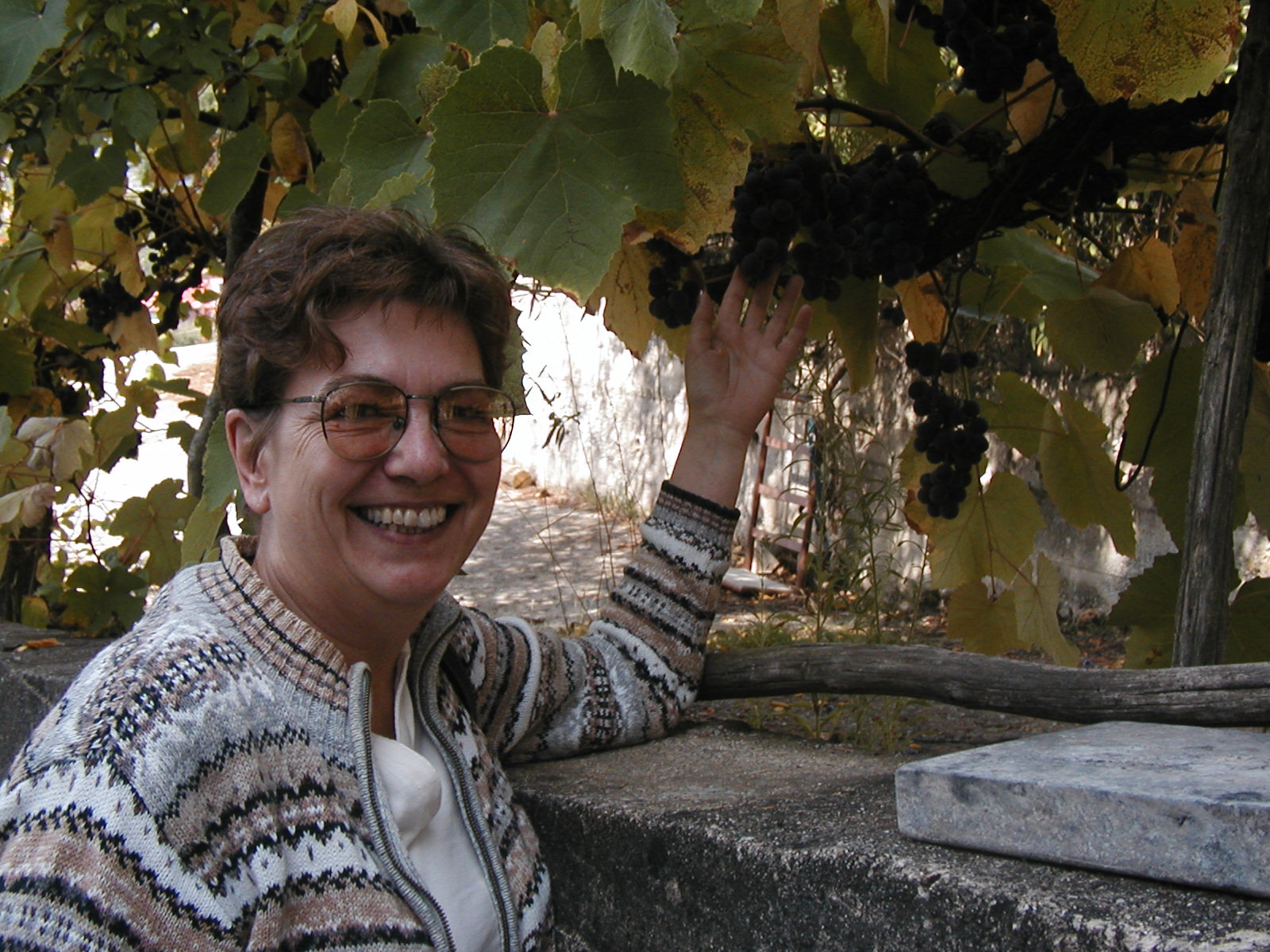
My sister, Marlie Johnson, checks out some Calabrian grapes on the vine.

The $3 wine was perfectly acceptable, so, hey, why not try the next one down?

We carried on with our experiment, right on down to the$1.50 bottles and found every one to be at worst tolerable, and sometimes surprisingly good.

The brand, you ask? They year? Sorry, I’m not talking about brand name wines. In little shops we found locally made wines not produced for export. I imagined them being made in the ‘cantina’ in the walk-out basement of a farmhouse at the edge of town, whatever

The cantina in a private home in Sinalunga, Tuscany.

town we were in, put up in giant casks. Maybe they grew the grapes in a local vigna, or maybe they bought them at the market or a roadside stand, where crates of grapes were stacked for sale in the fall.

We concluded, after many happy hours of experimentation, that Italians do not tolerate bad wine.

Food: Planting Italian

I’ve been doing some gardening during the last few days. Little sprouts of a salad garden are rising from a back-porch pot. Leaves are peeking up where I dropped peas in the ground last week. I love seeing things grow, and getting to eat them when they are ready–tomatoes warm with sunshine, feathery herbs chopped up on greens, or tossed with pasta.

And what would I be growing if I lived in Italy? Maybe something from Franchi Seeds.

Do they Santa Anna green beans taste any different than, say Blue Lake green beans, or the tomato San Marzano 2 from Romas grown at your local farms? I’d love to hear from anyone who has grown comparison crops, or who uses seeds from Italy in your gardens. Please comment and enlighten us!


Strange things at the fish market

A September day in Naples brought us to this fish market, and a lot of unfamiliar seafood to look over. It reminded me of a meal we had in Sorrento with our host, Maria, when we were studying Italian. She was very pleased to have a special meal of fish for the first Friday of Lent, telling us it was ‘seppia’. I had no idea what that was, and even looking it up in my Italian-English dictionary didn’t help. I didn’t know what a cuttlefish was. She showed me a covered pot in the sink, and then lifted the lid.

AAKKK!

The ugliest creature I ever ate stared up at me.

Now tell me, does that look like food to you?

Well, we ate it for dinner, and it was very good. Maria was an excellent cook, and we enjoyed many good meals during our two weeks in her home, but that was the most shocking one to me.

Ravioli Tostati–St. Louis Italian Food

My daughter and her husband moved to St. Louis, Missouri in early January, and three weeks later, we visited them, eager to see “The Hill”, St. Louis’ Little Italy. They took us out to dinner at Gian-Tony’s Ristorante, where I had my first taste of Ravioli Tostati.

This deep-fried ravioli is a tradition of St. Louis–but perhaps somewhere in Italy too, the cook accidentally knocked a raviolo into hot oil instead of water, inventing a crispy appetizer. I was told that several chefs on The Hill have claimed that fortunate mistake, sometime in the 1930s or ’40s. The popular dish is available in many parts of the Mid-west now, and some East Coast restaurants too.

So we enjoyed a plate of Ravioli Tostati before our dinner at Gian-Tony’s, dipping the crunchy squares in marinara sauce as we visited. I have to say, the cooks of St. Louis are on to something! Since coming home, I’ve looked for recipes, and am sharing links to a couple of them with you. Here’s a fast-food version from All-Recipes website. Charlie Gitto’s, one of the restaurants that claims the invention, provided this recipe on the Food Network website.

Reading about olives

Can I suggest some reading about olives? I’m offering a smorgasbord.

Here is a link to an online piece called “Graft and Corruption: On Olives and Olive Growing in the Pre-Modern Mediterranean” about the history and practices of olive growing. From the website of the Maxwell Institute of Brigham Young University, this is the introduction to a larger work, but covers lots of interesting history of olive cultivation.

A search on Amazon for “olives” turns up thousands of books (including those by authors named Olive, of course), with a lot of interesting titles. Many, like Olive Oil: Cooking, Exploring, Enjoying,  deal with using olives and olive oil in cooking. Others, like the Olive Production Manual, are practical guides to growing olives. One particularly caught my eye, because I enjoy reading memoirs. Olives, by Mort Rosenblum, has positive reviews and looks like fun to me. Have you read it? If so, throw in your two cents in the comments!

Happy reading!

The ancient sacred olive, in modern times

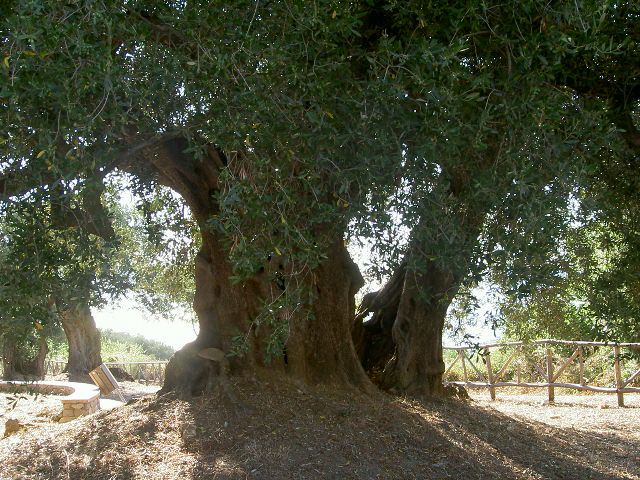
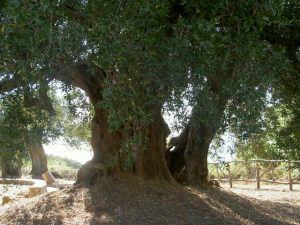
An olive tree in the Cilento region.

This tree was planted before the nation of Italy was born, when the Italian south was a kingdom apart. It could well have been producing olives when Naples was at the height of glory, one of the leading cities on the continent, and a must-see stop on the Grand Tour of the eighteenth century.

The olive is mentioned in ancient literature, including thirty times in the Bible. Its oil fueled the original Olympic flame. Kings were anointed with olive oil, and it is still used in religious ceremonies.
Theophrastus, a student of both Plato and Aristotle, wrote about olive husbandry. “The olive tree grows, one may say, in more ways than any other plant; it grows from a piece of the trunk or of the stock, from the root, from a twig, and from a stake…” He warns that olives grown from seed produce a wild olive, of poor quality. He also quotes Androtion in saying that olives require heavy pruning for the best production, and also need “the most pungent manure and the heaviest watering.” He describes the damage they suffer from hot winds or freezing temperatures. Though he wrote this in Greece in the third century B.C., these classical methods were carried into the Magna Graecia and applied to olive culture there.
I find fascinating the common knowledge of the natural world in earlier times. A statement of Theophrastus illustrates this, in regards to the summer solstice. How do I know when the solstice is? I check a calender, reference book, or (more likely) find it online. But two thousand years ago, people checked their olive trees for that information: “There is a peculiarity special to the olive, lime, elm, and abele: their leaves appear to invert the upper surface after the summer solstice, and by this men know that the solstice is past.”
In Roman times, a garden was not considered complete without some olive trees, and olive oil served as liquid money. It is still highly prized, with Italy consuming about 30% of the world’s olive oil, most of which is grown in the Mediterranean region.
Next time you break open a rustic loaf of bread, pour a little olive oil in a dish, add some balsamic vinegar, and think about the ancient origins of your small feast as you enjoy it.