My most Italian Christmas tradition: Torcetti

Mary (Arcuri) Sanders, at age 77

My Italian grandma, born Mary Nancy Arcuri, was a great cook. She lived into her 90s, and now her many dozens of descendants like to share “Gram’s recipe” for various foods we associate with her. Somehow, though, each of her seven kids has a different version of “Gram’s recipe” for spaghetti sauce, each claiming to be authentic, and the rest charlatans.

At Christmas, Gram always made torcetti (tor-chet-ee). The lightly sweetened pastry was rolled in powdered sugar, shaped in figure 8s or candy canes, or folded into little half-moon turnovers filled with mince or cherry pie filling. I always imagine her learning to make it at her mother’s side, in Italian–the only language her mother spoke. Gram came from a big family, and it is a big recipe–I have penciled in on my recipe card a smaller version, one-fourth of the original recipe. But for you, readers, I am providing the full meal deal, the recipe for 12 dozen torcetti. Enough to share with lots of friends!

Ingredients:

1 lb. butter or margerine

1 lb. vegetable shortning

10 cups sifted flour

1 cup warm milk

1 T. granulated sugar

1 T. vanilla

2 pkgs. yeast

4 eggs, beaten

2 lbs. powdered sugar

Cut shortning and butter into flour until it is like corn meal. Combine milk, granulated sugar, vanilla, and stir in yeast. Add liquid to flour mixture. Add eggs and beat. Add more flour if sticky. Knead slightly. Put in a greased bowl, cover in a warm place, and let rise until double in bulk, about one hour. {I must tell you, this is a heavy dough, and has rarely doubled its bulk for me!}

Cover a bread board with some of the powdered sugar. Break off egg-size pieces of the dough, roll in powdered sugar into one long piece, and shape into figures–pretzel, figure 8, knots, candy canes. Bake on a greased sheet 12-15 minutes at 375 degrees. For filled turnovers, roll out dough, sprinking with powdered sugar if sticky, and use a cookie cutter or water glass to make 3″ circles. Fill with a spoonful of your favorite fruit pie filling, fold in half, and seal by pressing a fork along the edge.

If you try Torcetti from Gram’s recipe, I’d love to hear from you. And do you have an Italian Christmas food you love? Let’s hear about it!

Book Review: The Stones of Naples

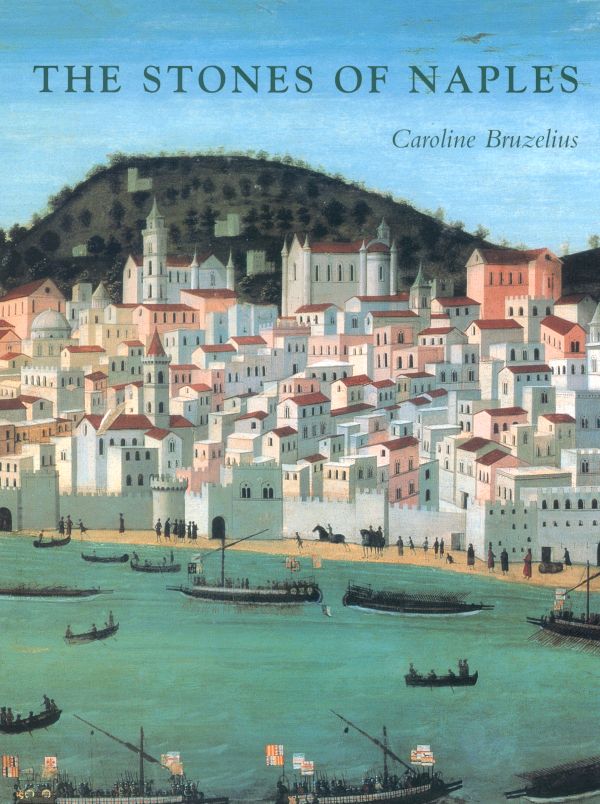
Sometimes I think that only a nerd like me would be fascinated by a book subtitled “Church Building in Angevin Italy, 1266-1343”. But I’m glad to know there are enough nerds like me around that the author, Caroline Bruzelius, and the publisher, Yale University Press, decided to produce it.

The Stones of Naples is filled with stories of why and how various churches were built in Naples during the first three generations of Angevin rule there, 1266 to 1343. The social history is tied to the architectural history to answer questions I didn’t even know I had! And I have plenty of questions about these Angevins–for some reason their story resonates with me.

The book is academic, filled with minutiae about builders and stone, about bishops and their political persuasions, about monastic influences on the royal family members, and their influence on one another. There are several appendices, and pages of end notes, a lengthy bibliography, and detailed index.

But the academic burden (which it might seem to some readers) is lightened by a few other inclusions. Right up front there are maps, a city plan of Naples, and a genealogical chart of the Angevins. The large-format book contains many photos (too few in color, but there are many) and illustrations of church floor plans, construction elements, and decor. And the cover is beautiful, featuring detail from the Tavola Strozzi, showing a view of Naples in 1465 commemorating the Aragonese victory.

Although Naples itself figures heavily in the Angevin church construction, locations throughout southern Italy are mentioned or discussed.

I would recommend this book to anyone with an interest in southern Italy of the thirteenth and fourteenth centuries. It helps me understand the events and the atmosphere of the period, and develop a clearer picture of medieval Naples.

Bari’s colorful past

I once mentioned to a friend that I would love to visit Bari. His brows shot up. “No you don’t,” he assured me.

He had been to Bari some years earlier, and found it less than enchanting.

But it isn’t Bari today that attracts me, as much as Bari’s history. When I mentioned Bari to my friend, I was thinking of the port where thousands of crusaders launched their sea journey to the Holy Land. Nearly 2,000 years ago the Emperor Trajan rerouted the Appian Way to Bari, bringing it to prominence as a Roman port and commercial city. Today it is southern Italy’s second most important city, with a university, two modern harbors, and a metropolitan population of more than a million people.

Statue of Saint Nicholas in Bari's basilicaThe relics of Saint Nicholas rest in Bari, secreted out of his native city of Myra (part of modern-day Turkey) in 1087 in the midst of an invasion. Accounts of the event vary, but ultimately the saint’s relics were brought to Bari, where a basilica built in his honor is considered by some to be Bari’s most important building, built in the 12th century. A festival held each May celebrates the arrival of the relics. This is the fourth century saint who has morphed over the ages into Santa Claus.

Bari’s port also saw a significant slave trade in the early Middle Ages durin Byzantine rule, when slavic captives were sold to the Turks and others in the eastern Mediterranean. About five hundred years of Byzantine rule gave way to Norman rule in the late 11th century.

Bari Vecchia, or Old Bari, was for many years a good place to avoid due to rampant petty crime. Perhaps this was my friend’s experience in Bari. But this review on Slow Travel Italy describes the old city in very appealing terms.

One day I will go and see for myself!

Sulmona: A city of surprises

Surprise #1: Sulmona is easy to reach by train or by car–about two or three hours east of Rome in the central Appenines. It’s off the beaten path for tourists, but is gradually being discovered, as evidenced by dozens of reviews on TripAdvisor for lodgings, restaurants, and things to do.

Confetti flowers for sale in Sulmona (RaBoe/Wikipedia)

Surprise #2: Confetti! Not the bits of colored paper, but bits of colored candy coated almonds and chocolate, attached to wire stems and shaped into butterflies, flowers, swans, and other beautiful creations. Bouquets of confetti line the shop fronts along the Corso Ovidio, brilliant color drawing you along to find the next candy fantasy.

Surprise #3: History galore! I suppose this shouldn’t come as a surprise anywhere in Italy, but there are Roman ruins beneath the city, visible in a couple of museums attached to churches: S.S. Annunziata and San Gaetano. The city is surrounded by medieval walls, and a medieval aqueduct forms one side of the large Piazza Garibaldi.

Surprise #4: World class events! In addition to annual jousting competitions held in late July and early August, an international Latin competition celebrates the Roman poet Ovid who was born in Sulmona, nearby towns have festivals celebrating cherries, red garlic, and wine, and in Pacentro the annual Corsa degli Zingari (Race of the Gypsies) in early September has been celebrated for more than 500 years. On one visit to Sulmona we were surprised to see the Piazza Garibaldi transformed into a skating track for the International Speedskating Championships.

Medieval aqueduct in Piazza Garibaldi, Sulmona. (RaBoe/Wikipedia)

Surprise #5: Great food! We enjoyed meals at the Hostaria del Arco and Cantina di Biffi–rated number one and two among restaurants in Sulmona on TripAdvisor. Like most Italian cities, coffee shops abound, along with pizzerias and a variety of restaurants.

Surprise #6: The great outdoors! Sulmona’s valley is surrounded by national parks with lots of hiking opportunity. The mountains have remnants of ancient shepherds’ huts, along with several hermitages which are popular hiking destinations. There are also about a dozen ski areas within 60 to 90 minutes’ drive of Sulmona. The beaches along the Adriatic coast are about an hour away.

I hope you’ll try Sulmona when you plan a trip to Italy!

Food: Caciocavallo and other cheesy delights

I paused in front of the cheese display at a little market in Scigliano. “Look!” I said to Vern. A herd of little horses, shaped from ivory strands of caciocavallo cheese, were lined up in the window to amuse me, and that they did!

Those Italians really know what to do with cheese! Going to the cheese-and-sausage stores was one of my favorite shopping delights in Italy. We always found interesting cheeses, and succumbed to many temptations there. The volume of cheese alone is enough to amaze someone used to the typical American cheese shopping experience. Giant wheels of cheese cut into thick wedges, balls and chunks, fresh and aged, cheese to try with figs, meats, pasta, bread, cold or melted. I salivate at the many tasty memories.

Caciocavallo was a special delight. It normally comes in double balls, something like a snowman, with a cord around the ‘neck’ where it has hung to dry. Someday I’d love to see the process of making some of the cheese into little horses (cavalli). I really wanted to buy little caciocavallo horses as souvenirs to take home, but they were a little too perishable for that.

If you visit Italy, even if the trip is short and your time tightly scheduled, take a few minutes to find a cheese shop, and explore the abundance. Choose something intriguing, and buy a few ounces. Savor the flavor. The experience might become your favorite memory of Italy.

Book Week: Siren Land by Norman Douglas

I cannot call this week’s post a book review, because I have been unable to read the book. Have you read Norman Douglas? If so, please share your experience with me.

I want to read it. Norman Douglas’s travel books on southern Italy are said to be classics of the genre. So I bought a paperback of Siren Land (a 2010 edition of a book first published in 1911, a sure sign of a classic) and have made several attempts.

This is not light reading, not the kind of travel book for hotel and restaurant reviews.

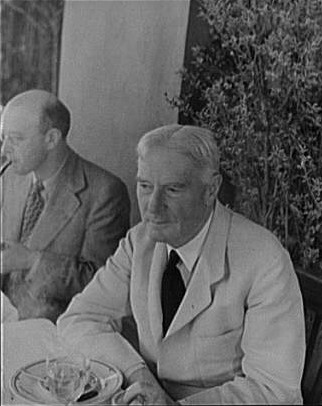
Norman Douglas in 1935

Granted, some might say I am a lazy reader, but Douglas writes dense, complex prose. He cites snippets of Latin, and uses Italian phrases, with no translation for the benefit of readers like me. He alludes to obscure mythologies and little-known historical events.

According to the introduction, Douglas said that the reader of a travel book is entitled to “all one would wish to know about the subject–features of landscape with their associative history, geology, zoology, botany, archaeology, etc.–but also that author’s ‘mind worth knowing'”. And Douglas has supplied these things, some of them in six- and eight-line sentences that require reading three or four times to disentangle the meaning from the words.

Truthfully, he lost me in the very first chapter, titled Sirens and their Ancestry. I tried to pick up on a topic of particular interest to me, his third chapter, The Siren Islets, and lasted a little longer.

His chapter On Liesure opens with this sentence: “Come, let us discourse beneath this knotty carob tree whose boughs have been bent earthward by a thousand gales for the over-shadowing of the Inspired Unemployed, and betwixt whose lustrous leaves the sea, far down below, is shining turquoise-blue in a dream of calm content–let me discourse, that is–for if other people are going to talk, as Whistler used to say, there can be no conversation–let me discourse of leisure, the siren’s gift to men.”

Who knew leisure would be such hard work? And that’s just the first sentence!

So this week, I would especially like to hear from anyone who has read Norman Douglas, with any hints or encouragements to help me through his book.


Naples from another perspective

Here’s a view of the Gulf of Naples that most visitors will never see, a view that takes in thousands of years. See what the eels and seahorses enjoy every day. I love the way this video combines past and present. It leaves me even more curious about the history of southern Italy.

Thanks to my friend Laura Vinti, who made me aware of Another Naples!

New View of Italian Roots

For this month’s travel post, I welcome guest blogger Vienna Lionberger, my daughter, with some thoughts from her recent trip to Italy:

Vienna Lionberger stands guard in Pompeii

All my life I have heard about Italy. My mother has studied Italian history and language, visited Italy for a few months, and taught me to make torcetti, an Italian pastry, from her grandma’s recipe. Though I am only 1/8 Italian, it has been the predominant culture (or at least the loudest one) in my life so I have always felt more Italian than anything else.

Despite my blue eyes and blonde hair (thanks to my dad), I take great pride in telling people I’m part southern Italian, from near Cosenza. Because I have felt so Italian, I was very excited to go there for part of my honeymoon.

Our first Italian stop was at Palermo in Sicily. I have to admit, I thought I would step off that boat onto Italian land, tear up with an upwelling of emotions and start hugging people simply because they were Italians too, and they, of course, would understand and hug me back. I actually stepped off the boat into horse manure. And I definitely wasn’t going to hug the first people we saw because they were the Italian authorities and they had guns and looked like they had had just about enough of tourists for the summer. Although the feeling of belonging I had expected wasn’t there, we enjoyed taking a horse-drawn buggy tour, eating sweet pastries, then savory ones, walking through the market, and touring some Spanish ruins. Back on the boat I thought, “The other ports will be where I feel at home, since, alas I am not Sicilian but southern Italian.”

A week later we stopped at Naples. Again I stepped from the boat, certain this time

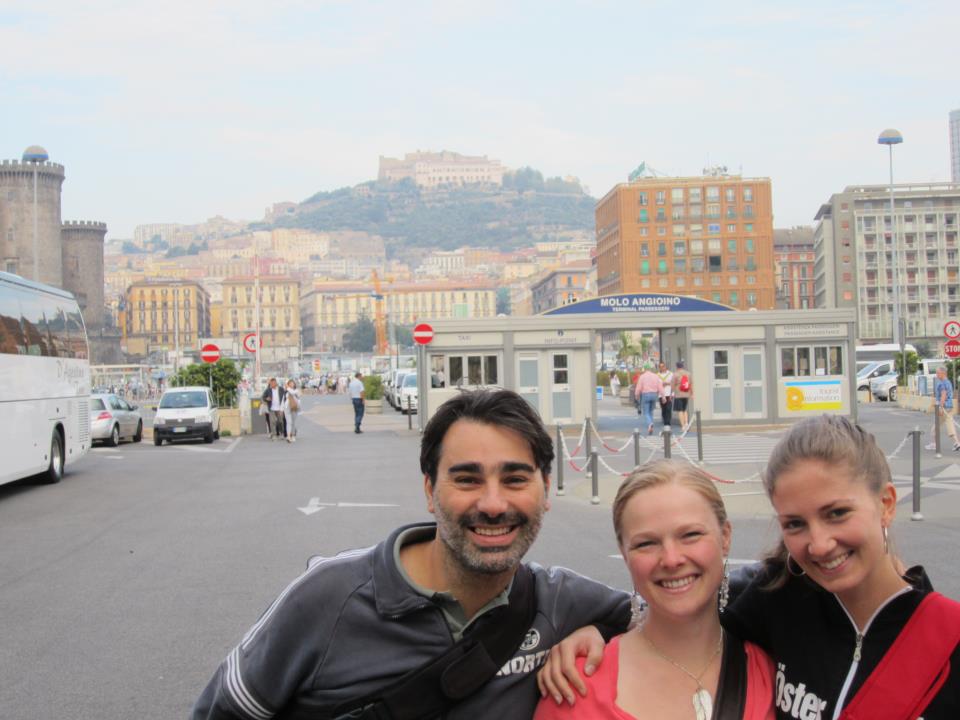
Vienna Lionberger, center, with Filippo and Julia in Naples

there would be tears and hugging. Our Italian friend Filippo met us at the dock. There were hugs, and tears came to my eyes—tears caused by the sweet, vinegary stench from piles of garbage all over the city—piles the size of a semi-truck load every couple of blocks. Filippo told us the garbage pickup was run by the “criminali” in Napoli. They let the garbage sit there for weeks until it became so unbearable that people would pay more to have it removed, basically extorting a whole city. Every couple of months the army was called in to get rid of the garbage because, oddly enough, no other garbage pickup company wanted to take over the contract.

Filippo took us to Pompeii in the morning – which was completely and totally awe inspiring. In the afternoon we went to the best Napolitano pizza place: L’Antica Pizzaria da Michele. They served only two kinds of pizza: Marinara and Margherita. I had a Margharita and never want to eat anything other than that again. We stopped for dessert and espresso, and I rolled onto the boat with a full and happy stomach, and a full camera card. But other than my stomach, I had no feeling of national pride or belonging.

At the end of the cruise, we returned to Rome to meet Filippo and his girlfriend Julia, and travel south with them to his family’s home in Benevento. We arrived late one evening. Filippo’s mother, Angela, knowing I loved mozzarella di bufala, had made fourteen pizzas mostly topped with mozzarella di bufala and tomatoes and basil from their garden. They pulled the pizzas from their brick pizza oven as we arrived. Beside the house where Angela and Dario, Filippo’s dad, live, six houses are clustered together. In these houses live aunts, uncles, brothers, cousins, grandparents, great aunts and great uncles. They all came to greet us, bring more food, sing some “country” songs with Jack, put on a magic show (seriously, a cousin did card tricks for us), drink some wine and simply just be with the family for the evening. Perhaps it was a bit livelier because there were guests, but the sense of family community coming together for the evening seemed a regular occurrence. It was a beautiful night and we went to bed satiated in every way.

The next day, a Sunday, we went to explore Filippo’s home town. The main boulevard was blockaded to cars. It looked as if everyone in town was there walking up and down the street chatting with friends, family and neighbors. No one rushed away to watch a football game or get back to work. Kids played in the fountains and ate gelato. Men congratulated one another on the big soccer win the night before. Women chatted on benches while watching their kids. The scene was an Italian version of a Norman Rockwell print.

We tore ourselves away from this slice of perfection and went back to the house, where Angela had prepared a delicious lunch. Afterward we enjoyed splashing in the full-size pool as the day got warmer. I toured the garden with Angela, who doesn’t speak English. My horrible Italian and her hand gestures allowed a little bit of communication. She showed me her chickens, the fig trees and how they got the figs from the high branches, the olive trees (not quite ready for harvest), the garden with
tomatoes, peppers, basil, carrots, broccoli, arugula, squash, strawberries, and the orchard with lemon, grapefruit, pomegranate, orange, and kumquat trees. (I have a new-found love for kumquats straight off the tree.) Kiwi vines shaded the picnic area.

As we walked she asked about my family. I told her that my mother’s family was from Scigliano near Cosenza. She grabbed my face with both hands, a big smile on her face, kissed my cheeks and said, “You Italian!” She released my face with a force that almost knocked me back, and went down the path to the kitchen to prepare us yet another meal.

Finally, the recognition I had been waiting for, but my feelings had changed. I felt less and less Italian every day as I struggled with the language and saw how different my life was from theirs. I ate my kumquats under the kiwi vines looking over the beautiful countryside thinking back on all of our Italian experiences. The thing I loved most was the feeling of family on that little farm, of being close to the land and people I love.

I am part southern Italian and I’m proud of that. I hope to go back and maybe one day even show my kids a little part of Italy, but until then I will focus on my family and being closer to them. I concluded that I shouldn’t label myself, no matter how fanciful it seems in my mind. I am a mix of many backgrounds with a flavor all my own, and that is ok.

English Soup? Save it for dessert!

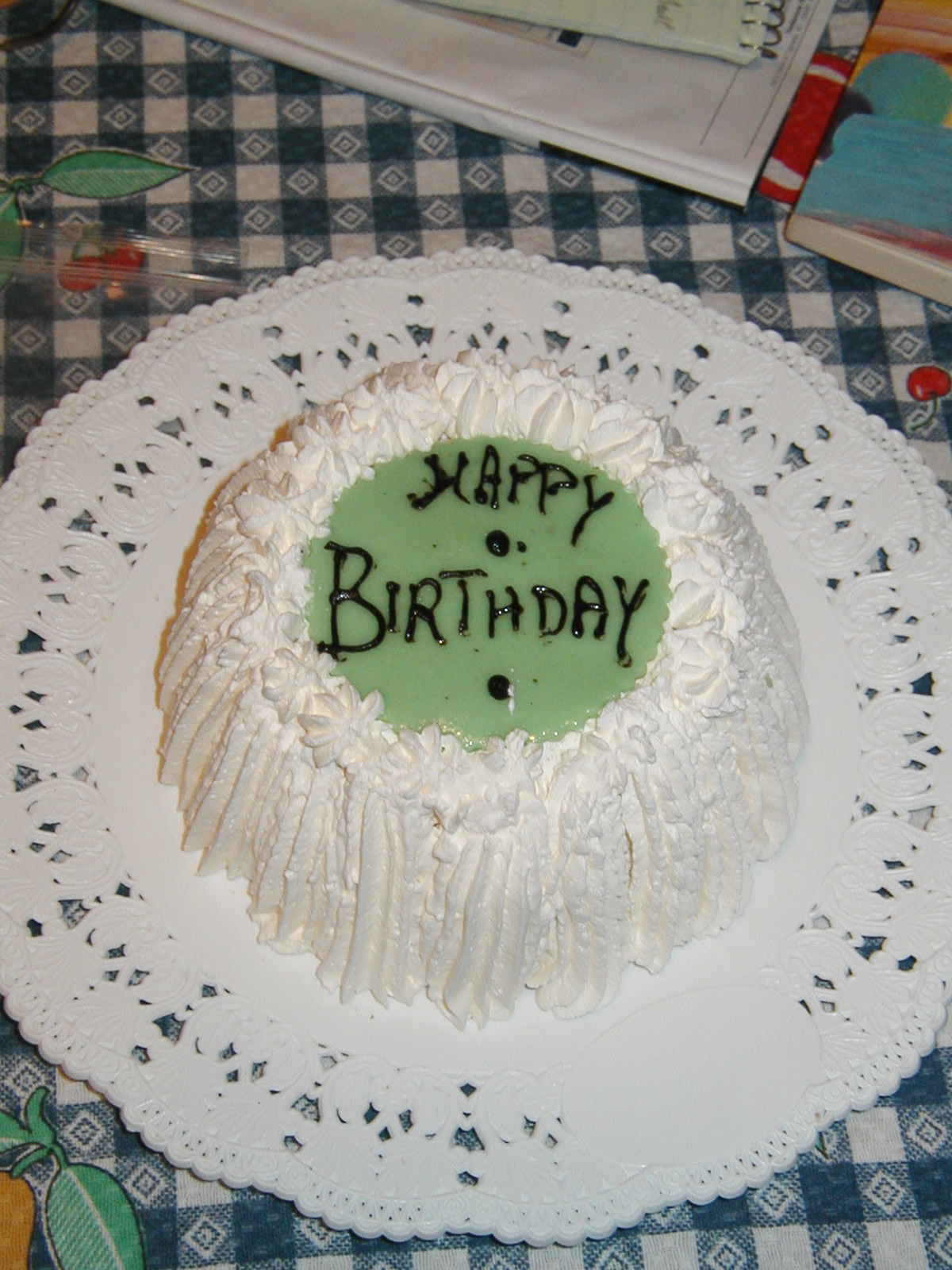
As Vern and I walked from our lodging to the language school in Sorrento, we passed a small bakery, often succumbing to temptation and buying a treat. The owner bantered with us, switching between our limited Italian and his limited English as he described the various pastries on display. One day a large rounded cake caught our eye, a little like the one pictured here which we bought later for Vern’s birthday.

“Zuppa Inglese,” he said when we pointed. He offered us a taste, and we fell in love.

Zuppa Inglese is described this way in the glossary of www.lacucinaitalianamagazine.com:

“TZOO-pah een-GLAY-zay

As the name suggests, zuppa inglese (“English soup”) is of English origin, and is derived from the trifle, a popular British dessert. To make zuppa inglese, wedges of sponge cake or delicate cookies such as ladyfingers are dipped in sweet wine or light liqueur, then layered with whipped cream, diced candied fruit, and chopped bittersweet chocolate.”

There are several stories about the origin of this dessert. The first we heard was that Admiral Nelson’s fleet made an unexpected call at Naples, and the king’s cooks were rushed to prepare something suitable for him. Zuppa Inglese was the result—a kind of hybrid between English trifle and tiramisu.

The internet abounds with recipes for Zuppa Inglese, from complicated (sponge cake
and custard made from scratch, hand shaved bittersweet chocolate, and so forth) to very simple (store-bought ladyfingers, instant pudding, chocolate chips). Find one you like the looks of, and adjust it to your cooking style. The basics are: a light cake of some kind in the bottom of the serving dish (clear glass looks pretty) sprinkled with a liquor such as rum or marsala; a custard or pudding with fruit of your choice mixed in, some form of chocolate as a highlight (not so much it overwhelms), and whipped cream. It can also be formed in a bowl or pan, layered and chilled, then inverted onto a platter and decorated with meringue or  whipped cream, the way we first encountered it in Sorrento.

Here’s a video demonstration featuring chef Jeff Michaud from Osteria Restaurant in
Philadelphia with a professional’s version of Zuppa Inglese.

And here is another video, definitely the home style version, with two sisters describing mamma’s shortcut recipe.

Whichever recipe you choose, this is a delicious dessert, and fun for a special occasion. Like, tonight!

The Link of Lampedusa

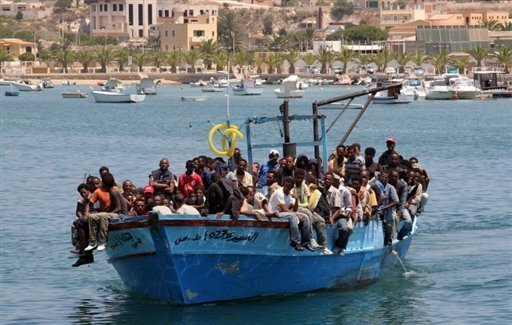
North African refugees flee to Lampedusa, photo from http://www.english-online.at

Americans are likely to think of “boat people” as coming from Cuba or Vietnam, desperately clinging to life and hope in a rusting, listing, failure of a boat.

In Italy, the boat people come from Libya and Tunisia. Their landing place is Lampedusa, a dry rock in the Mediterranean, closer to Africa than to Sicily.

Tens of thousands have fled Africa for Lampedusa in the past decade, overwhelming the island whose Italian population is about 5,000. More than 50,000 migrants have arrived this year, escaping upheaval in North Africa, looking for some safe haven, a link on the way to a new life.

Last January the BBC reported on the feel-good story of a Calabrian village whose mayor turned immigration to advantage, keeping the town of Riace alive. Mayor Domenico Lucano was nominated for the World Mayor award for his efforts to reverse population loss by welcoming immigrants. But Lampedusa has not been so welcoming.

News reports over the past year tell of refugees being turned away by island

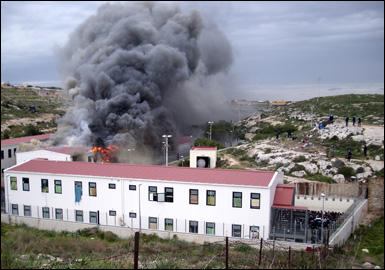
Refugees set fire to immigration center in Lampedusa, from http://www.morningstaronline.co.uk

residents, Italian premier Berlusconi promising a clean sweep of the illegal immigrants, and in recent weeks violence has broken out when Italy announced a decision to repatriate the boat people.

Now, an Italian film on the subject, called Terraferma, has been selected to represent Italy in the Academy Awards. Perhaps this is where most North Americans will learn of the struggles on Lampedusa. I hope a better solution is found than the one pictured here.