
Introducing a weekly SHARE–I’m going to be re-blogging some of the great posts I find from other bloggers on southern Italy. Thanks, Kimberly Sullivan!
Author: Sandy Frykholm
Anagni: Walk through the city with me..
 This entry gate to the city of Anagni looks like a great portal for time travel to me. And it’s easy to feel you’ve been transported to the medieval era in Anagni, as so much of that period is preserved.
The city has very ancient origins, and was part of a confederation attacked and defeated by Rome in 306BC. Since that time, Anagni has been an ally of Rome, and a strong supporter of the Roman church. It became an important city during the Middle Ages, and in one 100-year span covering the 13th century, four men from Anagni were elected pope.
 On an outer wall of the city’s cathedral hangs a statue of the most famous of those popes, Boniface VIII. You can see it in the upper right corner of this photo.
 Boniface’s palace is open for tours, and as we walked through it I could imagine the lavish furnishings this wealthy, powerful man might have enjoyed there. Today the contents are quite sparse, but there are remnants of the thirteenth century paint on some of the walls, in a pattern that reminded me of wallpaper.
The city is open for auto traffic, 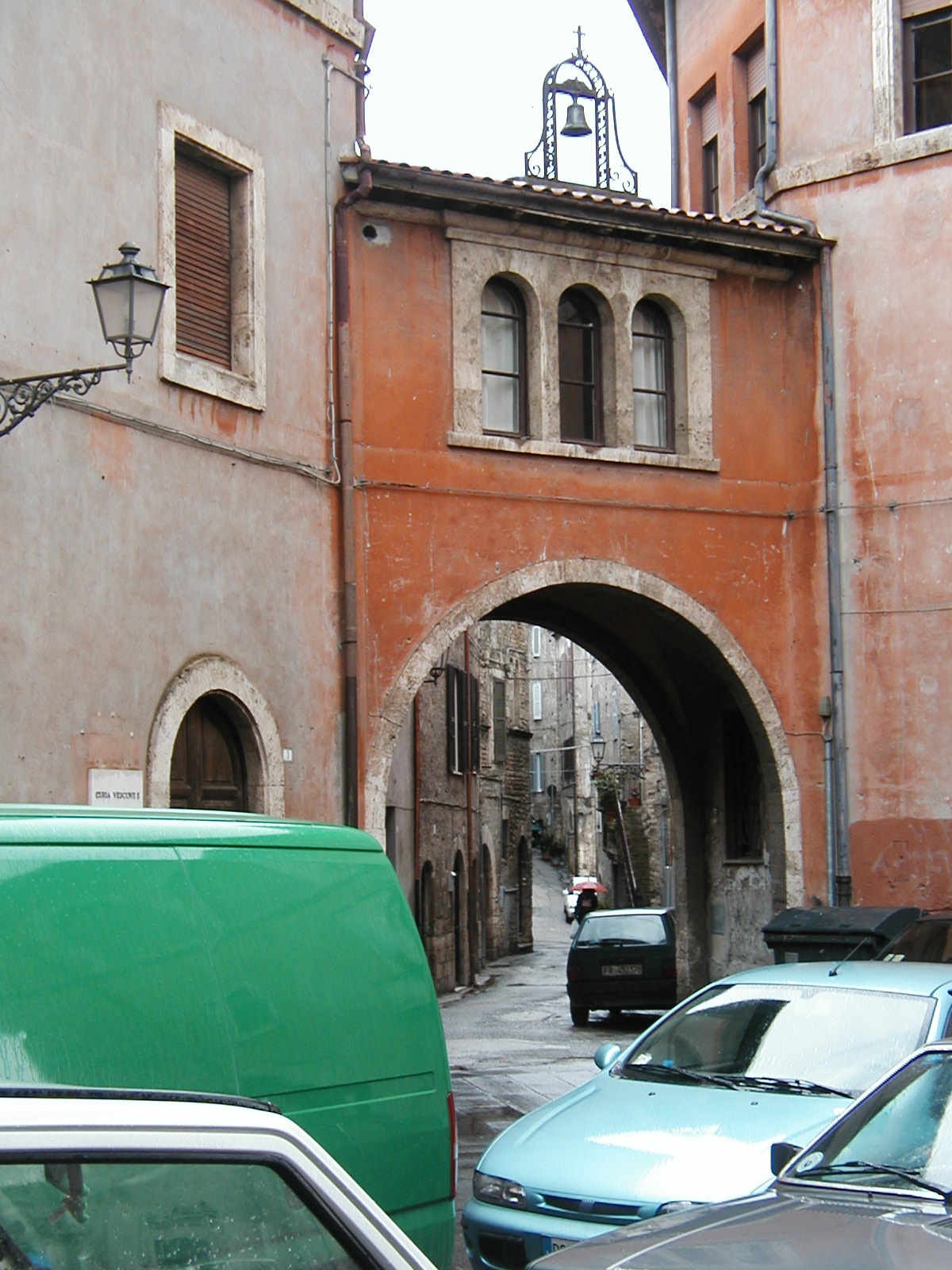 with many one-way streets and tight spaces. I was glad we found a parking spot outside the walls, and walked through the narrow lanes. Walking also allowed us to take in more of the atmosphere, even though the chilly rain dampened us a bit.
 The cathedral has beautiful Cosmati tile work on the floor, and the crypt is decorated with Romanesque/Byzantine frescoes in brilliant color and very well preserved.
The modern buildings surrounding it stand in stark contrast to the medieval center of Anagni. I recommend a visit for history lovers, and anyone interested in medieval buildings and design.
A modern day view of Vesuvius–what great photos!

Few cities on the planet can even start to compete with Naples in being ominously placed from a geological standpoint. The city has not only a tremendous historical background; it is also totally surrounded with active super volcanoes.
A few years ago I had the pleasure of having dinner in a villa on the slopes of Monte Vesuvius together with Italy’s car tycoon numero uno. After a tasty dinner together with nice wines we were sitting looking out at the ocean drinking a ridiculously old grappa (grappa tastes like a rotting hamster-cage smells) and I just had to ask if he never where worried about having a villa on one of the worlds more famous volcanoes. The answer was rather Italian; He turned around, raised all five fingers into the air in the general direction of Vesuvius and uttered the Italian immortal phrase “va’fan’culo”. I interpreted it as “who cares”…
View original post 317 more words
The Grand Tour: An Italy of the past

[Illustration from the September 1747 issue of “The Gentleman’s Magazine]
“A man who has not been to Italy is always conscious of an inferiority, from not having seen what it is expected a man should see.” Samuel Johnson said it, and Joseph Spence, at the age of 31 in 1730, set off from Oxford to see what a man should see. Spence was a commoner with little money, but through the connections of friends, arranged to travel with Lord Middlesex, the 19-year-old son of a duke. The rakish lord drank his way through Europe for a couple of years, while the Oxford don spent his time developing a passion for Italian opera.
In 1737, Spence accompanied John Morley Trevor to the continent, eager to return to Italy. However, Trevor turned out to be a dull companion, and they did not make it to Italy, because Trevor was recalled to England before the end of the year.
In 1740, Spence was asked to accompany another young nobleman, Lord Lincoln, to Italy, where Lincoln was to attend the Royal Academy at Turin. As his governor, Spence oversaw the improvement of Lincoln’s fragile health and guided him out of an affair with an unsuitable partner, returning him to England better prepared for his future.
Spence kept a journal, and wrote numerous letters to his mother while traveling. Here are excerpts from letters to his mother describing his first visit to Naples:
In going to Naples we often passed old Roman roads, in many places all laid with large smooth stone and as entire still as the pavement of a great hall, though near two thousand years old. ‘Tis to me the most surprising thing of art which we have seen abroad. This noble pavement, sometimes for miles together, is bordered with myrtles and a hundred other evergreens, and on each side of it you see perpetually the ruins of old tombs and monuments, for the Romans always buried by great roads (perhaps to put people in mind that this life is but a journey, and that in this world we are not properly at home).
There are sometimes orange-trees in the road, and at Mola, a little seaport on the way to Naples, all the orchards were full of them just like apple-trees with us. Within about thirty miles of Naples we came into a vast plain, the richest soil and the best cultivated in Italy: whence the Italians call it ‘Campagna Felice’ or ‘the happy country’. It was soon after that we discerned the top of the famous Mount Vesuvius, and the smoke which it perpetually flings out looked at that distance like a cloud gilded with the sun.
Naples is one of the most delicious sea-ports in the world: it lies down a sloping ground, all in a large half moon to the sea. The shore on for a great way humours the same shape of a half moon. In one side of it, about six miles on the left hand from Naples, is Vesuvius, and on the right the grotto of Pausilippo and the tomb of Virgil…
It was with a great deal of impatience that I waited for the morning when we were to go up Mount Vesuvius, which was heightened by my seeing it every morning. The tops of the houses are all flat at Naples and as smooth as a floor; they often set them out with flower-pots and orange-trees, and ’tis their usual place for diversion on summer evenings. From the top of our house we had a most distinct view of Vesuvius, and I used to run up there every morning the first thing I did, to see whether he increased in his smoking or not.
At last the morning came: four mile we went along the beautiful shore of Naples in chaises, which were then quit from the rising and badness of the way, for horses. These carried us two mile more, and then the way is so steep and bad that you are forced to quit even them and be dragged up the two last mile by men who make a trade of it…. Two of these honest men get just before you, with strong girdles on; you take hold of the girdles, and then they draw, and you climb up as fast as you can. Both they and we are forced to rest very often, and then tug and trudge again…. In some of the resting places here we felt the earth hot under us as we sat down…. The last stage is infinitely the worst. ‘Tis all loose crumbling earth in which your two draggers and you sink every step almost up to the knees, beside which it often yields under you, and ’tis often impossible not to slip back half a yard…but eagerness to get to the top when so near makes it the less troublesome. When there, you have a ragged rocky edge all round a vast cauldron of perhaps half a mile deep and a mile round, all full of smoke. The wind every three or four minutes clears away the smoke, and then you have a view of it. It sinks irregularly and raggedly all down on the inside. There are several places in it that look of a fire-colour, blueish, greenish and principally yellow…
One of my guides was an extraordinary honest fellow; I was got very intimately acquainted with him in our journey uup. He told me that ‘to be sure the devil lived in that hill’, and wished very heartily that all the Frenchmen were in there with him. Upon my telling him that we are all Frenchmen, he said he was sorry for it, but it could not be helped….
When the wind blew away the smoke from between the crags of the opposite side of the cauldron, we had a veiw of a beautiful piece of country, green fields, meadow-grounds, etc. thick set with houses; on the right hand appeared a part of the delicious bay of Naples: ’twas but turning the head, and we had a full view of all the city and bay.
Spence’s writings are collected in a book edited by Slava Klima entitled Joseph Spence: Letters from the Grand Tour published in 1975.
Watch for a BONUS re-blog of a modern day view of Vesuvius.
And the winner is…..
Thanks to those who entered my blogiversary drawing for a $25 Amazon gift card. The winner is Christine Rich! I’ll be contacting you, Christine–glad you have enjoyed The Italian South.
Strange things at the fish market
 A September day in Naples brought us to this fish market, and a lot of unfamiliar seafood to look over. It reminded me of a meal we had in Sorrento with our host, Maria, when we were studying Italian. She was very pleased to have a special meal of fish for the first Friday of Lent, telling us it was ‘seppia’. I had no idea what that was, and even looking it up in my Italian-English dictionary didn’t help. I didn’t know what a cuttlefish was. She showed me a covered pot in the sink, and then lifted the lid.
AAKKK!
The ugliest creature I ever ate stared up at me.

Now tell me, does that look like food to you?
Well, we ate it for dinner, and it was very good. Maria was an excellent cook, and we enjoyed many good meals during our two weeks in her home, but that was the most shocking one to me.
Anniversary Celebration and Amazon Gift Card Giveaway!

Thanks to Italy Mag for this great photo! This week marks a year since I started blogging about the Italian south. I’ve had a surge of activity in the last three or four months, and I thank you for sharing the blog with others!
To celebrate, I’m giving away a $25 Amazon gift card! To enter, post a comment about what you like about the blog, or what you’d like to see on it. What have you learned from it? Has it helped you in some way? Motivated you to actually visit the Italian south? I’d love to know!
Earn an extra entry by posting about the giveaway on Facebook, Twitter, Google+ or wherever you network. *Be sure to post a comment with a link to your ‘share’ so I can put in your extra entry.* Entries will close at the end of the day May 4.
And thanks for making my first year of blogging so much fun.
Sandy
Book Review: Chewing Gum in Holy Water by Mario Valentini

Mario Valentini shares engaging and nostalgic stories of his childhood in the mountain villages of Abruzzo during the lean years after World War II. At the age of four, Mario is given into the care of his uncle, a priest, while Mario’s father works in another country. His uncle can afford luxuries like shoes and education for Mario, and has the rare luxury of a car in the remote mountain villages he serves.
Mario recounts the misadventures that repeatedly land him in hot water with his “aunt”, a distant relation who serves as the priests housekeeper, and his early adventures in love and romance in his early teens. His child’s-eye-view of life in 1950s rural Italy is interesting and endearing, spiced with adventure–hunting wolves with a sling shot, discovering treasure in an abandoned castle’s well.
Valentini and his partner, Cheryl Hardacre, collaborated to write the book, presented as a first person account. The Italian words sprinkled through the text are translated in a glossary that appears at the end, along with a childhood photo of Mario with his beloved uncle.
The book was a pleasure to read, though I would like to have known more about Mario’s life after his childhood–even a brief summary. For many readers, this would be a good introduction to the rural Italy of their parents’ or grandparents’ time.
Chewing Gum in Holy Water was published by Arcade Publishing in 2006.
Happy Liberation Day, Italy!

Today Italians celebrate the fall of fascism in Italy, an achievement aided by the Allies at the end of World War II. Bravi, Italiani!
A walk in the woods, near Scigliano, Calabria
We walked east on Via Roma toward the hairpin turn that leads to the Roman bridge, and at the turn, headed up the rough track that leads to the Church of the Madonna delle Timpe. Beyond the church, the track narrows to a footpath, and hopscotches a stream humming down the valley. Walk along with me…


All this beauty on a warm fall afternoon! Don’t be afraid to get off the beaten path and enjoy a walk in the woods in Italy.
 The Italian South