For this month’s travel post, I welcome guest blogger Vienna Lionberger, my daughter, with some thoughts from her recent trip to Italy:

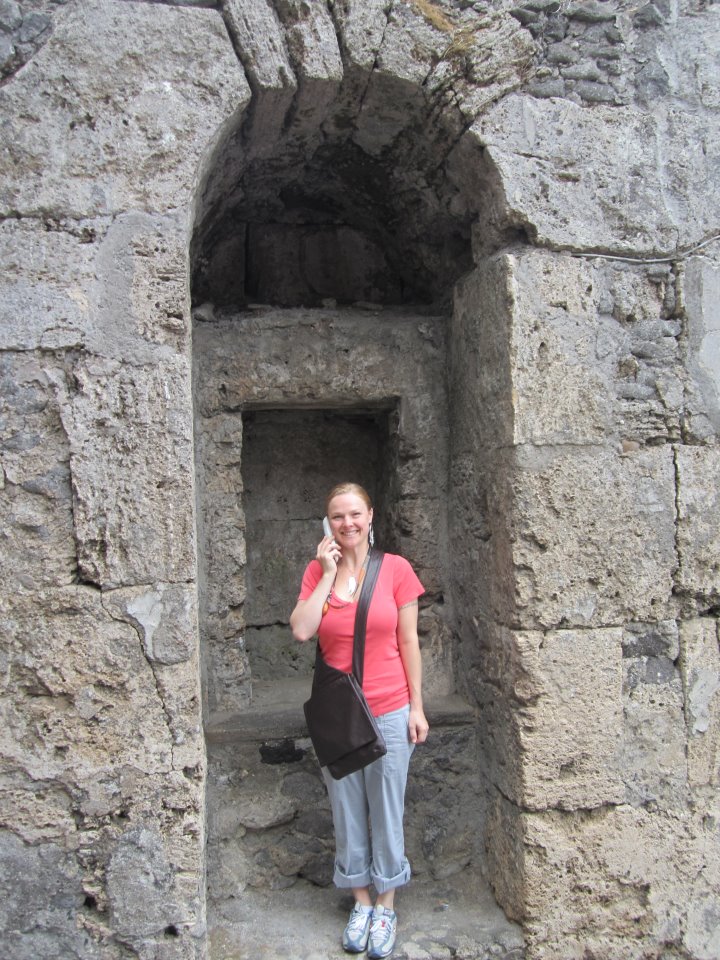
Vienna Lionberger stands guard in Pompeii
All my life I have heard about Italy. My mother has studied Italian history and language, visited Italy for a few months, and taught me to make torcetti, an Italian pastry, from her grandma’s recipe. Though I am only 1/8 Italian, it has been the predominant culture (or at least the loudest one) in my life so I have always felt more Italian than anything else.
Despite my blue eyes and blonde hair (thanks to my dad), I take great pride in telling people I’m part southern Italian, from near Cosenza. Because I have felt so Italian, I was very excited to go there for part of my honeymoon.
Our first Italian stop was at Palermo in Sicily. I have to admit, I thought I would step off that boat onto Italian land, tear up with an upwelling of emotions and start hugging people simply because they were Italians too, and they, of course, would understand and hug me back. I actually stepped off the boat into horse manure. And I definitely wasn’t going to hug the first people we saw because they were the Italian authorities and they had guns and looked like they had had just about enough of tourists for the summer. Although the feeling of belonging I had expected wasn’t there, we enjoyed taking a horse-drawn buggy tour, eating sweet pastries, then savory ones, walking through the market, and touring some Spanish ruins. Back on the boat I thought, “The other ports will be where I feel at home, since, alas I am not Sicilian but southern Italian.”
A week later we stopped at Naples. Again I stepped from the boat, certain this time

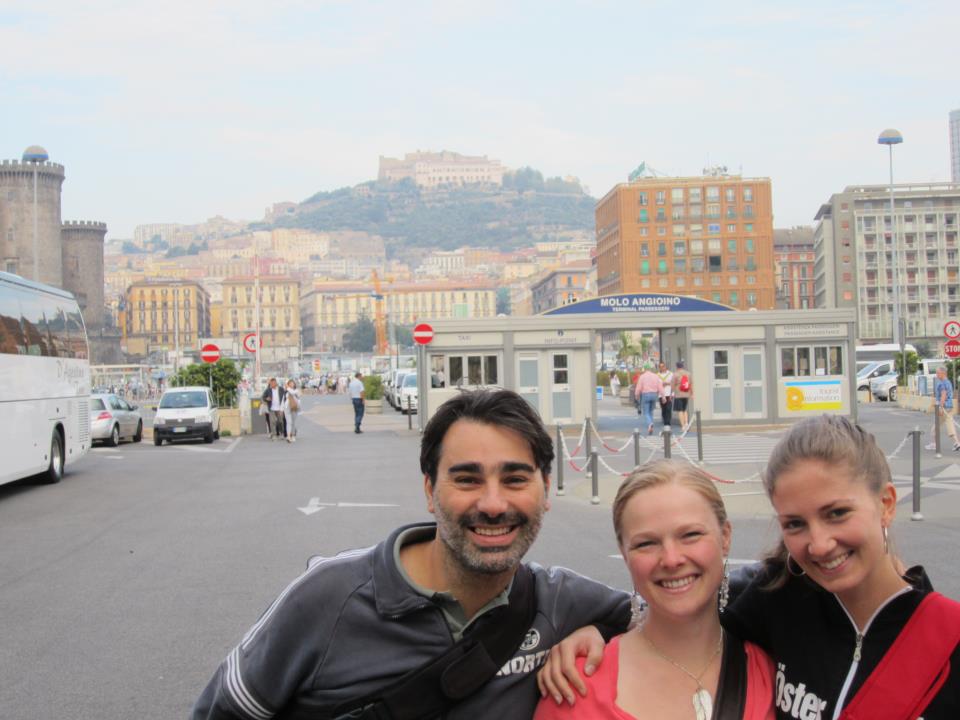
- Vienna Lionberger, center, with Filippo and Julia in Naples
there would be tears and hugging. Our Italian friend Filippo met us at the dock. There were hugs, and tears came to my eyes—tears caused by the sweet, vinegary stench from piles of garbage all over the city—piles the size of a semi-truck load every couple of blocks. Filippo told us the garbage pickup was run by the “criminali” in Napoli. They let the garbage sit there for weeks until it became so unbearable that people would pay more to have it removed, basically extorting a whole city. Every couple of months the army was called in to get rid of the garbage because, oddly enough, no other garbage pickup company wanted to take over the contract.
Filippo took us to Pompeii in the morning – which was completely and totally awe inspiring. In the afternoon we went to the best Napolitano pizza place: L’Antica Pizzaria da Michele. They served only two kinds of pizza: Marinara and Margherita. I had a Margharita and never want to eat anything other than that again. We stopped for dessert and espresso, and I rolled onto the boat with a full and happy stomach, and a full camera card. But other than my stomach, I had no feeling of national pride or belonging.
At the end of the cruise, we returned to Rome to meet Filippo and his girlfriend Julia, and travel south with them to his family’s home in Benevento. We arrived late one evening. Filippo’s mother, Angela, knowing I loved mozzarella di bufala, had made fourteen pizzas mostly topped with mozzarella di bufala and tomatoes and basil from their garden. They pulled the pizzas from their brick pizza oven as we arrived. Beside the house where Angela and Dario, Filippo’s dad, live, six houses are clustered together. In these houses live aunts, uncles, brothers, cousins, grandparents, great aunts and great uncles. They all came to greet us, bring more food, sing some “country” songs with Jack, put on a magic show (seriously, a cousin did card tricks for us), drink some wine and simply just be with the family for the evening. Perhaps it was a bit livelier because there were guests, but the sense of family community coming together for the evening seemed a regular occurrence. It was a beautiful night and we went to bed satiated in every way.
The next day, a Sunday, we went to explore Filippo’s home town. The main boulevard was blockaded to cars. It looked as if everyone in town was there walking up and down the street chatting with friends, family and neighbors. No one rushed away to watch a football game or get back to work. Kids played in the fountains and ate gelato. Men congratulated one another on the big soccer win the night before. Women chatted on benches while watching their kids. The scene was an Italian version of a Norman Rockwell print.
We tore ourselves away from this slice of perfection and went back to the house, where Angela had prepared a delicious lunch. Afterward we enjoyed splashing in the full-size pool as the day got warmer. I toured the garden with Angela, who doesn’t speak English. My horrible Italian and her hand gestures allowed a little bit of communication. She showed me her chickens, the fig trees and how they got the figs from the high branches, the olive trees (not quite ready for harvest), the garden with
tomatoes, peppers, basil, carrots, broccoli, arugula, squash, strawberries, and the orchard with lemon, grapefruit, pomegranate, orange, and kumquat trees. (I have a new-found love for kumquats straight off the tree.) Kiwi vines shaded the picnic area.
As we walked she asked about my family. I told her that my mother’s family was from Scigliano near Cosenza. She grabbed my face with both hands, a big smile on her face, kissed my cheeks and said, “You Italian!” She released my face with a force that almost knocked me back, and went down the path to the kitchen to prepare us yet another meal.
Finally, the recognition I had been waiting for, but my feelings had changed. I felt less and less Italian every day as I struggled with the language and saw how different my life was from theirs. I ate my kumquats under the kiwi vines looking over the beautiful countryside thinking back on all of our Italian experiences. The thing I loved most was the feeling of family on that little farm, of being close to the land and people I love.
I am part southern Italian and I’m proud of that. I hope to go back and maybe one day even show my kids a little part of Italy, but until then I will focus on my family and being closer to them. I concluded that I shouldn’t label myself, no matter how fanciful it seems in my mind. I am a mix of many backgrounds with a flavor all my own, and that is ok.

 The Italian South