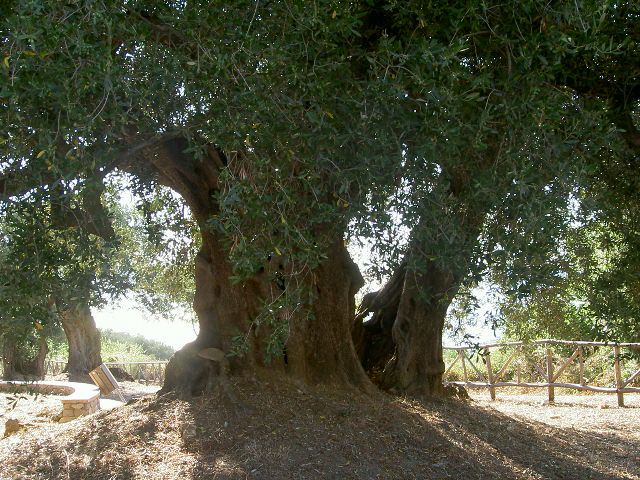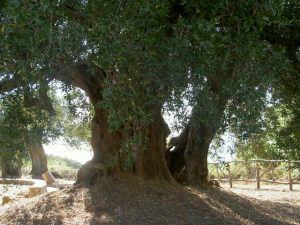
This tree was planted before the nation of Italy was born, when the Italian south was a kingdom apart. It could well have been producing olives when Naples was at the height of glory, one of the leading cities on the continent, and a must-see stop on the Grand Tour of the eighteenth century.
Italy
Agriturismo: Farmstays in southern Italy
To enjoy the atmosphere of a working farm, the rural setting and fresh foods, try a farm stay. WARNING: There are many listings at www.agriturismo.net but not all are working farms. They have a wide variety of amenities, so read carefully and search for the kind of place you want to visit. Some have spa facilities, some are country bed and breakfast properties with limited agricultural production. Others offer cooking classes, boating excursions, swimming pools, or children’s programs.
As I browse the various listings, a question comes to mind: How difficult is it to find a native (or at least fluent) English speaker to review the content of a website? The market appears to be wide open for this kind of service. It’s easy to find listings like these:
(Various kinds of spas therapies) “are the ingredients of our relax.” “It is possibile to have breakfast, lunch, or supposer in the farmhouse.” “As of 1754, the owner’s family give birth to the ancient farm building where oil and wine have been produced with their own traditional tools.”
Of course, I did appreciate the full disclosure of this description: “This place is not recommended to those who want to enjoy only the ocean or only the mountain, or are unable to live without the new technolgies, or are scared of farm bugs, or are unable to handle the fireplace or the wood-burning stove.”
Here are links to a couple of olive farms that appealed to me: First, the Agriturismo Madonna Incoronata, named for a 17th century church on the property. Located on the south side of the Gargano peninsula, they offer cooking classes, boat trips to private beaches, and an ancient olive mill and museum highlighting the history of olive production–which continues on the property today.
Near Matera, L’Orto di Lucania offers a varied farm stay. They grow and process organic wheat, olives, artichokes, eggplant, and tomatoes. They also have a beautiful swimming pool, as well as cooking classes, and bicycles for rent. Guests can take part in farm activities, or simply observe. And unique historical sites like the city of Matera (an ancient cave dwelling site), Castel del Monte built by Emperor Frederick II, and the trulli houses of Alberobello, are all easy day trips from the farm.
Have you stayed on a farm in southern Italy? Share your experience in the comments!
Culinary Tourism: Taste the olive oil.
In my part of the world, wine tasting is popular, and when I lived in Texas, I participated in a chili cook-off. And chocolate tasting? I’m nibbling some right now.
But in the south of Italy, you find tours dedicated to tasting olive oils. I never gave much thought to variations in olive oil until I visited Italy in 2004. Then, it seemed quite a curiosity to me, the interest people took in their oils. Now, I’m eager to explore olive oils myself, and where better but Puglia?
According to The Olive Oil Times, about 40% of Italy’s olive oil grows on roughly 60 million trees in Puglia. You can read descriptions of different types of oil, and a great deal of olive knowledge.
How do you taste it? At Olive Oil Source, you can learn from professional olive oil taster Nancy Ash, owner of Strictly Olive Oil. You can learn the lingo and see what the pros are looking for in their oils.
For the more visual learners among us, here’s a video of Bill Sanders (called the evangelist of olive oil and wine) showing us all how to taste olive oil:
If you can’t make it to Italy, how about olive oil tasting in California? Yes, it’s available there too, so go out there and try a little EVOO! That’s Extra Virgin Olive Oil–soon you will be a pro in the tasting room.
Travels in Calabria: My top picks
History figures large in my travels, so you won’t be surprised that my top tourist picks are mostly historical–and pretty famous!
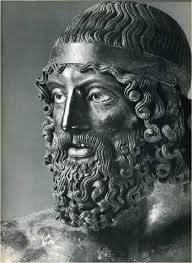
#1: The Riace Bronzes: Two 2,500 year old classical Greek statues, found by a scuba diver off the coast near Riace in 1972, and now housed in the Museo Nazionale della Magna Grecia in Reggo Calabria. The full collection on the Magna Grecia occupies two floors of the museum.
#2: The Roman bridge at Scigliano: Part of the ancient Via Popilia, the Roman road from Capua to Reggio Calabria, during the Punic Wars Hannibal is said to have crossed this bridge with his armies. Not sure if that included the elephants, which Hannibal brought up through Iberia and across the Alps. The bridge is a wonderful Roman era structure. Bed and Breakfast Calabria in Scigliano is a great place to stay nearby, and I found this photo on their website.
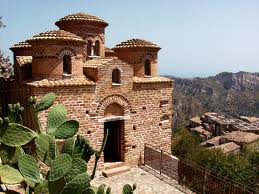
#3: The Cattolica di Stilo: Built in the 9th century, this church is considered one of the most important Byzantine structures, and is a national monument. I love to visit churches. Along with the frescoes and Christian interior, there are Arabic inscriptions in the church–the thought of it sends my mind spinning into all kinds of historical speculations!
#4: Le Castella: I couldn’t go to Italy without visiting a castle, and the history of this one is fascinating. And the Ionian beaches couldn’t be closer! I found this interior cutaway describing life in the castle–in Italian, but it gives some good additional detail.
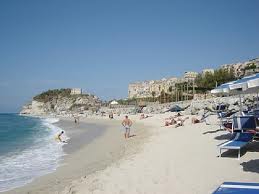
#5: Down time at some hot springs! There are several thermal bath options, and after visiting one in Tuscany a few years ago, I am eager to try one in Calabria. This or this should do–and then a couple of days at the beach in Tropea!
Happy 2012!
Good Luck for 2012: Lentils and grapes
Many regions and cultures have symbolic foods for holidays, including the celebration of the new year, or “capo d’anno” as Italians say. I was happy to discover that lentils are a traditional Italian food for the new year, because I like lentils a little better than black-eyed peas, which are eaten in the southern U.S.
Lentils symbolize coins, and are eaten in hopes of a prosperous new year. Grapes symbolize good health, and are eaten at midnight, just as the new year begins.
I found an interesting article with a couple of recipes from famous foodie Nigella Lawson, a food writer with a terrific website. The recipes sound delicious, and I plan to make one of them for my own New Year celebrations.
I hope you enjoy the article, and wish you the very best for 2012. Felice Anno Nuovo!
Book Excerpt: On the Spine of Italy
I knew my research in Italy would take me to Abruzzo, and Harry Clifton’s book “On the Spine of Italy: A Year in the Abruzzi” (Macmillan, 1999) fell into my hands at the right moment, to give me a taste of the region I was so eager to know better.
Clifton is an Irish poet. He and his wife went to a village in Abruzzo to spend a summer writing. In the end, they stayed a full year, and this book chronicles their experience of village life. I enjoyed reading it, and it stoked my interest in the region, although my visit of a few weeks would not compare to a year-long stay. I believe the book is now out of print, but it is available used from online booksellers.
Clifton describes the village at Christmas time:
“The village, in its small way, was preparing for Christmas. The shop had introduced a freezer, full of packaged vegetables, hamburgers, french fries, and fish fingers, to internationalize the local cuisine. It had a glass display case, containing cheeses and cold cuts of meat, clinically administered by the women in starched white. The co-operativa, as it stood now, would have done justice to a hospital.
“They had introduced a small stand of Christmas gifts and confectionery, a smaller and far poorer version of the extravaganzas we had witnessed in Perugia. There were bottles of Spumante and Amaro, the bitter digestivo favoured in the Abruzzo. There were sundry mechanical toys, times to autodestruct a week after they had been bought. And there was a big assortment of giftwrapped panettones, the soft fruity cakes filled with jam or chocolate that symbolize the Christmas season in Italy. We bought some for Silvio’s family, as a fence-mending gesture.
“In the bar, the men played cards obsessively. the lights were on until two in the morning, as they engaged in gigantic poker sessions. As it was Christmas, they were betting heavily and playing for real stakes. We knew villagers who had been literally ruined, dispossessed of their property and the shirts off their backs, by such sessions. The late night shouting and roaring across the road had plenty of reality behind it. But anything, especially in winter, was better than boredom, and cards were the one thing in the lives of the village men that lifted the burden of empty time off their backs.
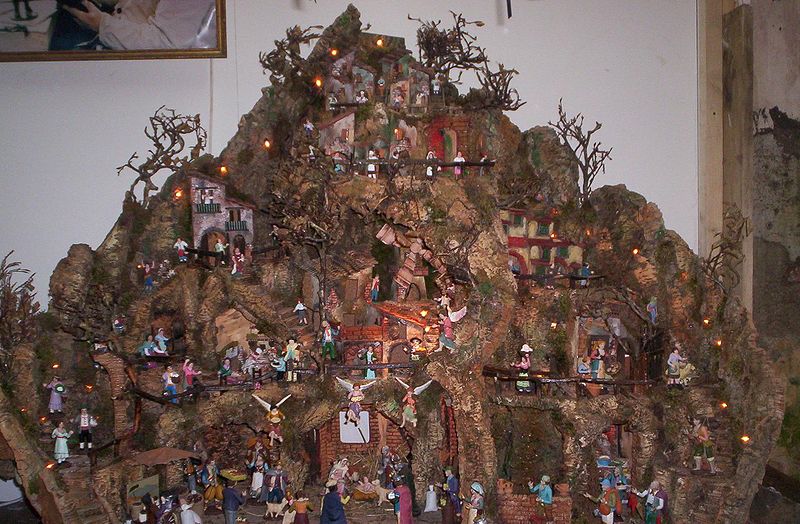
“A week before Christmas, a truck arrived from the commune of Poggio, with a string of coloured lights. In the course of one dark afternoon, they were draped over the solitary pine in the piazza. In the evening, switched on, it became our communal Christmas tree. Meanwhile, in the church, Gegeto had constructed a huge elaborate crib out of moss and mountain rocks–a miniature landscape threaded with electric lights, through which wandered shepherds, wise kings and animals, in the direction of the Holy Family. Until Christmas night, this massive construction went unwitnessed by almost everyone in the village. After Christmas, it was almost immediately dismantled. It was a labour of love. The lights on the pine tree, which were the work of the state, were still there the following May.”
I enjoyed Clifton’s book, which doesn’t identify the specific village, but includes the highs and lows of village life in rural southern Italy.
Merry Christmas to all my readers!
Christmas year-round: Nativities of Naples
Nativity scenes are part of the Christmas tradition for many of us, and they range from gilt-trimmed masterpieces to naked trolls. In the historic center of Naples, Via San Gregorio Armeno is home to workshops and storefronts selling an array of elaborate creches, or presepi in Italian.
The narrow pedestrian street is Nativity Central in Italy, carrying on a tradition established some four hundred years ago, in the Baroque era. From individual figurines and furnishings to elaborate full-village scenes, from finely crafted and expensive pieces to the very inexpensive–the array is fascinating. They go far beyond the typical scene of the holy family with wise men and shepherds. These scenes include the whole town–the innkeeper, the greengrocer, the mayor, homemakers and housekeepers, in lively scenes where you can imagine them sharing the story they’ve heard from the shepherds. “Did you hear about the baby? Did you hear about the angels? Can you believe it? Let’s go take a look!”
Christmas is a year-round affair on Via San Gregorio Armeno, so enjoy it whenever your visit to Naples comes along. At the end of the street is San Lorenzo Maggiore, a historic church that contains a museum focusing on the historic center of Naples. This neighborhood oozes history from every seam, so plan to spend some time exploring.
And whether you call it a creche, crib, presepi, or nativity, browse the workshops and enjoy the tradition of Christmas, celebrating the birth of Christ in a thousand variations on the theme.
(Remember those naked trolls I mentioned? Check out Nativity Scenes Gone Horribly Awry at a blog called “List of the Day”.)
My most Italian Christmas tradition: Torcetti
My Italian grandma, born Mary Nancy Arcuri, was a great cook. She lived into her 90s, and now her many dozens of descendants like to share “Gram’s recipe” for various foods we associate with her. Somehow, though, each of her seven kids has a different version of “Gram’s recipe” for spaghetti sauce, each claiming to be authentic, and the rest charlatans.
At Christmas, Gram always made torcetti (tor-chet-ee). The lightly sweetened pastry was rolled in powdered sugar, shaped in figure 8s or candy canes, or folded into little half-moon turnovers filled with mince or cherry pie filling. I always imagine her learning to make it at her mother’s side, in Italian–the only language her mother spoke. Gram came from a big family, and it is a big recipe–I have penciled in on my recipe card a smaller version, one-fourth of the original recipe. But for you, readers, I am providing the full meal deal, the recipe for 12 dozen torcetti. Enough to share with lots of friends!
Ingredients:
1 lb. butter or margerine
1 lb. vegetable shortning
10 cups sifted flour
1 cup warm milk
1 T. granulated sugar
1 T. vanilla
2 pkgs. yeast
4 eggs, beaten
2 lbs. powdered sugar
Cut shortning and butter into flour until it is like corn meal. Combine milk, granulated sugar, vanilla, and stir in yeast. Add liquid to flour mixture. Add eggs and beat. Add more flour if sticky. Knead slightly. Put in a greased bowl, cover in a warm place, and let rise until double in bulk, about one hour. {I must tell you, this is a heavy dough, and has rarely doubled its bulk for me!}
Cover a bread board with some of the powdered sugar. Break off egg-size pieces of the dough, roll in powdered sugar into one long piece, and shape into figures–pretzel, figure 8, knots, candy canes. Bake on a greased sheet 12-15 minutes at 375 degrees. For filled turnovers, roll out dough, sprinking with powdered sugar if sticky, and use a cookie cutter or water glass to make 3″ circles. Fill with a spoonful of your favorite fruit pie filling, fold in half, and seal by pressing a fork along the edge.
If you try Torcetti from Gram’s recipe, I’d love to hear from you. And do you have an Italian Christmas food you love? Let’s hear about it!
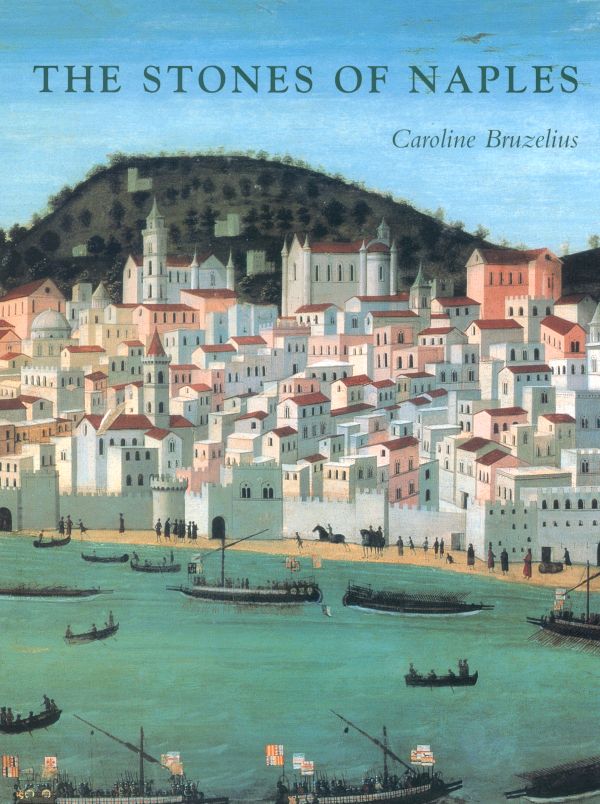
Book Review: The Stones of Naples
Sometimes I think that only a nerd like me would be fascinated by a book subtitled “Church Building in Angevin Italy, 1266-1343”. But I’m glad to know there are enough nerds like me around that the author, Caroline Bruzelius, and the publisher, Yale University Press, decided to produce it.
The Stones of Naples is filled with stories of why and how various churches were built in Naples during the first three generations of Angevin rule there, 1266 to 1343. The social history is tied to the architectural history to answer questions I didn’t even know I had! And I have plenty of questions about these Angevins–for some reason their story resonates with me.
The book is academic, filled with minutiae about builders and stone, about bishops and their political persuasions, about monastic influences on the royal family members, and their influence on one another. There are several appendices, and pages of end notes, a lengthy bibliography, and detailed index.
But the academic burden (which it might seem to some readers) is lightened by a few other inclusions. Right up front there are maps, a city plan of Naples, and a genealogical chart of the Angevins. The large-format book contains many photos (too few in color, but there are many) and illustrations of church floor plans, construction elements, and decor. And the cover is beautiful, featuring detail from the Tavola Strozzi, showing a view of Naples in 1465 commemorating the Aragonese victory.
Although Naples itself figures heavily in the Angevin church construction, locations throughout southern Italy are mentioned or discussed.
I would recommend this book to anyone with an interest in southern Italy of the thirteenth and fourteenth centuries. It helps me understand the events and the atmosphere of the period, and develop a clearer picture of medieval Naples.