Pompeii: Just do it!

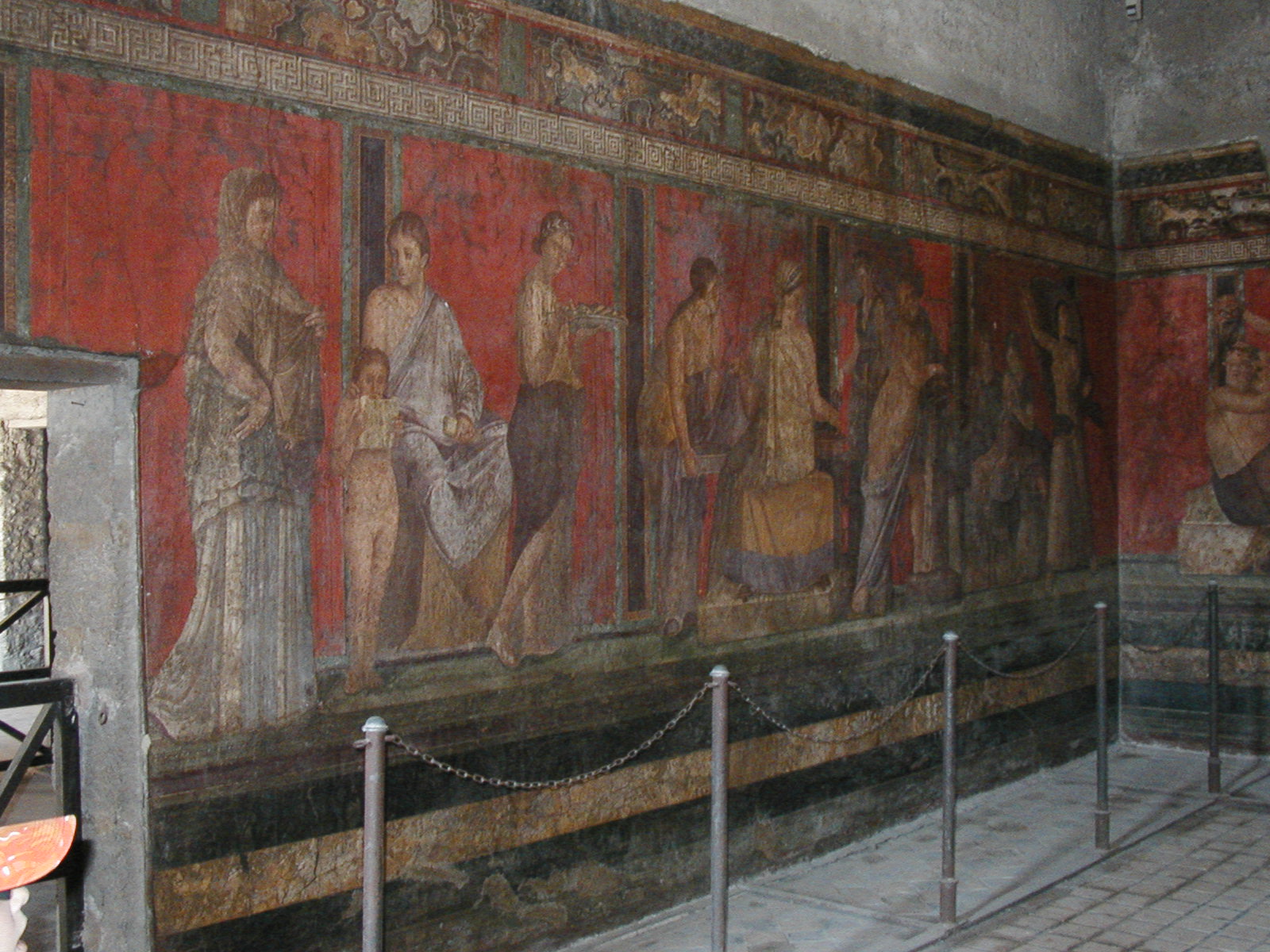
Frescoes in the Villa of Mysteries, Pompeii

Ancient history doesn’t turn my crank like medieval history does, but Pompeii is not to be missed regardless of your historical interests. Buried by an eruption of Mt. Vesuvius in 79 AD, Pompeii disappeared until its rediscovery in 1748.

Large sections of the city have since been unearthed–and I do mean large! The size of the city shocked me. Public buildings, retail shops, bakeries, a large theatre, public baths, even a brothel, and many homes now give mute testimony to the vibrant city that once was.

Bird mosaic at PompeiiA first-hand account of the eruption was written by Pliny the Younger, twenty-five years after the eruption in which his beloved uncle, Pliny the Elder perished attempting to rescue survivors. In two brief letters, he describes the earthquakes and ash, shooting flames and raining cinders, which brought terror to the entire Bay of Naples.

While Pompeii provides a fascinating view of life in a Roman era city, I was intrigued by the unexcavated areas. Ten or twelve feet above the level of the Roman streets, grassy fields bloom with daffodils in the spring, intrusions into the outline of the greater city. When I asked the staff about these areas, I was assured that they were excavating all the “important” areas, implying that nothing of significance lay in those intrusions.

How could they know?

BOOKS: Ann Cornelisen’s books bring southern Italy to life

Ann Cornelisen wrote several books about the Italian south. The best known is “Torregreca”, first published in 1969, and re-released in 2002 to further good reviews.

First edition cover of Torregreca

Reading Torregreca brought me a new understanding of the emigrants of southern Italy. Her work, setting up nurseries for Feed the Children, was carried out in various places throughout the region. The living conditions, poverty, and social practices she describes in Torregreca are based on her experiences in a village in Basilicata, but apply to much of the rural south. She worked in the region for about twenty years beginning in 1954. The lives of many in the rural south at that time was unchanged from earlier centuries.

Cornelisen’s books: “Torregreca: Life, Death, Miracles” (Little, Brown, 1969),  ”Women of the Shadows: Wives and Mothers of Southern Italy” (1976), ”Vendetta of Silence” (Little, Brown, 1971), ”Strangers and Pilgrims: The Last Italian Migration” (Holt, 1980), ”Any Four Women Could Rob the Bank of Italy” (Holt, 1983) and ”Where It All Began: Italy, 1954” (Dutton, 1990).

Her books would provide excellent background research for a historical novelist (like me) who wanted to set a story in rural southern Italy of an earlier era. I’m glad some of her books are available in new editions. They provide an insightful record of southern Italian culture for English language readers.

Cornelisen died in 2003. In her obituary, the New York Times says: “The strength of her work was partly her feeling of place. ‘The South is not the gentle, terraced landscape of Renaissance painting,’ she wrote in ”Women of the Shadows: Wives and Mothers of Southern Italy” (1976). ‘It is a bare, sepia world, a cruel world of jagged, parched hills, dry riverbeds and distant villages where clumps of low houses cling together at the edges of riverbanks.”’

I recommend her fine, clear prose and keen observations to anyone interested in recent Italian history. Only a couple of her books are currently in print, but all are available through used book sources.


Giuseppe Garibaldi, Hero of the Two Worlds

Giuseppe Garibaldi

His name is everywhere in Italy, found on streets, piazzas, and monuments throughout the country. He is also renowned in the western hemisphere for his military successes in Brazil and Uruguay.

Between May and September of 1860, Garibaldi captured the island of Sicily for Victor Emmanuel II, and marched up the Italian peninsula toward Rome. Along the way volunteers swelled his forces from an initial 800 to about 24,000. He played a crucial role in uniting Italy, and is considered a national hero.

But after this famous march, at the outbreak of the American civil war, Garibaldi offered his services to President Abraham Lincoln. Here is how Wikipedia summarizes his offer: Garibaldi was offered a Major General’s commission in the U.S. Army through the letter from Secretary of State William H. Seward to H. S. Sanford, the U.S. Minister at Brussels, July 17, 1861. On September 18, 1861, Sanford sent the following reply to Seward:

He [Garibaldi] said that the only way in which he could render service, as he ardently desired to do, to the cause of the United States, was as Commander-in-chief of its forces, that he would only go as such, and with the additional contingent power—to be governed by events—of declaring the abolition of slavery; that he would be of little use without the first, and without the second it would appear like a civil war in which the world at large could have little interest or sympathy.

According to Italian historian Petacco, “Garibaldi was ready to accept Lincoln’s 1862 offer but on one condition: that the war’s objective be declared as the abolition of slavery. But at that stage Lincoln was unwilling to make such a statement lest he worsen
an agricultural crisis.” On August 6, 1863, after the Emancipation Proclamation had been issued, Garibaldi wrote to Lincoln: “Posterity will call you the great emancipator, a more enviable title than any crown could be, and greater than any merely mundane treasure.”

Had Lincoln and Garibaldi come to agreeable terms, we Americans would no doubt be more familiar with his name.

A Castle Tour to Remember: Fumone

Ever arrive at a hotel or bed and breakfast and immediately regret making the reservation? We had a close call like that when trying to cram in lots of research into a short amount of time.

The research subject was Pope Celestine V—you’ve seen his name on this blog before. He resigned as pope in 1294, and was promptly taken prisoner by his successor, Pope Boniface VIII, to prevent Celestine’s friends from claiming that his resignation was coerced. (I don’t believe it was.) Boniface sent the former pope to the castle of Fumone, on a hilltop two hours north of Naples, where he died in 1296.

We phoned the day before our visit, and a man with a fine command of the English language assured us there were tours available in English, and even overnight accommodations. As our travel times were uncertain, we decided to play it loose and didn’t reserve a room.
Fumone’s hilltop fortress, between Rome and Naples.

Fumone is a spectacular sample of a medieval hilltop fortress, with parking outside the walls, and narrow twisting cobblestone streets.  We parked and walked through the gates in mid-afternoon, eager to find the castle inside the fortress, and begin our tour. We enjoyed wandering through the streets, but could not find the castle entrance, nor any real help finding it, because the
town was pretty deserted.

Darkness was falling by the time we knocked—and waited—at the castle door. It looked like no one was home, but after a few minutes a light came on, and a young man of Pakistani or maybe Indian origin opened the door. When we explained we wanted a tour in English, he reluctantly invited us to step into the entryway, then yelled up the stairs to an older man of similar origin, in a language we did not understand. They argued, apparently about who would be stuck showing us around, and the older man lost, so off we went with him. He turned lights off as we left the entry, and lights on as we came to each new room, so it seemed that whatever room we were in was the only lighted room in the castle. A little eerie.

As our guide began to describe…  ?? What was he saying? We came to realize he was speaking English, but with his thick south Asian accent, pretty much everything required two or three repetitions for us to understand. Our first stop was the chapel built adjacent to the “cell” where Pope Celestine spent his last months. The chapel was built at a later date, from the room which housed Celestine’s companions during his imprisonment. On the chapel wall hangs a shadowbox style reliquary containing relics of various saints and holy objects, and in true Roman Catholic style, it contains a relic of Celestine himself—a tooth.

Then, in dramatic tones our guide says there is another very sad story connected to the castle’s history, and it is difficult for some people. Are we sure we want to see it? Yes?  He leads us to another room with a portrait on the wall of a mother and child. This woman and her husband had only daughters, and prayed for a son. They were overjoyed when their prayer was answered, but their daughters knew very well that their brother would inherit all the family’s wealth. They poisoned their brother. But the mother, unable to part with her son, kept his body preserved (we are directed to look at a closed cabinet) so she could always be
near him. Inside the cupboard we are shown a glass case holding said child, and his little wardrobe of clothes and toys stored with him.

Then there is the virgin’s well…. I’m just going to let you read about that on the castle’s website here: http://www.castellodifumone.it/italy/arx/pozzo2.htm

We no longer had any interest in lodging at the castle, even though lodging at castles is always an enthralling prospect for me. No, we completed the tour, made our way down the hill in the dark, and were glad to find a room at a dreary, cold hotel a few miles away.

Little Italy in America

San Diego's Little Italy

Wikipedia lists approximately 50 American neighborhoods that are known, officially or unofficially, as “Little Italy”. A couple of weeks ago I walked around the Italian neighborhood in San Diego, and delighted in hearing Italian conversation around me!

Where did all these Italian immigrants come from? Between 1880 and 1920, more than 4,000,000 Italians immigrated to the USA, and most of them came from southern Italy. Like immigrants from other countries, they often formed neighborhoods of like ethnicity.

Among them were my great-grandparents, Francesco Arcuri, who came from Calabria in 1887 and found work as a lace-maker in New York, and Josephine Gualtieri, daughter of a shoemaker in the Calabrian village of Scigliano. Francesco lived in America for about ten years before returning to Italy to find a wife. He was about 50 when he married the 21-year-old ‘spinster’. They came to America in 1900, and lived in Patchogue, Suffolk County, New York on Long Island.

In his book Long Island Italians, author Salvatore John LaGumina says, “Patchogue was Suffolk’s most thriving [Italian] community in the early 20th century.” LaGumina mentions a large lace-making mill there which employed hundreds of Italian-Americans.

Poverty in the Italian south fueled the mass exodus of residents, and opportunity in America gave them direction.

Is there a “Little Italy” near you, or one you have enjoyed visiting? Please comment!

Why I Love Sorrento

Medieval cloister in Sorrento--a popular wedding spot!

From my travel diary in February of 2004:  “The city is a marvel of history to me, with ancient pre-Roman walls, from the original Greek colony, with Roman walls built on top of them, the remains of several old gates, including stairs in the steep cliffs along the water. There are houses and buildings around the town from every era of the last 2,000 years! ….. We found ourselves in a narrow street where a motorcycle could barely pass us, and we had to flatten ourselves in a doorway while several cars passed, and then we made a run for the next wide spot. We came back to town near the old city walls–through a gate whose sign indicates it was made in the 3rd-1st century BC. The Antica Mura. (ancient wall) …. Ah, a sunny morning! The air is so fresh and clear, pero un po freddo, a little cold. Still, it is beautiful to see the sun on the water, birds wheeling above, palms swaying in the breeze….. Today is Carnevale in Italy (a.k.a. Mardi Gras)…here in Sorrento the streets were full of people tonight when Vern and I walked around. There is confetti among the cobbles and paving stones, and paper streamers litter the ground. The Corso Italia was so crammed with people that cars were not even attempting to pass through. People of all ages were out for the passeggiata and festival. Parents with young children dressed as Zorro, Sleeping Beauty, animal characters. Young teens were dousing their friends with shaving cream or silly string, which was also sprayed on shop windows and cars, lampposts and on the sidewalks. Music–live–played from a bandstand in the Piazza Tasso, and old couples strolled the streets together. Older men talked in groups or leaned against a wall watching the crowd–happy revelers all, it appeared. There were a few adults in costume too–we saw a pair of dalmations get into a small car and drive away.”

Is there a place in Italy that you love?  Tell me about it!

BOOK REVIEW: The Lady Queen by Nancy Goldstone

Nancy Goldstone touches on my favorite era of southern Italian history–the Angevin period–in her book The Lady Queen: The Notorious Reign of Joanna I, Queen of Naples, Jerusalem, and Sicily. Goldstone’s lively prose brings Joanna to life and immerses the reader in the challenges and triumphs of her exceptional reign of nearly forty years.

Joanna was born in 1326, during the rule of her grandfather, Robert the Wise. Joanna’s father died when she was two years old, leaving her heiress to the kingdom. Soon afterwards, her mother died, and Joanna was raised in the court at Naples.

At 17, she became Queen when her grandfather died. Threats to her rule came from within and without her kingdom, persisting through four marriages, and Joanna faced them with courage. Goldstone engages her readers as she presents background and historical context which add significance to Joanna’s accomplishments.

The book is written for a general audience, but the endnotes, bibliography, and detailed index provide guidance for further study of the reign of Joanna and the lives of those who influenced her. If all history was written like this book, a lot more people would be interested!

According to her website, www.nancygoldstone.com, she is working on a book about Joan of Arc which is expected out in 2012. The Lady Queen was published by Walker Publishing in 2009. I can also recommend the book Four Queens, which touches on southern Italy. In Four Queens, Goldstone tells the story of four daughters of the Count of Provence who all became queens during the 13th century. One of them, Beatrice, married Charles of Anjou who later became King of Naples.

Goldstone shares her enthusiasm for Joanna in a YouTube video which also appears on her website:

Hermit Monk, Pope, Saint

The man who first drew my heart to the Italian south was a hermit monk. A pope. A saint, even. I read just a few paragraphs in an old Penguin Dictionary of Saints, and I was hooked.

The unlikeliness of his path through life intrigued me then, and still does today. A younger son of  a poor family, Peter found the religious life suited him. He felt the need to separate himself from the world, and spent several long periods living as a hermit in the remote mountains of Abruzzo.

He couldn’t stay alone, because people kept seeking him out for spiritual wisdom, healing, and prayer. Eventually he founded a monastic order, built several monasteries and churches, and became known as a man of spiritual power.

In his early eighties, he retired to a hermitage near Sulmona. Nothing prepared him for the turn his life took next.

In 1294, there had been no pope for two years. Rome was in chaos, and the continued to bicker but came no closer to agreement. Abbot Peter of Morrone wrote to his old friend Cardinal Latino Malabranca, urging a swift election to avoid the wrath of God.
Malabranca nominated Peter—to the shock of his fellow cardinals, who barely knew who Peter was.

The schemers did know that Peter was unschooled in papal politics, therefore someone who might be used for their own ends. And they knew he was quite old, and not likely to live long if he was elected. So they elected him.

The cardinals were meeting in Perugia at the time, and their next order of business was to notify Peter of his elevation to the papal throne. None of them wanted to make the arduous mountain journey, and the delay of several days gave another interested party
an unexpected opportunity.

King Charles of Naples had been waiting five years for papal approval of a treaty that would free three of his sons from imprisonment in Aragon. His spies in Perugia raced south to Melfi with the news, and Charles raced north to Sulmona, arriving before the cardinals’ delegation. Charles prevailed on the new pope to help him, and offered to host him in Naples.

Peter, who took the name Celestine V as his papal title, was pulled from all sides by men wanting favors, by powerful cardinals protecting their own interests, and by King Charles and others hoping to influence him.

The coronation of Pope Celestine V

He was crowned in L’Aquila in August of 1294, to the horror of the cardinals, who felt Rome was the proper place for the coronation. He spent months in Naples as a guest of the king, against the cardinals’ wishes again.

His spiritual wisdom could not make up for his political naivety, however, and by December of 1294 Peter knew he was making a mess of his job. All he wanted was to go back to his hermitage. But there was no provision for the resignation of a pope.

For that, he called on one of the cardinals for legal help: Benedict Gaetani, one of the brightest legal minds of the 13th century.
After years of enmity with King Charles, Gaetani allied with the king to ensure the resignation would be accepted—and that Gaetani himself would be the successor.

Then, Gaetani double-crossed them both, forcing Charles to bring the former pope to Gaetani as a prisoner before Gaetani would complete the political maneuvers necessary to free the king’s sons.

Peter spent the last two years of his life imprisoned in a castle in Fumone, one of the Gaetani family holdings, where he died in 1296. Dante consigned him to hell for the cowardice of his resignation, but others considered him a saint—and he was canonized with the name Saint Peter Celestine in 1313. He is even mentioned in Dan Brown’s Angels and Demons.

I walked the path to his hermitage near Sulmona, and visited the church in L’Aquila where his remains lie in a glass case. I am convinced he was a great spiritual leader, but the church of his day wanted a politician, which he certainly was not. I like to
think of him in his prime, surrounded by people who wanted to learn from him, and who saw him as an example of all the good in Christian life.

Earthquakes in L’Aquila


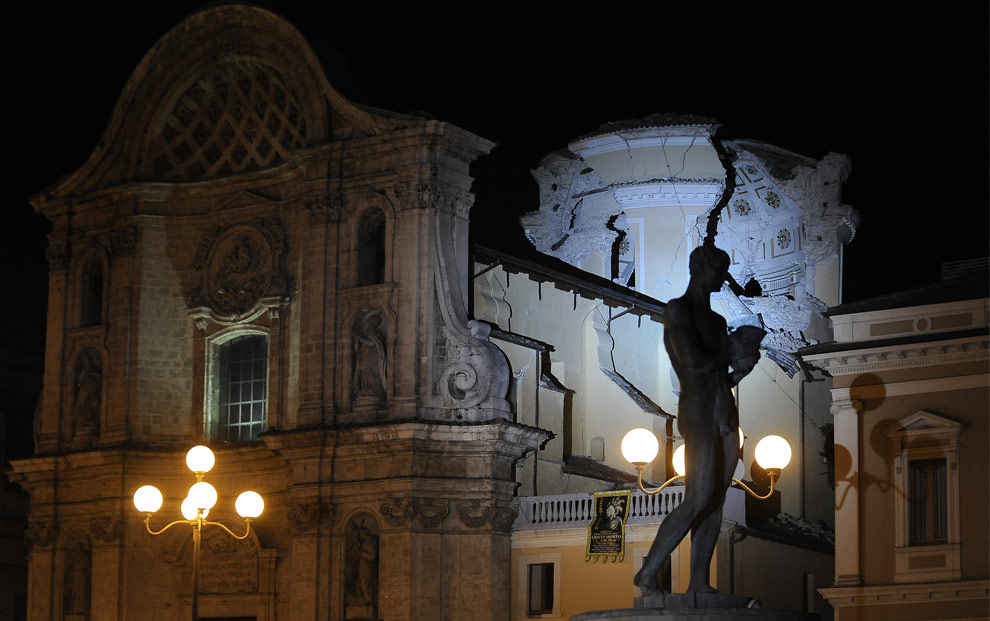
Earthquake damage at Santa Maria Paganica Church in L'Aquila, 2009.

When I first visited L’Aquila in 2004, I wandered through the city looking at churches. Though many of them had medieval origins, almost all were now decorated in Baroque style, heavy on the cherubs and gilded trims. Some thoughtful person or committee (and I thank you, whoever you are) had undertaken a signage project in L’Aquila, and almost every church had a sign—sometimes even in English—outlining the history of the church.

The reason for the almost universal Baroque décor became clear as we read, for the third, then fourth, and fifth time, that “after the terrible earthquake of 1703, the church was rebuilt…” during the following ten or twenty years.

 Naturally enough, those churches were rebuilt in the style current in 1703, and not their original style. Aggravating as it was to my medieval mind, nearly every church in town had been remade Baroque.

 The city of L’Aquila was founded by Frederick II, Holy Roman Emperor and King of Sicily, and completed in 1254 by his son. I knew many of those churches had medieval origins, and my main reason for visiting was to see the monastery church of Santa Maria di Collemaggio. (You can see its beautiful pink and white façade in the banner photo above.)

 Fortunately, Collemaggio was not destroyed in 1703, and its Romanesque layered arches and portals welcomed me as I explored it. I paid my respects to Pope Celestine V, one of the subjects of my research for several years, whose body lies in a glass case there. He is also known as Saint Peter Celestine, or Peter of Morrone, and he founded the church in the 1270s and was crowned pope there in 1294. I did notice that part of the interior of Collemaggio had a Baroque style, and wondered if that was a result of earthquake damage. 

 The 1703 “terremoto” is reputed to have killed 5,000 to 10,000 people and destroyed nearly every building in L’Aquila. In a terrible case of déjà vu, in April of 2009 the mountains under L’Aquila shook the city to rubble again. More than 300 people died, around 1,500 were injured, and 65,000 became homeless due to the destruction.

 Once again, most of Santa Maria di Collemaggio survived. If you search on Google Earth for “Santa Maria di Collemaggio” you’ll see a village of blue emergency tents erected on the wide lawn in front of the church’s pink and white façade.  The dome collapsed, but the rest of the church and monastery stood the test. The remarkably clear satellite photos used by Google Earth for L’Aquila were taken just a few weeks after the earthquake, so you can see other collapsed roofs as you scan around the city. The most telling series of photos I have seen (warning: some graphic content) of the 2009 earthquake damage is at this website:  http://www.boston.com/bigpicture/2009/04/the_laquila_earthquake.html  The photo above comes from this collection.

 In a December 2010 article in The Free Press (Rockland, Maine) columnist Chuck Marecic describes the downtown area of L’Aquila:  “On a recent walk through the city, I saw temporary wooden braces reinforcing the windows, doors, and walls of nearly every building. The town’s Duomo (cathedral) looks fine from the outside, but the inside has collapsed. Chain- link fences separate much of the city from its inhabitants. Here and there reconstruction projects are evident. However, for the most part the city stands mute and abandoned except for the teams of firefighters who continue to inspect the “red zone” to ensure public safety and the scores of visitors who have come to bear witness to the devastation.”

 I cried when I read about L’Aquila, and I’m not sure I’d want to join the ‘disaster tourism’ there, though it may provide some financial stimulus to the community. The city’s past fascinates me, but the future is very cloudy.

Southern Italy calling!

In February of 2004 I visited southern Italy for the first time, promptly taking the wrong train on the Circumvesuviana line from Garibaldi station in Naples. We intended to  follow the coastline past Pompeii to Sorrento. Instead,  my husband Vern and I listened to the incomprehensible dialect of a thickset and mustachioed fellow traveler urging us to… what was it? From his gestures and expressions (because we could not understand a word he said) we realized he was directing us to get off the train, go back and take a different train. By the time we figured that out, we had chugged halfway around the backside of Mount Vesuvius. At last another man took pity on us and explained our error, using slow, careful Italian. He offered to help us transfer at the end of the line, facilitating our tour around the mountain, the sentinel of the Bay of Naples.

In Sorrento, we studied Italian for two weeks at SorrentoLingue, a language school where I shared an “advanced beginners” class with a young Japanese woman who spoke no English. We were forced to communicate in Italian, our only common language, and despite limited vocabulary, we described to one another our hometown festivals, favorite foods, and experiences with romance.

History sits right on the surface in Italy. Baroque churches, medieval palaces, the remains of Roman villas, and Greek temple ruins surrounded us. It’s easy to imagine digging up ancient urns in your flower garden, or finding a Roman theatre in your basement, as one Napolitano man did. That theatre is now one stop on a fascinating “underground Naples” tour.

We enjoyed three months in Italy in 2004, combining language study, research, and some personal travel. We visited the Calabrian village where my great-grandmother, a shoemaker’s daughter, an old maid at twenty-one, married a lace-maker nearly thirty years her senior, who had come back after twenty years in America to find an Italian wife. The people of Scigliano displayed wonderful hospitality to my mother, sister, husband, and I during a four day visit, and we met distant cousins with whom smiles and clasped hands took over when our languages failed us.

I continue to read about the Italian south, to research and write another novel set there. I also dream of returning, tackling more Italian language, and eating more of the incomparable food. And did I mention the wine? Vern and I set a challenge for ourselves: How low did the price have to go to find a bad bottle of wine? We could not do it. Even spending just two or three dollars on unlabeled bottles in dusty village shops, the wine was always acceptable, and often very good. The Italians, we concluded, simply wouldn’t put up with bad wine.

The Italian south still draws me in through books, food, other blogs, and history. I hope you’ll join me here for a taste of it.