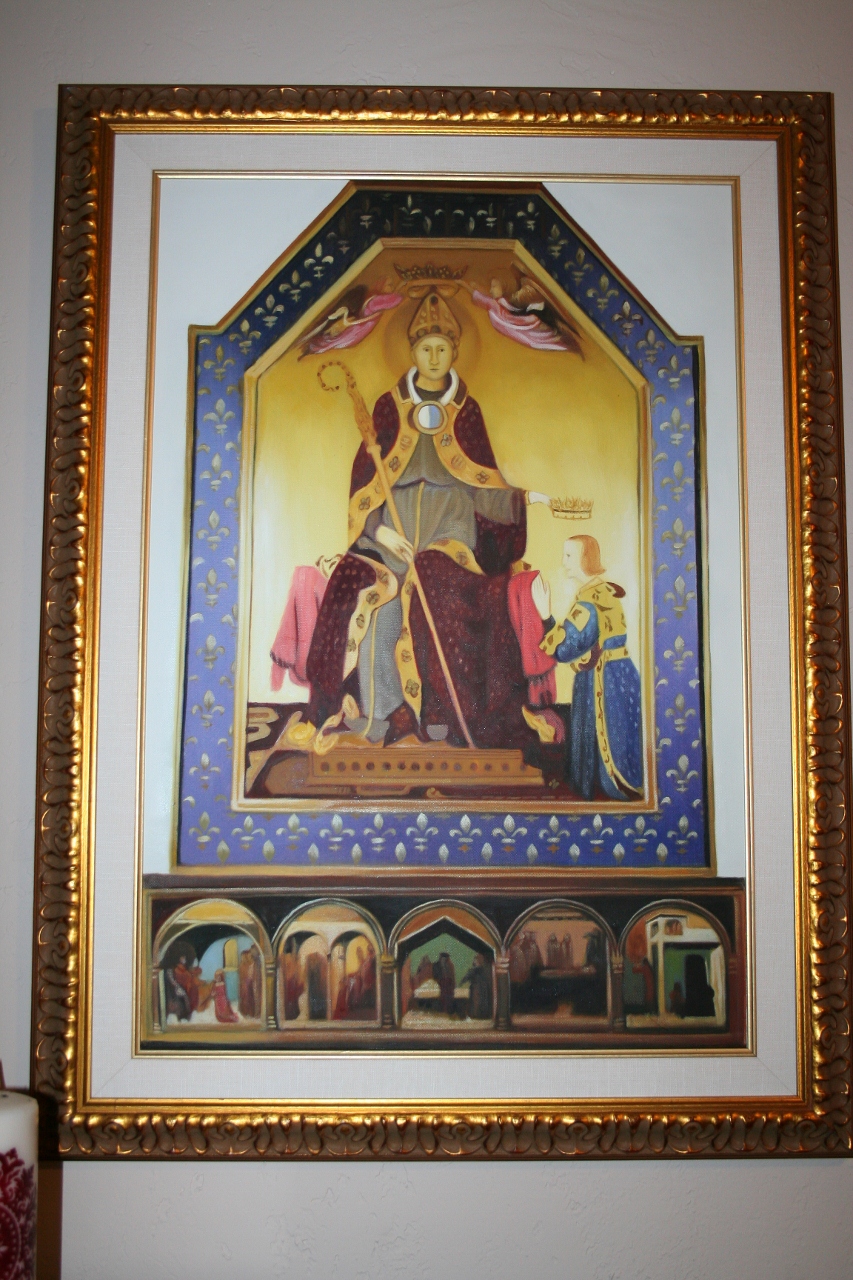
A new (old) painting on my wall


I have to thank my daughter and son-in-law for an amazing gift they presented to me not long ago. They listened (ever-so-patiently) as I waxed lyrical about Simone Martini’s painting, St. Louis of Toulouse crowning Robert of Anjou, which hangs in the Museo di Capodimonte at Naples. They heard (again, I’m afraid) the story of those two brothers, my favorites of the Angevins of Naples, about their long imprisonment from youth to young adulthood, how Louis was called to the Franciscan order and defied his father to answer that call, how his charismatic brother Robert, a third son, became heir to the throne of Naples because of Louis’s decision, and how Martini’s painting contains many symbols of the brothers’ complex relationship and history.

It was a gift that they listened so attentively to the story that has fascinated me, and charged my imagination, for decades.

But a few weeks later, they showed up at my house… with the painting!! Of course, not the one from Naples–the original is not for sale. Mine is a reproduction, a knock-off from one of those websites that will make you a copy of any oil painting you like, in any size you want.

I have it framed, now, and hanging in my bedroom. The saint (Louis of Toulouse) and the king (Robert the Wise) watch over me as I sleep.
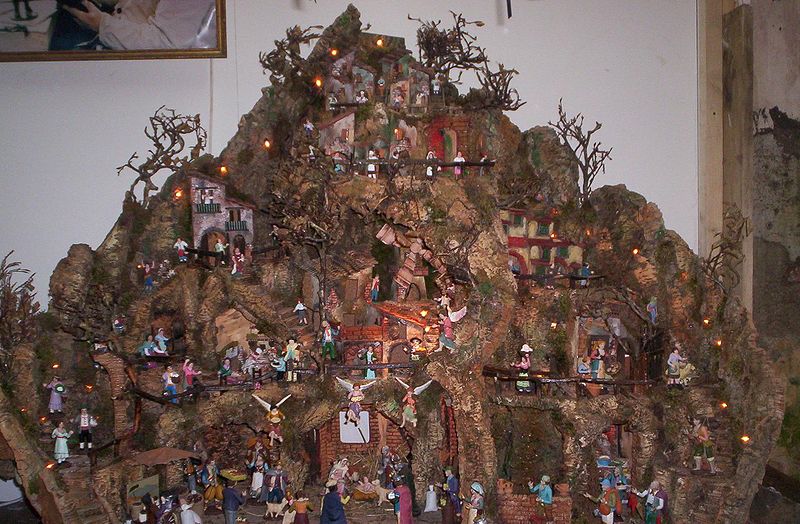
Christmas year-round: Nativities of Naples

Nativity scenes are part of the Christmas tradition for many of us, and they range from gilt-trimmed masterpieces to naked trolls. In the historic center of Naples, Via San Gregorio Armeno is home to workshops and storefronts selling an array of elaborate creches, or presepi in Italian.

The narrow pedestrian street is Nativity Central in Italy, carrying on a tradition established some four hundred years ago, in the Baroque era. From individual figurines and furnishings to elaborate full-village scenes, from finely crafted and expensive pieces to the very inexpensive–the array is fascinating. They go far beyond the typical scene of the holy family with wise men and shepherds. These scenes include the whole town–the innkeeper, the greengrocer, the mayor, homemakers and housekeepers, in lively scenes where you can imagine them sharing the story they’ve heard from the shepherds. “Did you hear about the baby? Did you hear about the angels? Can you believe it? Let’s go take a look!”

Christmas is a year-round affair on Via San Gregorio Armeno, so enjoy it whenever your visit to Naples comes along. At the end of the street is San Lorenzo Maggiore, a historic church that contains a museum focusing on the historic center of Naples. This neighborhood oozes history from every seam, so plan to spend some time exploring.

A selection of nativity scene characters for sale.

And whether you call it a creche, crib, presepi, or nativity, browse the workshops and enjoy the tradition of Christmas, celebrating the birth of Christ in a thousand variations on the theme.

(Remember those naked trolls I mentioned? Check out Nativity Scenes Gone Horribly Awry at a blog called “List of the Day”.)

Bari’s colorful past

I once mentioned to a friend that I would love to visit Bari. His brows shot up. “No you don’t,” he assured me.

He had been to Bari some years earlier, and found it less than enchanting.

But it isn’t Bari today that attracts me, as much as Bari’s history. When I mentioned Bari to my friend, I was thinking of the port where thousands of crusaders launched their sea journey to the Holy Land. Nearly 2,000 years ago the Emperor Trajan rerouted the Appian Way to Bari, bringing it to prominence as a Roman port and commercial city. Today it is southern Italy’s second most important city, with a university, two modern harbors, and a metropolitan population of more than a million people.

Statue of Saint Nicholas in Bari's basilicaThe relics of Saint Nicholas rest in Bari, secreted out of his native city of Myra (part of modern-day Turkey) in 1087 in the midst of an invasion. Accounts of the event vary, but ultimately the saint’s relics were brought to Bari, where a basilica built in his honor is considered by some to be Bari’s most important building, built in the 12th century. A festival held each May celebrates the arrival of the relics. This is the fourth century saint who has morphed over the ages into Santa Claus.

Bari’s port also saw a significant slave trade in the early Middle Ages durin Byzantine rule, when slavic captives were sold to the Turks and others in the eastern Mediterranean. About five hundred years of Byzantine rule gave way to Norman rule in the late 11th century.

Bari Vecchia, or Old Bari, was for many years a good place to avoid due to rampant petty crime. Perhaps this was my friend’s experience in Bari. But this review on Slow Travel Italy describes the old city in very appealing terms.

One day I will go and see for myself!

Giuseppe Garibaldi, Hero of the Two Worlds

Giuseppe Garibaldi

His name is everywhere in Italy, found on streets, piazzas, and monuments throughout the country. He is also renowned in the western hemisphere for his military successes in Brazil and Uruguay.

Between May and September of 1860, Garibaldi captured the island of Sicily for Victor Emmanuel II, and marched up the Italian peninsula toward Rome. Along the way volunteers swelled his forces from an initial 800 to about 24,000. He played a crucial role in uniting Italy, and is considered a national hero.

But after this famous march, at the outbreak of the American civil war, Garibaldi offered his services to President Abraham Lincoln. Here is how Wikipedia summarizes his offer: Garibaldi was offered a Major General’s commission in the U.S. Army through the letter from Secretary of State William H. Seward to H. S. Sanford, the U.S. Minister at Brussels, July 17, 1861. On September 18, 1861, Sanford sent the following reply to Seward:

He [Garibaldi] said that the only way in which he could render service, as he ardently desired to do, to the cause of the United States, was as Commander-in-chief of its forces, that he would only go as such, and with the additional contingent power—to be governed by events—of declaring the abolition of slavery; that he would be of little use without the first, and without the second it would appear like a civil war in which the world at large could have little interest or sympathy.

According to Italian historian Petacco, “Garibaldi was ready to accept Lincoln’s 1862 offer but on one condition: that the war’s objective be declared as the abolition of slavery. But at that stage Lincoln was unwilling to make such a statement lest he worsen
an agricultural crisis.” On August 6, 1863, after the Emancipation Proclamation had been issued, Garibaldi wrote to Lincoln: “Posterity will call you the great emancipator, a more enviable title than any crown could be, and greater than any merely mundane treasure.”

Had Lincoln and Garibaldi come to agreeable terms, we Americans would no doubt be more familiar with his name.

Mapping the Italian South

Just what are the boundaries of “southern Italy”? Sometimes people (both Italians and others) say that the north and south of Italy are like two different countries. Until about 150 years ago, they were two—and often more—countries, and for many centuries the south was the Kingdom of the Two Sicilies, or the Kingdom of Naples and the Kingdom of Sicily. It includes the island of Sicily and the “boot” up to Gaeta on the west coast, and further north, taking in modern day Abruzzo, on the Adriatic coast.


Here’s a very abbreviated timeline of the last 28 centuries of influence or control of the region:

  • 8th Century BCE: Greece
  • 3rd Century BCE: Carthage/Rome
  • 200 BCE: Rome
  • 500 CE: Byzantine Empire
  • 800 CE: Muslims (island) and Lombards (mainland)
  • 1000s CE: Normans
  • 1200 CE: Hohenstaufen (German)
  • 1250s CE: Angevins (French) on mainland, Aragon (island)
  • 1440s CE: Aragon (Spanish) and Anjou (French) alternated for about 100 years.
  • 1550s CE: Aragon
  • 1720s CE: Bourbons
  • 1800s: Napoleon, Austrians, back to Bourbons.
  • 1816: Naples and Sicily united as the Kingdom of the Two Sicilies under the Bourbons.
  • 1860/61: Briefly part of the Kingdom of Sardinia, then joined with the Kingdom of Italy.

 Complicated as it seems, I have simplified this chart greatly. The evidence of these groups show up in the architecture, dialects, family names, and foods of the region. America is often called a melting pot, but southern Italy is a strong rival for that title.

 When I talked with my mother about the invasions and influences on southern Italy, her face fell. “I thought we were Italian,” she said. “But it sounds like we aren’t.” If not, what are we? Her grandparents’ family names, Gualtieri and Arcuri, may provide clues to more distant origins. Behind the Name.com, a website on name origins, identifies Gualtieri as an adaptation of the name Walter, which is said to be of Norman origin. Arcuri closely resembles some Greek surnames. Could my ancestors have come to Italy with the ‘other’ Normans who controlled the south in the 1100s? Or with the founders of the Magna Graecia, the Greek settlers who arrived almost 3,000 years ago? I would love to know their stories!