Who hunts the wild boar?

One food I enjoyed in Italy, but seldom see in America, is wild boar. When we were staying in Sulmona, our friend Cesare took us through several mountain villages to see various monasteries and hermitages connected to Pope Celestine V (the subject of my research in central Italy).

We stopped for lunch in a village in the mountains of Majella National Park, and went to a restaurant called Belvedere, which hung on the edge of a precipice overlooking the wild hinterlands of Abruzzo. Vern was intrigued to find wild boar on the menu—cinghiale in Italian—and decided to try it. His curiosity was rewarded: the waiter soon delivered a huge bowl of savory chunky stew. The meat was similar to pork, and very tasty.

As we ate, I asked Cesare who hunts the wild boar they serve in the restaurant. At first he seemed not to understand the question, but I persisted. “Nobody hunts them,” he finally said.  “Where do they come from then?” I asked. “Una fattoria.”

Yes, it seems the ‘wild’ boar was raised on a farm! Quite a disappointment, as a boar hunt was fully formed in my imagination already.

Truly wild boars have proliferated in some areas of rural Italy, because their natural enemy, the wolf, has declined in population. According to some sources they now produce more offspring due to mating with domesticated pigs. They damage farms and gardens, and can be a traffic hazard.

My son and I found wild boar on the menu of La Dolce Vita restaurant in Seattle a couple of years ago, and like his dad, he had to try it. I don’t see it on their online menu now. I haven’t found any to try cooking myself, but I found a recipe online at http://italianfood.about.com/od/furredgameetc/r/blr1082.htm that looks pretty good. If you want to try it using pork, and just pretend it’s wild boar, go ahead—I won’t tell!

Driving to L’Aquila

In early March of 2004, after two weeks of studying Italian in Sorrento, Vern and I rented a car to drive to L’Aquila, high in the central Apennines, researching some of the settings of the novel I was writing. Set in the late 1200s, the novel included the coronation of Pope Celestine V, who was crowned in L’Aquila where he had founded the Santa Maria di Collemaggio monastery. 

The forecast called for snow in the mountains, so we insisted on having some tire chains for our rental car when we picked it up in Sorrento in the morning. The rental agent  reluctantly rounded some up for us. By mid-afternoon , as we climbed into the mountains, we were glad to know we had those chains. 

With lots of snow-driving experience behind us, we weren’t concerned with the first couple of inches of snow, and just kept driving. Finally, though, when the snow was approaching six inches deep, we pulled off under an overpass to put the chains on. 

Guess what? They didn’t fit our tires.

In the dark, with the snow still falling thick around us, we wondered if we would be able to make the last hour or so of the trip. There wasn’t much traffic on the roads, and we didn’t have a cell phone with us to call for help if we needed it.

As we sat in the car talking it over, we heard heavy truck traffic on the overpass, and then down the ramp, headed toward L’Aquila, came a snow plow. Just what we needed!  As we started the car, a second plow followed the first one, pulling out onto the road ahead of us. And then a third! 

We felt like a special escort had been arranged just for us, and though the speed was a little slow, we followed the plows all the way to L’Aquila’s city gates. From there, we had to make our own way through the snowy streets to our hotel.

The following morning, a Sunday, we walked through a foot of fresh snow to the monastery church of Collemaggio, whose pink and white façade I had seen in many photos in the course of my research on Pope Celestine V. The banner photo on this blog was taken that morning.

BOOK REVIEW: Head over Heel

Head over Heel: Seduced by Southern Italy by Chris Harrison, 2009, Nicholas Brealey Publishing

Head over Heel by Chris Harrison, recommended by theitaliansouth.com


Australian writer Chris Harrison captured me first with his opening quote from Luigi Barzini: “In the heart of every man, wherever he is born, whatever his education and tastes, there is one small corner which is Italian… ”  In my family, there is a low-brow version of Barzini’s sentiment: There are only two kinds of people in the world—Italians and those that want to be. This book made me glad I am a little Italian. It also strengthened my urge to return to the sunny Italian south.

Harrison’s memoir draws us into Andrano, the village in Puglia he moved to after a love-at-first-sight encounter, and long distance romance with an Italian woman. In Andrano he learns to tolerate being wakened by the amplified voice of the vegetable seller roving through town in his truck, and to navigate the governmental obstacle course for residency and a driver’s license.

His stories rang true with my own experiences in southern Italy’s small towns, and colorful detail brings them to life: the festivals both religious and gastronomic (he favors the latter), the tragicomedy of nearly every interaction with the local carabinieri, and the challenges of teaching English to the most apathetic students.

Personal relationships have their own challenges, and Chris and Daniela discover when they move to Milan for work, and live with her brother. Daniela’s father wanders in a fog of Alzheimer’s disease, and her mother cares for him. Her family doesn’t always understand Chris and his Australian ways.

Entertaining all the way through, Harrison’s book also carried me back to Italy as I read. The south, and Puglia, are not often the subject of such books, and for me this added to the appeal. I found myself reading excerpts to my husband, and thinking of various friends who might also enjoy reading the book. You might enjoy it too–I recommend it!

Dreaming in Italian

At the top of my list, for my next trip and possibly any trip to Italy:  A couple of weeks (or a month, or three months) of Italian language school at SorrentoLingue.

In February of 2004 I started two weeks of study there, hoping to hack down at least some of the language barrier that stood between me and my research. I was placed in an advanced beginners class (thanks to some introductory Italian study and previous Spanish and Latin classes), and I had one classmate, Wakana from Japan, who spoke no English, and about as much Italian as I did.

How much can be communicated with those limitations?  I learned that Wakana’s home town in Japan has an annual festival taking a local god from their temple down to the ocean to be washed. I learned that she hoped to speak Italian well enough to attend a university in Italy to study architecture. She learned about my home town’s annual Irrigation Festival, and about the research I was doing for a novel set in the 13th century.

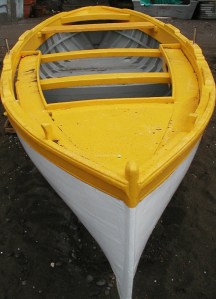
Vern and I walked around Sorrento, visiting the touristy places—shops selling ceramics and inlaid wood products, learning Italian as we bought coffee and pastries in the sidewalk cafes, and tickets for the bus to Positano. The ancient city walls, medieval cloisters, and brightly painted fishing boats in the Piccola Marina all delighted us, and kept the camera clicking.

About ten days into our two weeks of Italian study, I woke up from a dream. I was drifting on the Bay of Naples in one of those small fishing boats, an Italian fisherman at the oars. I held a fishing pole and cast out into the water. Soon I had something on the line, and reeled it in. Not a fish, but a paper with an Italian word written on it. Unfortunately, not the word I was looking for. Disappointed, I threw it back in and cast my line out again. I reeled in another word, but it still wasn’t the right one.

Perhaps it was my frustration that woke me, because I never “caught” the word I wanted! But I woke up laughing, and shared the dream with Wakana and our teacher, Elena, at school that morning. I had heard of people dreaming in a language they are learning, but my fishing expedition was a new take on the theme.

After our last day of classes, Wakana and I put our communication skills to the test. She joined Vern and I on a visit to Pompeii, about 40 minutes by train from Sorrento. As we wandered around the remains of the Roman-era city, we jabbered in a mixture of bad Italian, a few Spanish words, and her limited English. Then we saw a Japanese tour group with a guide explaining things to them in Japanese. Hanging around the fringes, Wakana translated into Italian for me, and I translated into English for Vern.  A little like the old party game of Gossip, I wonder if what Vern heard was anything like what the guide told his group.

I left Sorrento far from fluent, but far better equipped than when I arrived. We were able to manage much better during the following two weeks as we traveled. When we returned to Italy in August, we again spent two weeks at SorrentoLingue. With another leap in language skills, our travels were much more enjoyable, and research more productive.

Immersion language schools are available in many countries, and if your travel time is flexible enough to include a week or two—often the classes are half-day, so you can still see the sights—do it! Check out SorrentoLingue at www.sorrentolingue.com.

Southern Italy calling!

In February of 2004 I visited southern Italy for the first time, promptly taking the wrong train on the Circumvesuviana line from Garibaldi station in Naples. We intended to  follow the coastline past Pompeii to Sorrento. Instead,  my husband Vern and I listened to the incomprehensible dialect of a thickset and mustachioed fellow traveler urging us to… what was it? From his gestures and expressions (because we could not understand a word he said) we realized he was directing us to get off the train, go back and take a different train. By the time we figured that out, we had chugged halfway around the backside of Mount Vesuvius. At last another man took pity on us and explained our error, using slow, careful Italian. He offered to help us transfer at the end of the line, facilitating our tour around the mountain, the sentinel of the Bay of Naples.

In Sorrento, we studied Italian for two weeks at SorrentoLingue, a language school where I shared an “advanced beginners” class with a young Japanese woman who spoke no English. We were forced to communicate in Italian, our only common language, and despite limited vocabulary, we described to one another our hometown festivals, favorite foods, and experiences with romance.

History sits right on the surface in Italy. Baroque churches, medieval palaces, the remains of Roman villas, and Greek temple ruins surrounded us. It’s easy to imagine digging up ancient urns in your flower garden, or finding a Roman theatre in your basement, as one Napolitano man did. That theatre is now one stop on a fascinating “underground Naples” tour.

We enjoyed three months in Italy in 2004, combining language study, research, and some personal travel. We visited the Calabrian village where my great-grandmother, a shoemaker’s daughter, an old maid at twenty-one, married a lace-maker nearly thirty years her senior, who had come back after twenty years in America to find an Italian wife. The people of Scigliano displayed wonderful hospitality to my mother, sister, husband, and I during a four day visit, and we met distant cousins with whom smiles and clasped hands took over when our languages failed us.

I continue to read about the Italian south, to research and write another novel set there. I also dream of returning, tackling more Italian language, and eating more of the incomparable food. And did I mention the wine? Vern and I set a challenge for ourselves: How low did the price have to go to find a bad bottle of wine? We could not do it. Even spending just two or three dollars on unlabeled bottles in dusty village shops, the wine was always acceptable, and often very good. The Italians, we concluded, simply wouldn’t put up with bad wine.

The Italian south still draws me in through books, food, other blogs, and history. I hope you’ll join me here for a taste of it.