BOOKS: Must have this book!

For people like me, with a freakish interest in the medieval Angevin Kingdom of Naples, there are some books we must have. Only recently I learned that a Bible has surfaced, after mouldering for half a millennium in the Low Countries somewhere, a Bible which was created at the court of Robert the Wise in Naples, and presented to his granddaughter Joanna, who would succeed him to the throne of Naples and rule for more than forty years.

The Anjou Bible: A Royal Manuscript Revealed was published last year by Peeters Publishers. At 350 pages, it weighs 4-1/2 pounds and costs about $100.

I don’t care. I want it.

All the illuminated folios are reproduced in the book, as well as information about the illuminator who signed the work in the early 1300s. Historical information about the Angevin dynasty in Naples–a family I have researched for more than 25 years–sounds as beautiful to me as the illuminations.

The fourteenth century Bible is now owned by the University of Leuven in Belgium, the oldest existing Catholic university in the world. The manuscript was disassembled, cleaned, digitized, and displayed for twelve weeks  in 2010 before being rebound and returned to the vaults for long-term storage.

This book is definitely on my Christmas list!!

Pompeii: Just do it!

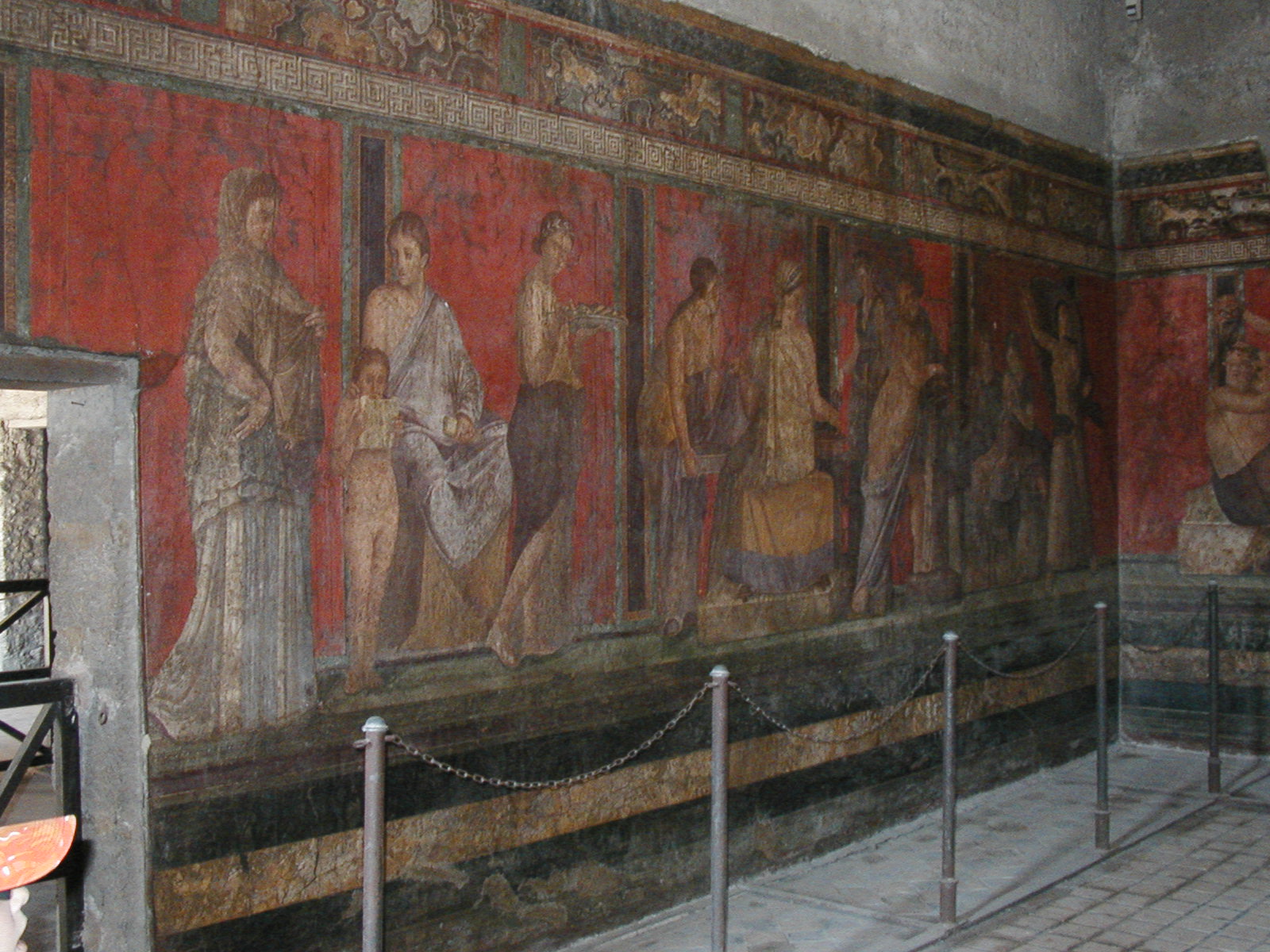
Frescoes in the Villa of Mysteries, Pompeii

Ancient history doesn’t turn my crank like medieval history does, but Pompeii is not to be missed regardless of your historical interests. Buried by an eruption of Mt. Vesuvius in 79 AD, Pompeii disappeared until its rediscovery in 1748.

Large sections of the city have since been unearthed–and I do mean large! The size of the city shocked me. Public buildings, retail shops, bakeries, a large theatre, public baths, even a brothel, and many homes now give mute testimony to the vibrant city that once was.

Bird mosaic at PompeiiA first-hand account of the eruption was written by Pliny the Younger, twenty-five years after the eruption in which his beloved uncle, Pliny the Elder perished attempting to rescue survivors. In two brief letters, he describes the earthquakes and ash, shooting flames and raining cinders, which brought terror to the entire Bay of Naples.

While Pompeii provides a fascinating view of life in a Roman era city, I was intrigued by the unexcavated areas. Ten or twelve feet above the level of the Roman streets, grassy fields bloom with daffodils in the spring, intrusions into the outline of the greater city. When I asked the staff about these areas, I was assured that they were excavating all the “important” areas, implying that nothing of significance lay in those intrusions.

How could they know?

If I were in Italy today…

An Adriatic beach in late summer, Abruzzo.

Crowds have thinned out at the beaches, but it’s still warm enough to enjoy! Grapes are beginning to ripen, and the market is filled with produce–tomatoes, lemons, tasty greens, eggplant, and the fragrance of basil. Blooming flowers cascade over walls and burst from their pots. A delightful season to enjoy the Italian south!

Even the calendar becomes a garden in Naples!

Food festivals: Enjoy the feast!

My mother can’t stop talking about it! She visited Calabria five years ago, and when friends took her out to dinner in one of the villages near Scigliano, she ordered a mushroom dish. I still haven’t heard the end of it.

Sadly for all of us, we do not have the recipe. But the season for mushrooms is approaching, and they will be celebrated in the Italian south.

In the Sila, the mountains of Calabria, the village of Camigliatello Silano celebrates a wild mushroom festival each year. In Diamante, the chili pepper takes center stage. Chestnut festivals are common throughout Italy, but the village of Zafferana Etnea in Sicily goes one better, celebrating a Chestnut and Wine Festival. Eggplant, pasta, sausage, chocolate–it seems like most any food in the cupboard has a festival in its honor.

But we were talking about mushrooms. In Marcella Hazan’s “Essentials of Classic Italian Cooking” I found this recipe that pays homage to the mushroom.

Fresh Mushrooms with Porcini, Rosemary, and Tomatoes

1 lb. fresh, firm white button OR cremini mushrooms

1/3 cup extra virgin olive oil

1 teaspoon chopped garlic

1 teaspoon fresh chopped rosemary leaves

About 1 ounce dried porcini mushrooms

Filtered water from soaking the mushrooms (see instructions)

Salt, Fresh ground black pepper

1/2 cup canned imported Italian plum tomatoes, with their juice

To prepare the dried porcini mushrooms, soak in two cups of barely warm water for at least 30 minutes. Lift the mushrooms by hand, squeezing out as much water as possible, and let the water flow back into the container in which it has been soaking. Retain the water, and rinse the mushrooms in fresh water, scraping any spots where soil is embedded. Pat dry with paper towels , and chop.

Filter the soaking water through a paper towel or coffee filter, and retain until called for.

Trim, wash, and towel dry the fresh mushrooms and cut in half  or quarters lengthwise, keeping the caps attached to stems.

Choose a saute pan that will contain all the ingredients loosely. Start with oil and garlic heated to medium high until the garlic becomes pale gold. Add rosemary and the reconstituted porcini. Stir once or twice to coat well, then add the filtered water from soaking the mushrooms. Turn up the heat and cook at a lively pace until all the water has simmered away.

Add the cut up fresh mushrooms to the pan, together with salt and pepper, turn the heat to high, and cook, stirring frequently, until the liquid shed by the fresh mushrooms has simmered away.

Add the tomatoes with their juice, toss thoroughly to coat well, cover the pan, and turn the heat to low. Cook about ten minutes. If needed to prevent sticking, add one or two tablespoons of water to the pan. When done, serve immediately.

Salute!

BOOKS: Ann Cornelisen’s books bring southern Italy to life

Ann Cornelisen wrote several books about the Italian south. The best known is “Torregreca”, first published in 1969, and re-released in 2002 to further good reviews.

First edition cover of Torregreca

Reading Torregreca brought me a new understanding of the emigrants of southern Italy. Her work, setting up nurseries for Feed the Children, was carried out in various places throughout the region. The living conditions, poverty, and social practices she describes in Torregreca are based on her experiences in a village in Basilicata, but apply to much of the rural south. She worked in the region for about twenty years beginning in 1954. The lives of many in the rural south at that time was unchanged from earlier centuries.

Cornelisen’s books: “Torregreca: Life, Death, Miracles” (Little, Brown, 1969),  ”Women of the Shadows: Wives and Mothers of Southern Italy” (1976), ”Vendetta of Silence” (Little, Brown, 1971), ”Strangers and Pilgrims: The Last Italian Migration” (Holt, 1980), ”Any Four Women Could Rob the Bank of Italy” (Holt, 1983) and ”Where It All Began: Italy, 1954” (Dutton, 1990).

Her books would provide excellent background research for a historical novelist (like me) who wanted to set a story in rural southern Italy of an earlier era. I’m glad some of her books are available in new editions. They provide an insightful record of southern Italian culture for English language readers.

Cornelisen died in 2003. In her obituary, the New York Times says: “The strength of her work was partly her feeling of place. ‘The South is not the gentle, terraced landscape of Renaissance painting,’ she wrote in ”Women of the Shadows: Wives and Mothers of Southern Italy” (1976). ‘It is a bare, sepia world, a cruel world of jagged, parched hills, dry riverbeds and distant villages where clumps of low houses cling together at the edges of riverbanks.”’

I recommend her fine, clear prose and keen observations to anyone interested in recent Italian history. Only a couple of her books are currently in print, but all are available through used book sources.


Giuseppe Garibaldi, Hero of the Two Worlds

Giuseppe Garibaldi

His name is everywhere in Italy, found on streets, piazzas, and monuments throughout the country. He is also renowned in the western hemisphere for his military successes in Brazil and Uruguay.

Between May and September of 1860, Garibaldi captured the island of Sicily for Victor Emmanuel II, and marched up the Italian peninsula toward Rome. Along the way volunteers swelled his forces from an initial 800 to about 24,000. He played a crucial role in uniting Italy, and is considered a national hero.

But after this famous march, at the outbreak of the American civil war, Garibaldi offered his services to President Abraham Lincoln. Here is how Wikipedia summarizes his offer: Garibaldi was offered a Major General’s commission in the U.S. Army through the letter from Secretary of State William H. Seward to H. S. Sanford, the U.S. Minister at Brussels, July 17, 1861. On September 18, 1861, Sanford sent the following reply to Seward:

He [Garibaldi] said that the only way in which he could render service, as he ardently desired to do, to the cause of the United States, was as Commander-in-chief of its forces, that he would only go as such, and with the additional contingent power—to be governed by events—of declaring the abolition of slavery; that he would be of little use without the first, and without the second it would appear like a civil war in which the world at large could have little interest or sympathy.

According to Italian historian Petacco, “Garibaldi was ready to accept Lincoln’s 1862 offer but on one condition: that the war’s objective be declared as the abolition of slavery. But at that stage Lincoln was unwilling to make such a statement lest he worsen
an agricultural crisis.” On August 6, 1863, after the Emancipation Proclamation had been issued, Garibaldi wrote to Lincoln: “Posterity will call you the great emancipator, a more enviable title than any crown could be, and greater than any merely mundane treasure.”

Had Lincoln and Garibaldi come to agreeable terms, we Americans would no doubt be more familiar with his name.

A Castle Tour to Remember: Fumone

Ever arrive at a hotel or bed and breakfast and immediately regret making the reservation? We had a close call like that when trying to cram in lots of research into a short amount of time.

The research subject was Pope Celestine V—you’ve seen his name on this blog before. He resigned as pope in 1294, and was promptly taken prisoner by his successor, Pope Boniface VIII, to prevent Celestine’s friends from claiming that his resignation was coerced. (I don’t believe it was.) Boniface sent the former pope to the castle of Fumone, on a hilltop two hours north of Naples, where he died in 1296.

We phoned the day before our visit, and a man with a fine command of the English language assured us there were tours available in English, and even overnight accommodations. As our travel times were uncertain, we decided to play it loose and didn’t reserve a room.
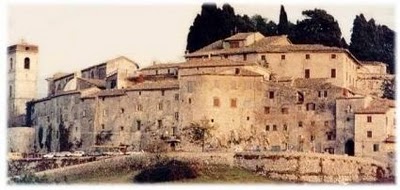
Fumone’s hilltop fortress, between Rome and Naples.

Fumone is a spectacular sample of a medieval hilltop fortress, with parking outside the walls, and narrow twisting cobblestone streets.  We parked and walked through the gates in mid-afternoon, eager to find the castle inside the fortress, and begin our tour. We enjoyed wandering through the streets, but could not find the castle entrance, nor any real help finding it, because the
town was pretty deserted.

Darkness was falling by the time we knocked—and waited—at the castle door. It looked like no one was home, but after a few minutes a light came on, and a young man of Pakistani or maybe Indian origin opened the door. When we explained we wanted a tour in English, he reluctantly invited us to step into the entryway, then yelled up the stairs to an older man of similar origin, in a language we did not understand. They argued, apparently about who would be stuck showing us around, and the older man lost, so off we went with him. He turned lights off as we left the entry, and lights on as we came to each new room, so it seemed that whatever room we were in was the only lighted room in the castle. A little eerie.

As our guide began to describe…  ?? What was he saying? We came to realize he was speaking English, but with his thick south Asian accent, pretty much everything required two or three repetitions for us to understand. Our first stop was the chapel built adjacent to the “cell” where Pope Celestine spent his last months. The chapel was built at a later date, from the room which housed Celestine’s companions during his imprisonment. On the chapel wall hangs a shadowbox style reliquary containing relics of various saints and holy objects, and in true Roman Catholic style, it contains a relic of Celestine himself—a tooth.

Then, in dramatic tones our guide says there is another very sad story connected to the castle’s history, and it is difficult for some people. Are we sure we want to see it? Yes?  He leads us to another room with a portrait on the wall of a mother and child. This woman and her husband had only daughters, and prayed for a son. They were overjoyed when their prayer was answered, but their daughters knew very well that their brother would inherit all the family’s wealth. They poisoned their brother. But the mother, unable to part with her son, kept his body preserved (we are directed to look at a closed cabinet) so she could always be
near him. Inside the cupboard we are shown a glass case holding said child, and his little wardrobe of clothes and toys stored with him.

Then there is the virgin’s well…. I’m just going to let you read about that on the castle’s website here: http://www.castellodifumone.it/italy/arx/pozzo2.htm

We no longer had any interest in lodging at the castle, even though lodging at castles is always an enthralling prospect for me. No, we completed the tour, made our way down the hill in the dark, and were glad to find a room at a dreary, cold hotel a few miles away.

Gift of the Goths: Mozzarella di Bufala

The water buffaloes surprised me. Like something in a photo from Cambodia or China, but not in the countryside of Campania.

But there they are, and have been for centuries. One theory says they came to Italy with Goth invaders about 1,500 years ago. Others suggest Arabs brought them to Sicily, and the Normans spread them to the southern mainland. And some think they are native to the area. However they got there, I’m glad they did.

Initially used as draft animals, there are some references to cheese products from the buffalo’s rich milk as early as the twelfth century. The mozzarella di bufala we know today came to prominence in southern Italy 200 to 300 years ago. When I spent a few weeks in Sorrento, I was told that only cheese made from buffalo milk can be labeled ‘mozzarella’ in that part of Italy.

Fresh mozzarella, those soft bright white balls, must be kept in a ‘broth’ and is very perishable, so should be used quickly. While mozzarella can be made from cows’ milk (and unless it is labeled ‘di bufala’, it probably is), the buffalo version is much richer and more flavorful.

The most familiar use of mozzarella di bufala, for tourists in Italy, is the ubiquitous Caprese salad: Alternating slices of fresh tomatoes and creamy cheese, interlaced with fresh leaves of basil, and drizzled with olive oil and balsamic vinegar. Perfetto!

Though both are called mozzarella, the fresh version seems to have no relationship to the shredded dry cheese melted on pizza all over America. For a real treat, use some thinly sliced fresh mozzarella next time you make a pizza, or top your next baked pasta dish with it during the last few minutes of cooking.

If you make the mistake I did in Italy, and call it mozzarella di “bufalo” the Italians will laugh. Everyone knows it is “di bufala” and if you try to get milk from a “bufalo” you’ll be in trouble.

Ready to try cooking with fresh mozzarella? In 2009, Alanna Kellogg (www.blogher.com) posted ten recipes here: http://www.blogher.com/ten-summer-recipes-fresh-mozzeralla.  Put one together today, and as you eat it, imagine you are in the Italian south, eating lunch on your terrace with a warm breeze carrying the fragrance of basil and oregano. Salute!

5th Friday Surprise: Blog tour of the Italian south!

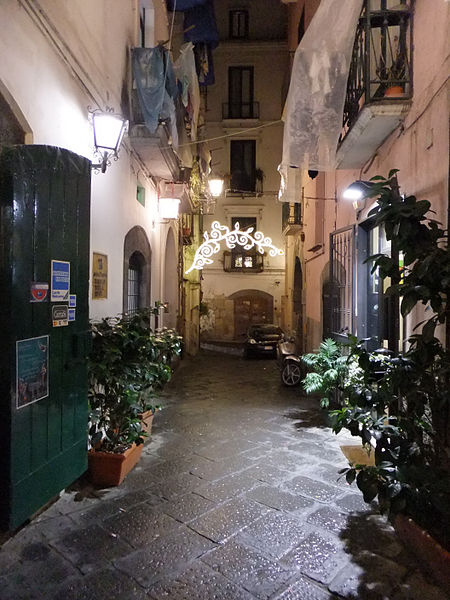
Like the light at the end of this street in Salerno, the Italian south draws me to explore.

Join me today on a tour that will leave your hungry for more. I’m sharing some of the other blogs about southern Italy that have inspired me.

Michelle Fabio’s www.bleedingespresso.com is a favorite–she moved from Pennsylvania to her family’s ancestral village in Calabria, and stayed!

At www.napoliunplugged.com, Bonnie shares all things Naples, from transportation strikes to church services, in the city she describes as “beautiful, chaotic, unbending, romantic, confusing”. Get to know this vibrant, gritty city better!

If Sicily tugs at your heart, visit http://lostinsicilia.blogspot.com/ for a smorgasbord of Sicilian topics, like kid-friendly sightseeing, festivals and holidays, natural wonders, and lots more.

Mary at www.flavorsofabruzzo.com shares a lot about food, as the blog name suggests, but there are plenty of other topics sprinkling flavor throughout her posts.