Culinary Tourism: Taste the olive oil.

In my part of the world, wine tasting is popular, and when I lived in Texas, I participated in a chili cook-off. And chocolate tasting? I’m nibbling some right now.

But in the south of Italy, you find tours dedicated to tasting olive oils. I never gave much thought to variations in olive oil until I visited Italy in 2004. Then, it seemed quite a curiosity to me, the interest people took in their oils. Now, I’m eager to explore olive oils myself, and where better but Puglia?

According to The Olive Oil Times, about 40% of Italy’s olive oil grows on roughly 60 million trees in Puglia. You can read descriptions of different types of oil, and a great deal of olive knowledge.

How do you taste it? At Olive Oil Source, you can learn from professional olive oil taster Nancy Ash, owner of Strictly Olive Oil. You can learn the lingo and see what the pros are looking for in their oils.

For the more visual learners among us, here’s a video of Bill Sanders (called the evangelist of olive oil and wine) showing us all how to taste olive oil:

If you can’t make it to Italy, how about olive oil tasting in California? Yes, it’s available there too, so go out there and try a little EVOO! That’s Extra Virgin Olive Oil–soon you will be a pro in the tasting room.

BOOK REVIEW: Stolen Figs

Have you ever wanted to visit the ‘old country’, wherever that may be for you–the land where your parents, or grandparents, or great-grandparents, spent their childhood?

So did author Mark Rotella. After years of listening to his family’s stories of life in Calabria, he convinced his reluctant father to accompany him to the village of Gimigliano, for just a day. When they unexpectedly connect with distant relatives, Rotella becomes immersed in the life he previously only heard about, returning to Calabria again and again.

A memoir and travel story combined, Stolen Figs lets us share Rotella’s discoveries in clear, inviting language. He shares the flavor of his experiences–the aroma of homemade soprasetta, the taste of fresh artichokes on pizza, the tingling fear of driving unfamiliar backroads that seem hostile.

Rotella had the advantage of speaking Italian as he ventured through Calabria, but still ran into communication issues with the Calabrian dialect. He also describes a visit to a Greek-speaking village, an area mentioned in last week’s post.

I enjoyed his adventures, and recommend his book–a mini-escape to Calabra.

Katoitaliotika, Italy’s Greek dialect

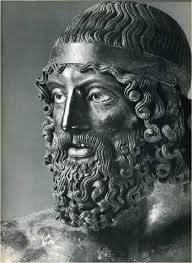
Greeks began to settle the Italian south almost 3,000 years ago, and were the prominant culture there for almost 2,000 years. I tend to think of the culture of the “Magna Graecia” as something buried deep in history, like the Riace bronzes I posted about last week.

But now I find out about the Griko–a surviving culture speaking a Greek dialect, which Greek speakers call Katoitaliotika, or Southern Italian!

This very interesting video (thanks to Agora Productions) provides a lot of history and many great photos reflecting the Greek history of the Italian south.

Travels in Calabria: My top picks

History figures large in my travels, so you won’t be surprised that my top tourist picks are mostly historical–and pretty famous!

#1: The Riace Bronzes: Two 2,500 year old classical Greek statues, found by a scuba diver off the coast near Riace in 1972, and now housed in the Museo Nazionale della Magna Grecia in Reggo Calabria. The full collection on the Magna Grecia occupies two floors of the museum.

#2: The Roman bridge at Scigliano: Part of the ancient Via Popilia, the Roman road from Capua to Reggio Calabria, during the Punic Wars Hannibal is said to have crossed this bridge with his armies. Not sure if that included the elephants, which Hannibal brought up through Iberia and across the Alps. The bridge is a wonderful Roman era structure. Bed and Breakfast Calabria in Scigliano is a great place to stay nearby, and I found this photo on their website.

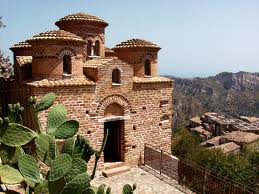
#3: The Cattolica di Stilo: Built in the 9th century, this church is considered one of the most important Byzantine structures, and is a national monument. I love to visit churches. Along with the frescoes and Christian interior, there are Arabic inscriptions in the church–the thought of it sends my mind spinning into all kinds of historical speculations!

#4: Le Castella: I couldn’t go to Italy without visiting a castle, and the history of this one is fascinating. And the Ionian beaches couldn’t be closer! I found this interior cutaway describing life in the castle–in Italian, but it gives some good additional detail.

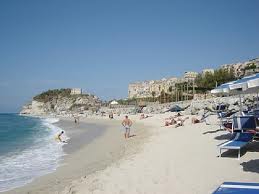
#5: Down time at some hot springs! There are several thermal bath options, and after visiting one in Tuscany a few years ago, I am eager to try one in Calabria. This or this should do–and then a couple of days at the beach in Tropea!

Bergamot oranges from Calabria

“This precious product delights the senses and often inebriates the brain with iridescent images which make life beautiful and dreamlike and floods the soul with romantic sweetness.” Sound like a recreational drug, something you can take to help you leave your troubles behind?

No. Giuseppe Sergi, an Italian anthropologist, wrote this statement in his 1925 monograph on the bergamot oranges grown around the southern coastline of Calabria.

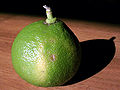
Bergamot oil gives Earl Grey tea its distinctive flavor–the tea that reportedly became a sensation in London when Lady Grey (wife of Charles Grey, 2nd Earl Grey, who was Prime Minister of the United Kingdom from 1830 to 1834) served it. There are many stories about the origin of the tea, but the Grey family claim that a Chinese mandarin (a bureaucrat in imperial China) formulated the tea for them to offset lime in the water at their estate in Northumberland.

A more common use of bergamot oil is in perfumes. The Consortium of Bergamot in Reggio Calabria has a website (available in English) packed with information about the oranges. They claim health benefits and a wide variety of uses for the oil, and provide a recipe for cologne. Bergamot is also used in pastries and confections.

The Canadian newspaper The Globe and Mail published an article in 2010 about bergamots, the “green gold” of Calabria.

Now, I have finished my cup of Earl Grey tea, which I enjoy for the flavor of bergamot and the reminder of southern Italy.

Good Luck for 2012: Lentils and grapes

Many regions and cultures have symbolic foods for holidays, including the celebration of the new year, or “capo d’anno” as Italians say. I was happy to discover that lentils are a traditional Italian food for the new year, because I like lentils a little better than black-eyed peas, which are eaten in the southern U.S.

Lentils symbolize coins, and are eaten in hopes of a prosperous new year. Grapes symbolize good health, and are eaten at midnight, just as the new year begins.

I found an interesting article with a couple of recipes from famous foodie Nigella Lawson, a food writer with a terrific website. The recipes sound delicious, and I plan to make one of them for my own New Year celebrations.

I hope you enjoy the article, and wish you the very best for 2012. Felice Anno Nuovo!

Book Excerpt: On the Spine of Italy

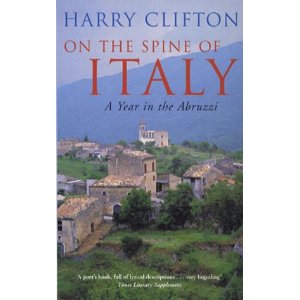
I knew my research in Italy would take me to Abruzzo, and Harry Clifton’s book “On the Spine of Italy: A Year in the Abruzzi” (Macmillan, 1999) fell into my hands at the right moment, to give me a taste of the region I was so eager to know better.

Clifton is an Irish poet. He and his wife went to a village in Abruzzo to spend a summer writing. In the end, they stayed a full year, and this book chronicles their experience of village life. I enjoyed reading it, and it stoked my interest in the region, although my visit of a few weeks would not compare to a year-long stay. I believe the book is now out of print, but it is available used from online booksellers.

Clifton describes the village at Christmas time:

“The village, in its small way, was preparing for Christmas. The shop had introduced a freezer, full of packaged vegetables, hamburgers, french fries, and fish fingers, to internationalize the local cuisine. It had a glass display case, containing cheeses and cold cuts of meat, clinically administered by the women in starched white. The co-operativa, as it stood now, would have done justice to a hospital.

“They had introduced a small stand of Christmas gifts and confectionery, a smaller and far poorer version of the extravaganzas we had witnessed in Perugia. There were bottles of Spumante and Amaro, the bitter digestivo favoured in the Abruzzo. There were sundry mechanical toys, times to autodestruct a week after they had been bought. And there was a big assortment of giftwrapped panettones, the soft fruity cakes filled with jam or chocolate that symbolize the Christmas season in Italy. We bought some for Silvio’s family, as a fence-mending gesture.

“In the bar, the men played cards obsessively. the lights were on until two in the morning, as they engaged in gigantic poker sessions. As it was Christmas, they were betting heavily and playing for real stakes. We knew villagers who had been literally ruined, dispossessed of their property and the shirts off their backs, by such sessions. The late night shouting and roaring across the road had plenty of reality behind it. But anything, especially in winter, was better than boredom, and cards were the one thing in the lives of the village men that lifted the burden of empty time off their backs.

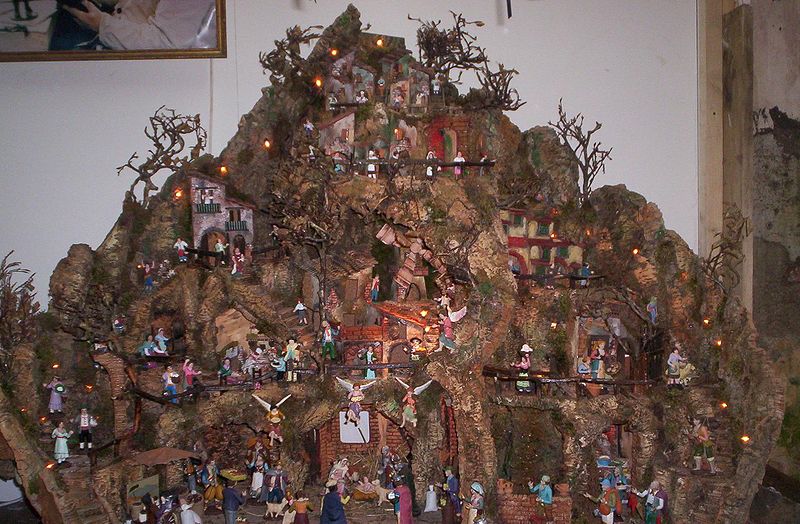
“A week before Christmas, a truck arrived from the commune of Poggio, with a string of coloured lights. In the course of one dark afternoon, they were draped over the solitary pine in the piazza. In the evening, switched on, it became our communal Christmas tree. Meanwhile, in the church, Gegeto had constructed a huge elaborate crib out of moss and mountain rocks–a miniature landscape threaded with electric lights, through which wandered shepherds, wise kings and animals, in the direction of the Holy Family. Until Christmas night, this massive construction went unwitnessed by almost everyone in the village. After Christmas, it was almost immediately dismantled. It was a labour of love. The lights on the pine tree, which were the work of the state, were still there the following May.”

I enjoyed Clifton’s book, which doesn’t identify the specific village, but includes the highs and lows of village life in rural southern Italy.

Merry Christmas to all my readers!

A new (old) painting on my wall


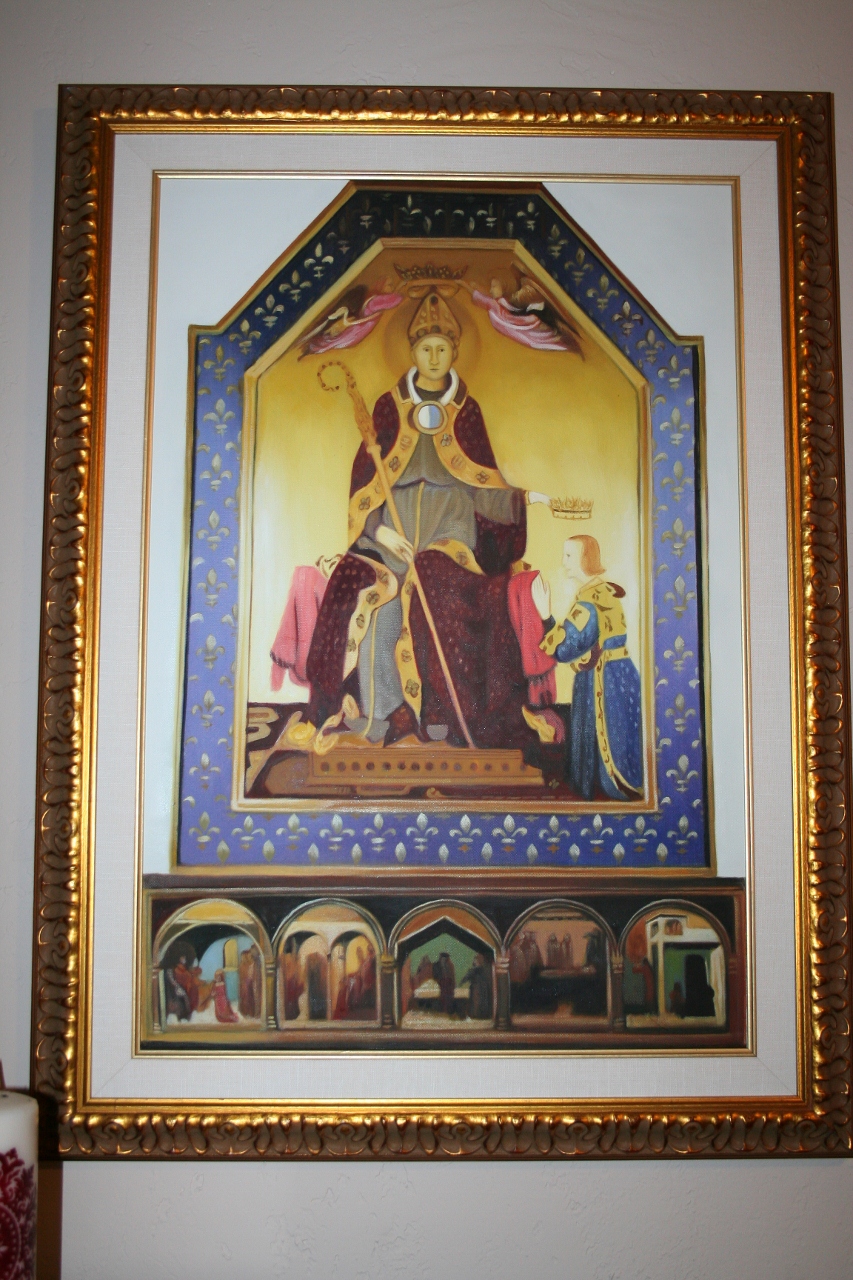
I have to thank my daughter and son-in-law for an amazing gift they presented to me not long ago. They listened (ever-so-patiently) as I waxed lyrical about Simone Martini’s painting, St. Louis of Toulouse crowning Robert of Anjou, which hangs in the Museo di Capodimonte at Naples. They heard (again, I’m afraid) the story of those two brothers, my favorites of the Angevins of Naples, about their long imprisonment from youth to young adulthood, how Louis was called to the Franciscan order and defied his father to answer that call, how his charismatic brother Robert, a third son, became heir to the throne of Naples because of Louis’s decision, and how Martini’s painting contains many symbols of the brothers’ complex relationship and history.

It was a gift that they listened so attentively to the story that has fascinated me, and charged my imagination, for decades.

But a few weeks later, they showed up at my house… with the painting!! Of course, not the one from Naples–the original is not for sale. Mine is a reproduction, a knock-off from one of those websites that will make you a copy of any oil painting you like, in any size you want.

I have it framed, now, and hanging in my bedroom. The saint (Louis of Toulouse) and the king (Robert the Wise) watch over me as I sleep.

Christmas year-round: Nativities of Naples

Nativity scenes are part of the Christmas tradition for many of us, and they range from gilt-trimmed masterpieces to naked trolls. In the historic center of Naples, Via San Gregorio Armeno is home to workshops and storefronts selling an array of elaborate creches, or presepi in Italian.

The narrow pedestrian street is Nativity Central in Italy, carrying on a tradition established some four hundred years ago, in the Baroque era. From individual figurines and furnishings to elaborate full-village scenes, from finely crafted and expensive pieces to the very inexpensive–the array is fascinating. They go far beyond the typical scene of the holy family with wise men and shepherds. These scenes include the whole town–the innkeeper, the greengrocer, the mayor, homemakers and housekeepers, in lively scenes where you can imagine them sharing the story they’ve heard from the shepherds. “Did you hear about the baby? Did you hear about the angels? Can you believe it? Let’s go take a look!”

Christmas is a year-round affair on Via San Gregorio Armeno, so enjoy it whenever your visit to Naples comes along. At the end of the street is San Lorenzo Maggiore, a historic church that contains a museum focusing on the historic center of Naples. This neighborhood oozes history from every seam, so plan to spend some time exploring.

A selection of nativity scene characters for sale.

And whether you call it a creche, crib, presepi, or nativity, browse the workshops and enjoy the tradition of Christmas, celebrating the birth of Christ in a thousand variations on the theme.

(Remember those naked trolls I mentioned? Check out Nativity Scenes Gone Horribly Awry at a blog called “List of the Day”.)