BOOK REVIEW: Head over Heel

Head over Heel: Seduced by Southern Italy by Chris Harrison, 2009, Nicholas Brealey Publishing

Head over Heel by Chris Harrison, recommended by theitaliansouth.com


Australian writer Chris Harrison captured me first with his opening quote from Luigi Barzini: “In the heart of every man, wherever he is born, whatever his education and tastes, there is one small corner which is Italian… ”  In my family, there is a low-brow version of Barzini’s sentiment: There are only two kinds of people in the world—Italians and those that want to be. This book made me glad I am a little Italian. It also strengthened my urge to return to the sunny Italian south.

Harrison’s memoir draws us into Andrano, the village in Puglia he moved to after a love-at-first-sight encounter, and long distance romance with an Italian woman. In Andrano he learns to tolerate being wakened by the amplified voice of the vegetable seller roving through town in his truck, and to navigate the governmental obstacle course for residency and a driver’s license.

His stories rang true with my own experiences in southern Italy’s small towns, and colorful detail brings them to life: the festivals both religious and gastronomic (he favors the latter), the tragicomedy of nearly every interaction with the local carabinieri, and the challenges of teaching English to the most apathetic students.

Personal relationships have their own challenges, and Chris and Daniela discover when they move to Milan for work, and live with her brother. Daniela’s father wanders in a fog of Alzheimer’s disease, and her mother cares for him. Her family doesn’t always understand Chris and his Australian ways.

Entertaining all the way through, Harrison’s book also carried me back to Italy as I read. The south, and Puglia, are not often the subject of such books, and for me this added to the appeal. I found myself reading excerpts to my husband, and thinking of various friends who might also enjoy reading the book. You might enjoy it too–I recommend it!
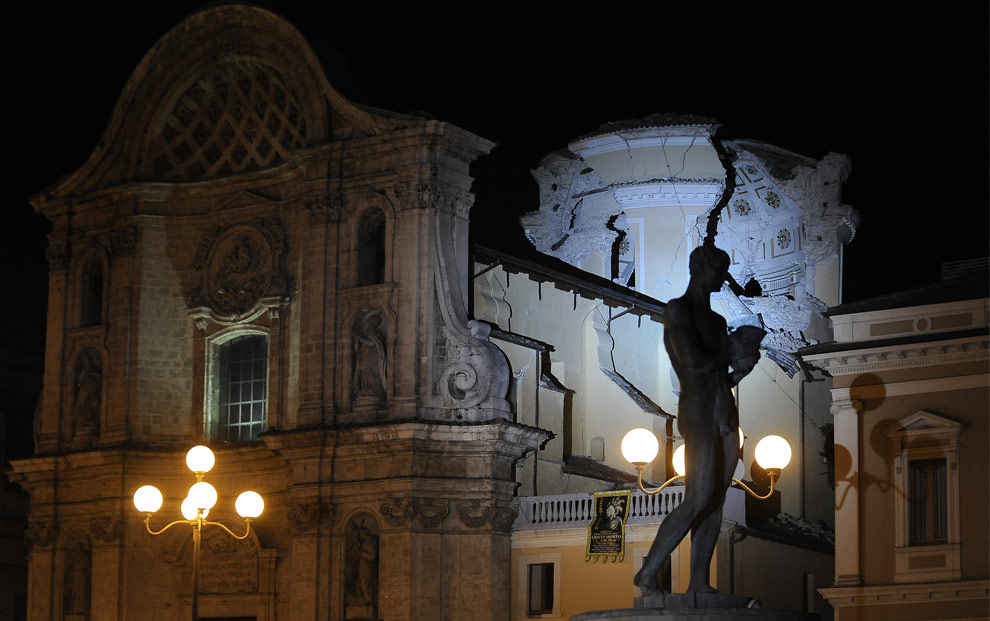
Earthquakes in L’Aquila


Earthquake damage at Santa Maria Paganica Church in L'Aquila, 2009.

When I first visited L’Aquila in 2004, I wandered through the city looking at churches. Though many of them had medieval origins, almost all were now decorated in Baroque style, heavy on the cherubs and gilded trims. Some thoughtful person or committee (and I thank you, whoever you are) had undertaken a signage project in L’Aquila, and almost every church had a sign—sometimes even in English—outlining the history of the church.

The reason for the almost universal Baroque décor became clear as we read, for the third, then fourth, and fifth time, that “after the terrible earthquake of 1703, the church was rebuilt…” during the following ten or twenty years.

 Naturally enough, those churches were rebuilt in the style current in 1703, and not their original style. Aggravating as it was to my medieval mind, nearly every church in town had been remade Baroque.

 The city of L’Aquila was founded by Frederick II, Holy Roman Emperor and King of Sicily, and completed in 1254 by his son. I knew many of those churches had medieval origins, and my main reason for visiting was to see the monastery church of Santa Maria di Collemaggio. (You can see its beautiful pink and white façade in the banner photo above.)

 Fortunately, Collemaggio was not destroyed in 1703, and its Romanesque layered arches and portals welcomed me as I explored it. I paid my respects to Pope Celestine V, one of the subjects of my research for several years, whose body lies in a glass case there. He is also known as Saint Peter Celestine, or Peter of Morrone, and he founded the church in the 1270s and was crowned pope there in 1294. I did notice that part of the interior of Collemaggio had a Baroque style, and wondered if that was a result of earthquake damage. 

 The 1703 “terremoto” is reputed to have killed 5,000 to 10,000 people and destroyed nearly every building in L’Aquila. In a terrible case of déjà vu, in April of 2009 the mountains under L’Aquila shook the city to rubble again. More than 300 people died, around 1,500 were injured, and 65,000 became homeless due to the destruction.

 Once again, most of Santa Maria di Collemaggio survived. If you search on Google Earth for “Santa Maria di Collemaggio” you’ll see a village of blue emergency tents erected on the wide lawn in front of the church’s pink and white façade.  The dome collapsed, but the rest of the church and monastery stood the test. The remarkably clear satellite photos used by Google Earth for L’Aquila were taken just a few weeks after the earthquake, so you can see other collapsed roofs as you scan around the city. The most telling series of photos I have seen (warning: some graphic content) of the 2009 earthquake damage is at this website:  http://www.boston.com/bigpicture/2009/04/the_laquila_earthquake.html  The photo above comes from this collection.

 In a December 2010 article in The Free Press (Rockland, Maine) columnist Chuck Marecic describes the downtown area of L’Aquila:  “On a recent walk through the city, I saw temporary wooden braces reinforcing the windows, doors, and walls of nearly every building. The town’s Duomo (cathedral) looks fine from the outside, but the inside has collapsed. Chain- link fences separate much of the city from its inhabitants. Here and there reconstruction projects are evident. However, for the most part the city stands mute and abandoned except for the teams of firefighters who continue to inspect the “red zone” to ensure public safety and the scores of visitors who have come to bear witness to the devastation.”

 I cried when I read about L’Aquila, and I’m not sure I’d want to join the ‘disaster tourism’ there, though it may provide some financial stimulus to the community. The city’s past fascinates me, but the future is very cloudy.

Dreaming in Italian

At the top of my list, for my next trip and possibly any trip to Italy:  A couple of weeks (or a month, or three months) of Italian language school at SorrentoLingue.

In February of 2004 I started two weeks of study there, hoping to hack down at least some of the language barrier that stood between me and my research. I was placed in an advanced beginners class (thanks to some introductory Italian study and previous Spanish and Latin classes), and I had one classmate, Wakana from Japan, who spoke no English, and about as much Italian as I did.

How much can be communicated with those limitations?  I learned that Wakana’s home town in Japan has an annual festival taking a local god from their temple down to the ocean to be washed. I learned that she hoped to speak Italian well enough to attend a university in Italy to study architecture. She learned about my home town’s annual Irrigation Festival, and about the research I was doing for a novel set in the 13th century.

Vern and I walked around Sorrento, visiting the touristy places—shops selling ceramics and inlaid wood products, learning Italian as we bought coffee and pastries in the sidewalk cafes, and tickets for the bus to Positano. The ancient city walls, medieval cloisters, and brightly painted fishing boats in the Piccola Marina all delighted us, and kept the camera clicking.

About ten days into our two weeks of Italian study, I woke up from a dream. I was drifting on the Bay of Naples in one of those small fishing boats, an Italian fisherman at the oars. I held a fishing pole and cast out into the water. Soon I had something on the line, and reeled it in. Not a fish, but a paper with an Italian word written on it. Unfortunately, not the word I was looking for. Disappointed, I threw it back in and cast my line out again. I reeled in another word, but it still wasn’t the right one.

Perhaps it was my frustration that woke me, because I never “caught” the word I wanted! But I woke up laughing, and shared the dream with Wakana and our teacher, Elena, at school that morning. I had heard of people dreaming in a language they are learning, but my fishing expedition was a new take on the theme.

After our last day of classes, Wakana and I put our communication skills to the test. She joined Vern and I on a visit to Pompeii, about 40 minutes by train from Sorrento. As we wandered around the remains of the Roman-era city, we jabbered in a mixture of bad Italian, a few Spanish words, and her limited English. Then we saw a Japanese tour group with a guide explaining things to them in Japanese. Hanging around the fringes, Wakana translated into Italian for me, and I translated into English for Vern.  A little like the old party game of Gossip, I wonder if what Vern heard was anything like what the guide told his group.

I left Sorrento far from fluent, but far better equipped than when I arrived. We were able to manage much better during the following two weeks as we traveled. When we returned to Italy in August, we again spent two weeks at SorrentoLingue. With another leap in language skills, our travels were much more enjoyable, and research more productive.

Immersion language schools are available in many countries, and if your travel time is flexible enough to include a week or two—often the classes are half-day, so you can still see the sights—do it! Check out SorrentoLingue at www.sorrentolingue.com.

Pasta!

One of the big surprises for an American visiting Italy for the first time: pasta and its many forms and finishes.

I hesitate to use the word “sauces” for fear of conjuring the image of jars of store-bought spaghetti sauce, or the thick tomato sauce my uncle used to serve when he owned a restaurant in Anchorage, Alaska in the 1960s. Dishes the size of serving platters, piled with spaghetti, a few baseball-sized meatballs, all buried in a thick sludge of his home-cooked tomato sauce. Enough for a family of four, if you planned to have a little dessert.

Tasty, yes. But Italian? Not so much. I saw no pasta in Italy remotely like it.

Instead, the traditional second course of Italian meals, pasta is served in more modest portions, keeping in mind that the antipasto has already taken the edge off your hunger, and the main meat course is yet to follow. And pasta is served with a variety of vegetables, bits of meat, nuts, oils—often there is not a tomato in sight!

Soon after I came home from Italy in 2004, I bought a cookbook called Four Seasons Pasta: A Year of Inspired Recipes in the Italian Tradition, written by Janet Fletcher.

Thank you, Janet! I cooked from her recipes two or three times a weeks, allowing me to savor my Italian experience for months longer than I might have without it. I enjoyed things I would never have put with pasta before. Artichokes, peas, beans, radicchio, arugula, kale.

Janet Fletcher acknowledges the help of the Peduzzi family of Abruzzo, and many of the recipes originate in the Italian south. Check out more about her recipes and books at www.janetfletcher.com.

One of my favorites, perfect at this time of year, is Spaghetti con Asparagi ed Uova, or Spaghetti with Asparagus, Fried Eggs, Black Pepper, and Pecorino. This one-dish meal serves two.

 Ingredients:

1 pound asparagus

4 tablespoons extra-virgin olive oil

Salt and freshly ground black pepper

½ pound spaghetti

2 eggs

3 tablespoons freshly grated aged pecorino cheese, or toasted bread crumbs, plus more for topping.

Preheat the oven to 425 degrees F. Bring a large pot of salted water to a boil over high heat.

Holding an asparagus spear in both hands, bend the spear gently. It will break naturally at the point at which the spear becomes tough. Repeat with the remaining asparagus. Discard the tough ends. Cut the trimmed spears on the diagonal into ½-inch pieces, leaving the tips whole. Put the asparagus in a baking dish or on a baking sheet big enough to hold them in a single layer. Toss with 2 tablespoons of the olive oil and season with salt and pepper to taste. Bake until sizzling and tender, about 15 minutes.

While the asparagus is baking, add the pasta to the boiling water and cook until al dente. About 2 minutes before the pasta is done, heat a skillet over moderately high heat. Add the remaining 2 tablespoons olive oil. When the oil is hot, break in the eggs, season with salt and pepper to taste, and cook, without turning, just until the whites are barely firm. The yolks should remain runny.

Drain the pasta and return it to the warm pot. Add the asparagus and any oil in the baking dish, then add the eggs and any oil in the skillet. Toss well, breaking up the eggs as you toss. The runny yolks will coat the spaghetti with a creamy sauce. Add the cheese or bread crumbs, then add a few grindings of black pepper. Toss again and serve immediately in warm bowls, topping with additional cheese or bread crumbs.

I’d love to see comments from anybody who gives this a try!