Reading about olives

Can I suggest some reading about olives? I’m offering a smorgasbord.

Here is a link to an online piece called “Graft and Corruption: On Olives and Olive Growing in the Pre-Modern Mediterranean” about the history and practices of olive growing. From the website of the Maxwell Institute of Brigham Young University, this is the introduction to a larger work, but covers lots of interesting history of olive cultivation.

A search on Amazon for “olives” turns up thousands of books (including those by authors named Olive, of course), with a lot of interesting titles. Many, like Olive Oil: Cooking, Exploring, Enjoying,  deal with using olives and olive oil in cooking. Others, like the Olive Production Manual, are practical guides to growing olives. One particularly caught my eye, because I enjoy reading memoirs. Olives, by Mort Rosenblum, has positive reviews and looks like fun to me. Have you read it? If so, throw in your two cents in the comments!

Happy reading!

The ancient sacred olive, in modern times

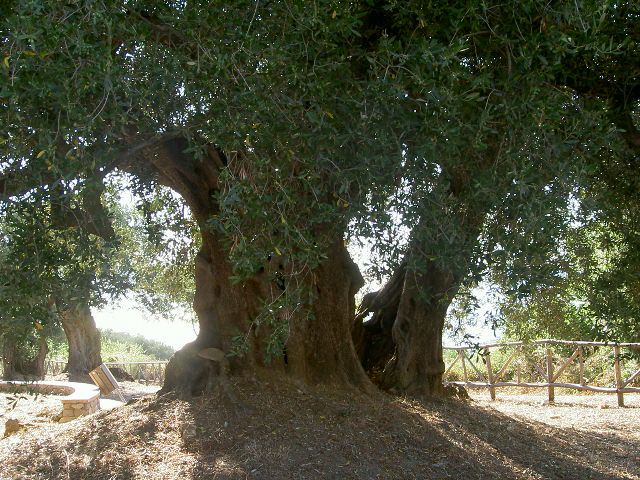
An olive tree in the Cilento region.

This tree was planted before the nation of Italy was born, when the Italian south was a kingdom apart. It could well have been producing olives when Naples was at the height of glory, one of the leading cities on the continent, and a must-see stop on the Grand Tour of the eighteenth century.

The olive is mentioned in ancient literature, including thirty times in the Bible. Its oil fueled the original Olympic flame. Kings were anointed with olive oil, and it is still used in religious ceremonies.
Theophrastus, a student of both Plato and Aristotle, wrote about olive husbandry. “The olive tree grows, one may say, in more ways than any other plant; it grows from a piece of the trunk or of the stock, from the root, from a twig, and from a stake…” He warns that olives grown from seed produce a wild olive, of poor quality. He also quotes Androtion in saying that olives require heavy pruning for the best production, and also need “the most pungent manure and the heaviest watering.” He describes the damage they suffer from hot winds or freezing temperatures. Though he wrote this in Greece in the third century B.C., these classical methods were carried into the Magna Graecia and applied to olive culture there.
I find fascinating the common knowledge of the natural world in earlier times. A statement of Theophrastus illustrates this, in regards to the summer solstice. How do I know when the solstice is? I check a calender, reference book, or (more likely) find it online. But two thousand years ago, people checked their olive trees for that information: “There is a peculiarity special to the olive, lime, elm, and abele: their leaves appear to invert the upper surface after the summer solstice, and by this men know that the solstice is past.”
In Roman times, a garden was not considered complete without some olive trees, and olive oil served as liquid money. It is still highly prized, with Italy consuming about 30% of the world’s olive oil, most of which is grown in the Mediterranean region.
Next time you break open a rustic loaf of bread, pour a little olive oil in a dish, add some balsamic vinegar, and think about the ancient origins of your small feast as you enjoy it.

Agriturismo: Farmstays in southern Italy

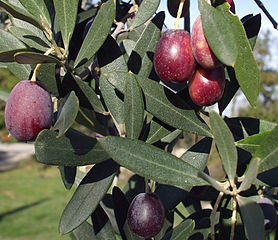
Olives awaiting harvest in Abruzzo

To enjoy the atmosphere of a working farm, the rural setting and fresh foods, try a farm stay. WARNING: There are many listings at www.agriturismo.net but not all are working farms. They have a wide variety of amenities, so read carefully and search for the kind of place you want to visit. Some have spa facilities, some are country bed and breakfast properties with limited agricultural production. Others offer cooking classes, boating excursions, swimming pools, or children’s programs.

As I browse the various listings, a question comes to mind: How difficult is it to find a native (or at least fluent) English speaker to review the content of a website? The market appears to be wide open for this kind of service. It’s easy to find listings like these:

(Various kinds of spas therapies) “are the ingredients of our relax.” “It is possibile to have breakfast, lunch, or supposer in the farmhouse.” “As of 1754, the owner’s family give birth to the ancient farm building where oil and wine have been produced with their own traditional tools.”

Of course, I did appreciate the full disclosure of this description: “This place is not recommended to those who want to enjoy only the ocean or only the mountain, or are unable to live without the new technolgies, or are scared of farm bugs, or are unable to handle the fireplace or the wood-burning stove.”

Here are links to a couple of olive farms that appealed to me: First, the Agriturismo Madonna Incoronata, named for a 17th century church on the property. Located on the south side of the Gargano peninsula, they offer cooking classes, boat trips to private beaches, and an ancient olive mill and museum highlighting the history of olive production–which continues on the property today.

Near Matera, L’Orto di Lucania offers a varied farm stay. They grow and process organic wheat, olives, artichokes, eggplant, and tomatoes. They also have a beautiful swimming pool, as well as cooking classes, and bicycles for rent. Guests can take part in farm activities, or simply observe. And unique historical sites like the city of Matera (an ancient cave dwelling site), Castel del Monte built by Emperor Frederick II, and the trulli houses of Alberobello, are all easy day trips from the farm.

Have you stayed on a farm in southern Italy? Share your experience in the comments!

Culinary Tourism: Taste the olive oil.

In my part of the world, wine tasting is popular, and when I lived in Texas, I participated in a chili cook-off. And chocolate tasting? I’m nibbling some right now.

But in the south of Italy, you find tours dedicated to tasting olive oils. I never gave much thought to variations in olive oil until I visited Italy in 2004. Then, it seemed quite a curiosity to me, the interest people took in their oils. Now, I’m eager to explore olive oils myself, and where better but Puglia?

According to The Olive Oil Times, about 40% of Italy’s olive oil grows on roughly 60 million trees in Puglia. You can read descriptions of different types of oil, and a great deal of olive knowledge.

How do you taste it? At Olive Oil Source, you can learn from professional olive oil taster Nancy Ash, owner of Strictly Olive Oil. You can learn the lingo and see what the pros are looking for in their oils.

For the more visual learners among us, here’s a video of Bill Sanders (called the evangelist of olive oil and wine) showing us all how to taste olive oil:

If you can’t make it to Italy, how about olive oil tasting in California? Yes, it’s available there too, so go out there and try a little EVOO! That’s Extra Virgin Olive Oil–soon you will be a pro in the tasting room.