Good Luck for 2012: Lentils and grapes

Many regions and cultures have symbolic foods for holidays, including the celebration of the new year, or “capo d’anno” as Italians say. I was happy to discover that lentils are a traditional Italian food for the new year, because I like lentils a little better than black-eyed peas, which are eaten in the southern U.S.

Lentils symbolize coins, and are eaten in hopes of a prosperous new year. Grapes symbolize good health, and are eaten at midnight, just as the new year begins.

I found an interesting article with a couple of recipes from famous foodie Nigella Lawson, a food writer with a terrific website. The recipes sound delicious, and I plan to make one of them for my own New Year celebrations.

I hope you enjoy the article, and wish you the very best for 2012. Felice Anno Nuovo!

Book Excerpt: On the Spine of Italy

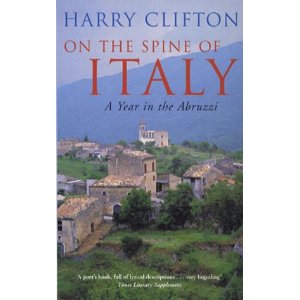
I knew my research in Italy would take me to Abruzzo, and Harry Clifton’s book “On the Spine of Italy: A Year in the Abruzzi” (Macmillan, 1999) fell into my hands at the right moment, to give me a taste of the region I was so eager to know better.

Clifton is an Irish poet. He and his wife went to a village in Abruzzo to spend a summer writing. In the end, they stayed a full year, and this book chronicles their experience of village life. I enjoyed reading it, and it stoked my interest in the region, although my visit of a few weeks would not compare to a year-long stay. I believe the book is now out of print, but it is available used from online booksellers.

Clifton describes the village at Christmas time:

“The village, in its small way, was preparing for Christmas. The shop had introduced a freezer, full of packaged vegetables, hamburgers, french fries, and fish fingers, to internationalize the local cuisine. It had a glass display case, containing cheeses and cold cuts of meat, clinically administered by the women in starched white. The co-operativa, as it stood now, would have done justice to a hospital.

“They had introduced a small stand of Christmas gifts and confectionery, a smaller and far poorer version of the extravaganzas we had witnessed in Perugia. There were bottles of Spumante and Amaro, the bitter digestivo favoured in the Abruzzo. There were sundry mechanical toys, times to autodestruct a week after they had been bought. And there was a big assortment of giftwrapped panettones, the soft fruity cakes filled with jam or chocolate that symbolize the Christmas season in Italy. We bought some for Silvio’s family, as a fence-mending gesture.

“In the bar, the men played cards obsessively. the lights were on until two in the morning, as they engaged in gigantic poker sessions. As it was Christmas, they were betting heavily and playing for real stakes. We knew villagers who had been literally ruined, dispossessed of their property and the shirts off their backs, by such sessions. The late night shouting and roaring across the road had plenty of reality behind it. But anything, especially in winter, was better than boredom, and cards were the one thing in the lives of the village men that lifted the burden of empty time off their backs.

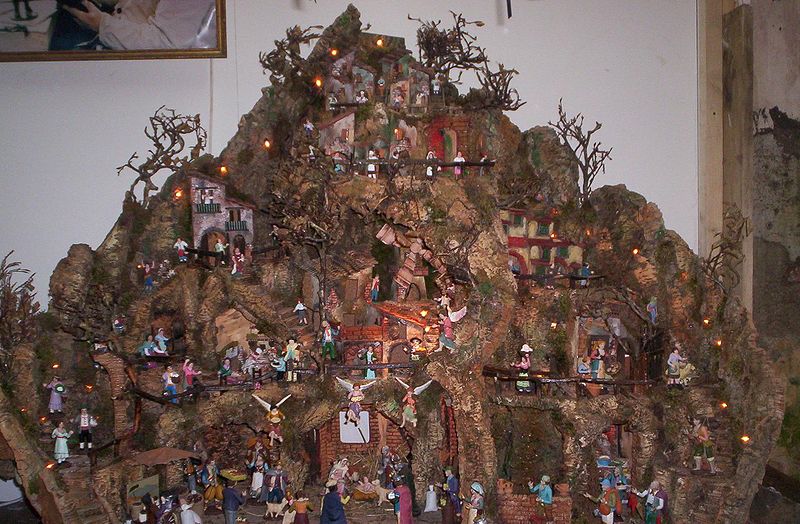
“A week before Christmas, a truck arrived from the commune of Poggio, with a string of coloured lights. In the course of one dark afternoon, they were draped over the solitary pine in the piazza. In the evening, switched on, it became our communal Christmas tree. Meanwhile, in the church, Gegeto had constructed a huge elaborate crib out of moss and mountain rocks–a miniature landscape threaded with electric lights, through which wandered shepherds, wise kings and animals, in the direction of the Holy Family. Until Christmas night, this massive construction went unwitnessed by almost everyone in the village. After Christmas, it was almost immediately dismantled. It was a labour of love. The lights on the pine tree, which were the work of the state, were still there the following May.”

I enjoyed Clifton’s book, which doesn’t identify the specific village, but includes the highs and lows of village life in rural southern Italy.

Merry Christmas to all my readers!

A new (old) painting on my wall


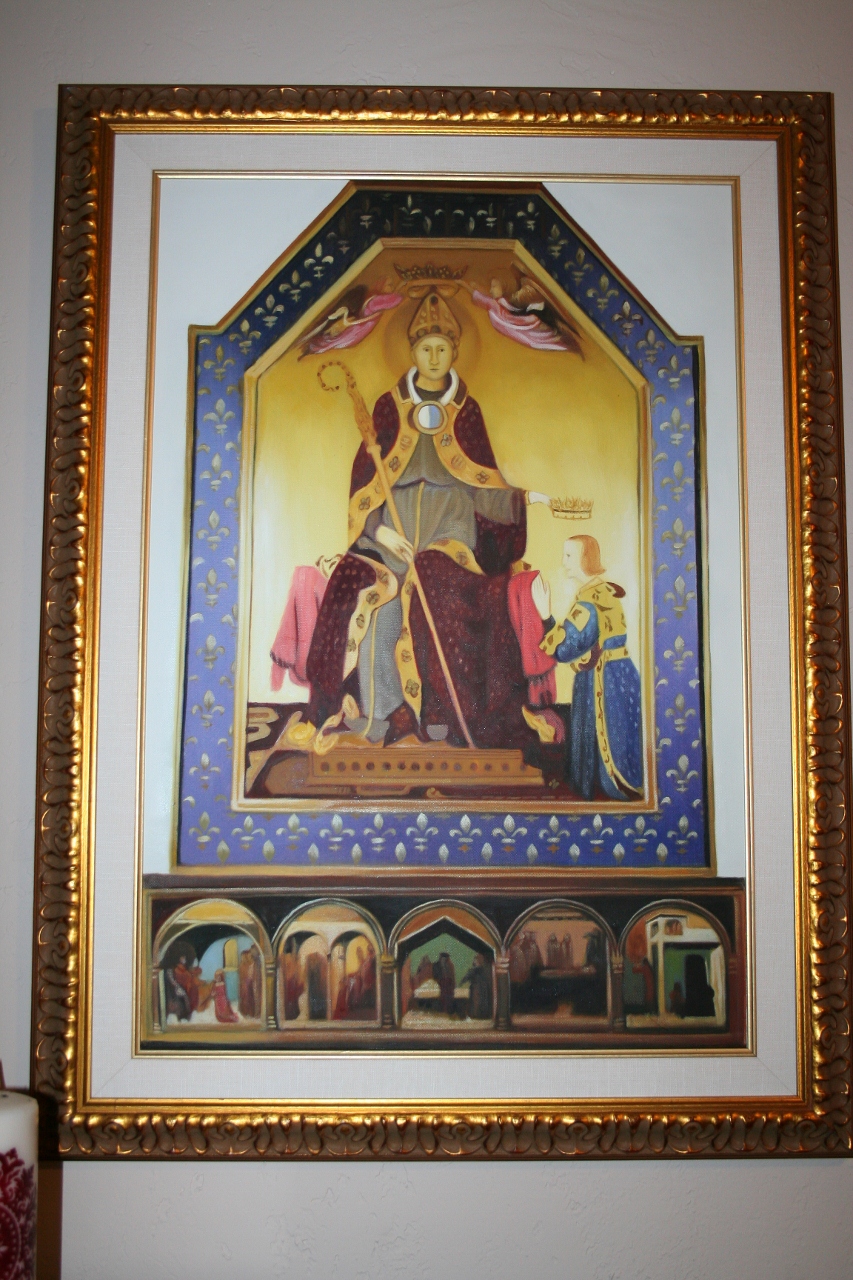
I have to thank my daughter and son-in-law for an amazing gift they presented to me not long ago. They listened (ever-so-patiently) as I waxed lyrical about Simone Martini’s painting, St. Louis of Toulouse crowning Robert of Anjou, which hangs in the Museo di Capodimonte at Naples. They heard (again, I’m afraid) the story of those two brothers, my favorites of the Angevins of Naples, about their long imprisonment from youth to young adulthood, how Louis was called to the Franciscan order and defied his father to answer that call, how his charismatic brother Robert, a third son, became heir to the throne of Naples because of Louis’s decision, and how Martini’s painting contains many symbols of the brothers’ complex relationship and history.

It was a gift that they listened so attentively to the story that has fascinated me, and charged my imagination, for decades.

But a few weeks later, they showed up at my house… with the painting!! Of course, not the one from Naples–the original is not for sale. Mine is a reproduction, a knock-off from one of those websites that will make you a copy of any oil painting you like, in any size you want.

I have it framed, now, and hanging in my bedroom. The saint (Louis of Toulouse) and the king (Robert the Wise) watch over me as I sleep.

Christmas year-round: Nativities of Naples

Nativity scenes are part of the Christmas tradition for many of us, and they range from gilt-trimmed masterpieces to naked trolls. In the historic center of Naples, Via San Gregorio Armeno is home to workshops and storefronts selling an array of elaborate creches, or presepi in Italian.

The narrow pedestrian street is Nativity Central in Italy, carrying on a tradition established some four hundred years ago, in the Baroque era. From individual figurines and furnishings to elaborate full-village scenes, from finely crafted and expensive pieces to the very inexpensive–the array is fascinating. They go far beyond the typical scene of the holy family with wise men and shepherds. These scenes include the whole town–the innkeeper, the greengrocer, the mayor, homemakers and housekeepers, in lively scenes where you can imagine them sharing the story they’ve heard from the shepherds. “Did you hear about the baby? Did you hear about the angels? Can you believe it? Let’s go take a look!”

Christmas is a year-round affair on Via San Gregorio Armeno, so enjoy it whenever your visit to Naples comes along. At the end of the street is San Lorenzo Maggiore, a historic church that contains a museum focusing on the historic center of Naples. This neighborhood oozes history from every seam, so plan to spend some time exploring.

A selection of nativity scene characters for sale.

And whether you call it a creche, crib, presepi, or nativity, browse the workshops and enjoy the tradition of Christmas, celebrating the birth of Christ in a thousand variations on the theme.

(Remember those naked trolls I mentioned? Check out Nativity Scenes Gone Horribly Awry at a blog called “List of the Day”.)

My most Italian Christmas tradition: Torcetti

Mary (Arcuri) Sanders, at age 77

My Italian grandma, born Mary Nancy Arcuri, was a great cook. She lived into her 90s, and now her many dozens of descendants like to share “Gram’s recipe” for various foods we associate with her. Somehow, though, each of her seven kids has a different version of “Gram’s recipe” for spaghetti sauce, each claiming to be authentic, and the rest charlatans.

At Christmas, Gram always made torcetti (tor-chet-ee). The lightly sweetened pastry was rolled in powdered sugar, shaped in figure 8s or candy canes, or folded into little half-moon turnovers filled with mince or cherry pie filling. I always imagine her learning to make it at her mother’s side, in Italian–the only language her mother spoke. Gram came from a big family, and it is a big recipe–I have penciled in on my recipe card a smaller version, one-fourth of the original recipe. But for you, readers, I am providing the full meal deal, the recipe for 12 dozen torcetti. Enough to share with lots of friends!

Ingredients:

1 lb. butter or margerine

1 lb. vegetable shortning

10 cups sifted flour

1 cup warm milk

1 T. granulated sugar

1 T. vanilla

2 pkgs. yeast

4 eggs, beaten

2 lbs. powdered sugar

Cut shortning and butter into flour until it is like corn meal. Combine milk, granulated sugar, vanilla, and stir in yeast. Add liquid to flour mixture. Add eggs and beat. Add more flour if sticky. Knead slightly. Put in a greased bowl, cover in a warm place, and let rise until double in bulk, about one hour. {I must tell you, this is a heavy dough, and has rarely doubled its bulk for me!}

Cover a bread board with some of the powdered sugar. Break off egg-size pieces of the dough, roll in powdered sugar into one long piece, and shape into figures–pretzel, figure 8, knots, candy canes. Bake on a greased sheet 12-15 minutes at 375 degrees. For filled turnovers, roll out dough, sprinking with powdered sugar if sticky, and use a cookie cutter or water glass to make 3″ circles. Fill with a spoonful of your favorite fruit pie filling, fold in half, and seal by pressing a fork along the edge.

If you try Torcetti from Gram’s recipe, I’d love to hear from you. And do you have an Italian Christmas food you love? Let’s hear about it!