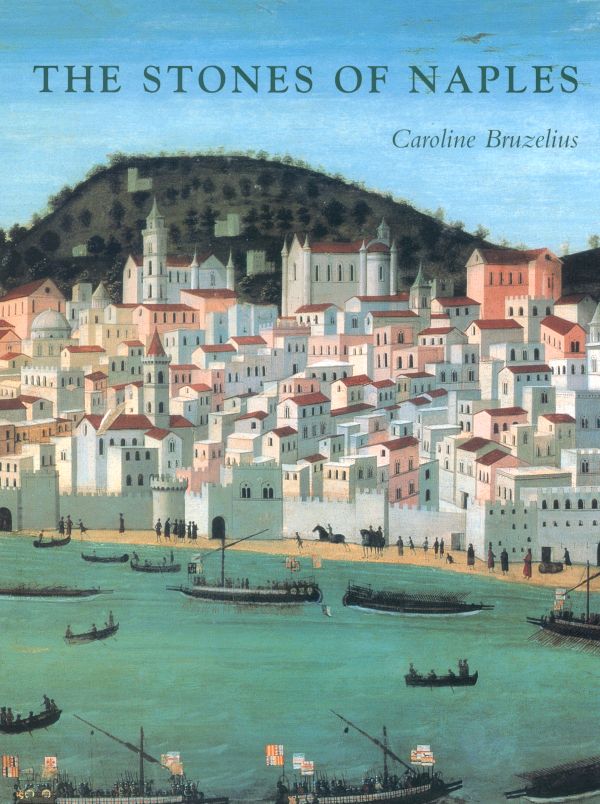
Book Review: The Stones of Naples

Sometimes I think that only a nerd like me would be fascinated by a book subtitled “Church Building in Angevin Italy, 1266-1343”. But I’m glad to know there are enough nerds like me around that the author, Caroline Bruzelius, and the publisher, Yale University Press, decided to produce it.

The Stones of Naples is filled with stories of why and how various churches were built in Naples during the first three generations of Angevin rule there, 1266 to 1343. The social history is tied to the architectural history to answer questions I didn’t even know I had! And I have plenty of questions about these Angevins–for some reason their story resonates with me.

The book is academic, filled with minutiae about builders and stone, about bishops and their political persuasions, about monastic influences on the royal family members, and their influence on one another. There are several appendices, and pages of end notes, a lengthy bibliography, and detailed index.

But the academic burden (which it might seem to some readers) is lightened by a few other inclusions. Right up front there are maps, a city plan of Naples, and a genealogical chart of the Angevins. The large-format book contains many photos (too few in color, but there are many) and illustrations of church floor plans, construction elements, and decor. And the cover is beautiful, featuring detail from the Tavola Strozzi, showing a view of Naples in 1465 commemorating the Aragonese victory.

Although Naples itself figures heavily in the Angevin church construction, locations throughout southern Italy are mentioned or discussed.

I would recommend this book to anyone with an interest in southern Italy of the thirteenth and fourteenth centuries. It helps me understand the events and the atmosphere of the period, and develop a clearer picture of medieval Naples.

Bari’s colorful past

I once mentioned to a friend that I would love to visit Bari. His brows shot up. “No you don’t,” he assured me.

He had been to Bari some years earlier, and found it less than enchanting.

But it isn’t Bari today that attracts me, as much as Bari’s history. When I mentioned Bari to my friend, I was thinking of the port where thousands of crusaders launched their sea journey to the Holy Land. Nearly 2,000 years ago the Emperor Trajan rerouted the Appian Way to Bari, bringing it to prominence as a Roman port and commercial city. Today it is southern Italy’s second most important city, with a university, two modern harbors, and a metropolitan population of more than a million people.

Statue of Saint Nicholas in Bari's basilicaThe relics of Saint Nicholas rest in Bari, secreted out of his native city of Myra (part of modern-day Turkey) in 1087 in the midst of an invasion. Accounts of the event vary, but ultimately the saint’s relics were brought to Bari, where a basilica built in his honor is considered by some to be Bari’s most important building, built in the 12th century. A festival held each May celebrates the arrival of the relics. This is the fourth century saint who has morphed over the ages into Santa Claus.

Bari’s port also saw a significant slave trade in the early Middle Ages durin Byzantine rule, when slavic captives were sold to the Turks and others in the eastern Mediterranean. About five hundred years of Byzantine rule gave way to Norman rule in the late 11th century.

Bari Vecchia, or Old Bari, was for many years a good place to avoid due to rampant petty crime. Perhaps this was my friend’s experience in Bari. But this review on Slow Travel Italy describes the old city in very appealing terms.

One day I will go and see for myself!

Sulmona: A city of surprises

Surprise #1: Sulmona is easy to reach by train or by car–about two or three hours east of Rome in the central Appenines. It’s off the beaten path for tourists, but is gradually being discovered, as evidenced by dozens of reviews on TripAdvisor for lodgings, restaurants, and things to do.

Confetti flowers for sale in Sulmona (RaBoe/Wikipedia)

Surprise #2: Confetti! Not the bits of colored paper, but bits of colored candy coated almonds and chocolate, attached to wire stems and shaped into butterflies, flowers, swans, and other beautiful creations. Bouquets of confetti line the shop fronts along the Corso Ovidio, brilliant color drawing you along to find the next candy fantasy.

Surprise #3: History galore! I suppose this shouldn’t come as a surprise anywhere in Italy, but there are Roman ruins beneath the city, visible in a couple of museums attached to churches: S.S. Annunziata and San Gaetano. The city is surrounded by medieval walls, and a medieval aqueduct forms one side of the large Piazza Garibaldi.

Surprise #4: World class events! In addition to annual jousting competitions held in late July and early August, an international Latin competition celebrates the Roman poet Ovid who was born in Sulmona, nearby towns have festivals celebrating cherries, red garlic, and wine, and in Pacentro the annual Corsa degli Zingari (Race of the Gypsies) in early September has been celebrated for more than 500 years. On one visit to Sulmona we were surprised to see the Piazza Garibaldi transformed into a skating track for the International Speedskating Championships.

Medieval aqueduct in Piazza Garibaldi, Sulmona. (RaBoe/Wikipedia)

Surprise #5: Great food! We enjoyed meals at the Hostaria del Arco and Cantina di Biffi–rated number one and two among restaurants in Sulmona on TripAdvisor. Like most Italian cities, coffee shops abound, along with pizzerias and a variety of restaurants.

Surprise #6: The great outdoors! Sulmona’s valley is surrounded by national parks with lots of hiking opportunity. The mountains have remnants of ancient shepherds’ huts, along with several hermitages which are popular hiking destinations. There are also about a dozen ski areas within 60 to 90 minutes’ drive of Sulmona. The beaches along the Adriatic coast are about an hour away.

I hope you’ll try Sulmona when you plan a trip to Italy!

Food: Caciocavallo and other cheesy delights

I paused in front of the cheese display at a little market in Scigliano. “Look!” I said to Vern. A herd of little horses, shaped from ivory strands of caciocavallo cheese, were lined up in the window to amuse me, and that they did!

Those Italians really know what to do with cheese! Going to the cheese-and-sausage stores was one of my favorite shopping delights in Italy. We always found interesting cheeses, and succumbed to many temptations there. The volume of cheese alone is enough to amaze someone used to the typical American cheese shopping experience. Giant wheels of cheese cut into thick wedges, balls and chunks, fresh and aged, cheese to try with figs, meats, pasta, bread, cold or melted. I salivate at the many tasty memories.

Caciocavallo was a special delight. It normally comes in double balls, something like a snowman, with a cord around the ‘neck’ where it has hung to dry. Someday I’d love to see the process of making some of the cheese into little horses (cavalli). I really wanted to buy little caciocavallo horses as souvenirs to take home, but they were a little too perishable for that.

If you visit Italy, even if the trip is short and your time tightly scheduled, take a few minutes to find a cheese shop, and explore the abundance. Choose something intriguing, and buy a few ounces. Savor the flavor. The experience might become your favorite memory of Italy.