5th Friday Surprise: Blog tour of the Italian south!

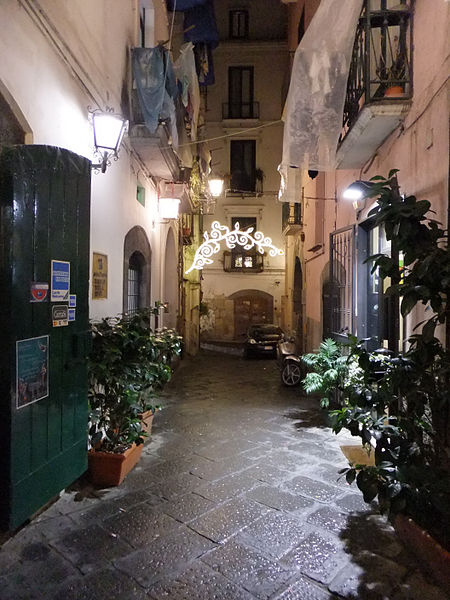
Like the light at the end of this street in Salerno, the Italian south draws me to explore.
Join me today on a tour that will leave your hungry for more. I’m sharing some of the other blogs about southern Italy that have inspired me.

Michelle Fabio’s www.bleedingespresso.com is a favorite–she moved from Pennsylvania to her family’s ancestral village in Calabria, and stayed!

At www.napoliunplugged.com, Bonnie shares all things Naples, from transportation strikes to church services, in the city she describes as “beautiful, chaotic, unbending, romantic, confusing”. Get to know this vibrant, gritty city better!

If Sicily tugs at your heart, visit http://lostinsicilia.blogspot.com/ for a smorgasbord of Sicilian topics, like kid-friendly sightseeing, festivals and holidays, natural wonders, and lots more.

Mary at www.flavorsofabruzzo.com shares a lot about food, as the blog name suggests, but there are plenty of other topics sprinkling flavor throughout her posts.

BOOK REVIEW: Blood Washes Blood

Blood Washes Blood: A True Story of Love, Murder, and Redemption Under the Sicilian Sun by Frank Viviano  (Washington Square Press, 2002)

Do you love a juicy murder mystery combined with a journey of self-discovery? To top it off, make it a true story set in Sicily. Frank Viviano, foreign correspondent, pursues the barest of clues to find the truth about his great-great-grandfather’s murder, and subsequent events that allow him to see his own family and past in a new light.

Viviano’s melancholy suits the languid landscapes of rural Sicily, and carried me along, as I hoped for the next breakthrough in his search, celebrated each unexpected revelation taking him a step closer to finding his ancestor’s murderer. Family legends and whispered suspicions draw him beyond the limits of officially documented history, beyond the cultural code of silence, beyond the head-banging disorganization. And once in a while, in the midst of the story’s dark longing, comes a laugh-out-loud moment that breaks the tension and makes the journey bearable. Years of research, of wavering between patience and despair, eventually lead Viviano to a discovery he never imagined

Using the best kind of history—history revealed through personal story—Viviano explores the longer history of Sicily, the development of the Mafia, and the social and political forces that made it prosper.

I have recommended Frank Viviano’s memoir more than any other book about southern Italy that I have read. I’ve loaned out two or three copies, never to be seen again. So I cannot offer to lend you the book, but I do encourage you to read it, and to let me know what you think.

Little Italy in America

San Diego's Little Italy

Wikipedia lists approximately 50 American neighborhoods that are known, officially or unofficially, as “Little Italy”. A couple of weeks ago I walked around the Italian neighborhood in San Diego, and delighted in hearing Italian conversation around me!

Where did all these Italian immigrants come from? Between 1880 and 1920, more than 4,000,000 Italians immigrated to the USA, and most of them came from southern Italy. Like immigrants from other countries, they often formed neighborhoods of like ethnicity.

Among them were my great-grandparents, Francesco Arcuri, who came from Calabria in 1887 and found work as a lace-maker in New York, and Josephine Gualtieri, daughter of a shoemaker in the Calabrian village of Scigliano. Francesco lived in America for about ten years before returning to Italy to find a wife. He was about 50 when he married the 21-year-old ‘spinster’. They came to America in 1900, and lived in Patchogue, Suffolk County, New York on Long Island.

In his book Long Island Italians, author Salvatore John LaGumina says, “Patchogue was Suffolk’s most thriving [Italian] community in the early 20th century.” LaGumina mentions a large lace-making mill there which employed hundreds of Italian-Americans.

Poverty in the Italian south fueled the mass exodus of residents, and opportunity in America gave them direction.

Is there a “Little Italy” near you, or one you have enjoyed visiting? Please comment!

Why I Love Sorrento

Medieval cloister in Sorrento--a popular wedding spot!

From my travel diary in February of 2004:  “The city is a marvel of history to me, with ancient pre-Roman walls, from the original Greek colony, with Roman walls built on top of them, the remains of several old gates, including stairs in the steep cliffs along the water. There are houses and buildings around the town from every era of the last 2,000 years! ….. We found ourselves in a narrow street where a motorcycle could barely pass us, and we had to flatten ourselves in a doorway while several cars passed, and then we made a run for the next wide spot. We came back to town near the old city walls–through a gate whose sign indicates it was made in the 3rd-1st century BC. The Antica Mura. (ancient wall) …. Ah, a sunny morning! The air is so fresh and clear, pero un po freddo, a little cold. Still, it is beautiful to see the sun on the water, birds wheeling above, palms swaying in the breeze….. Today is Carnevale in Italy (a.k.a. Mardi Gras)…here in Sorrento the streets were full of people tonight when Vern and I walked around. There is confetti among the cobbles and paving stones, and paper streamers litter the ground. The Corso Italia was so crammed with people that cars were not even attempting to pass through. People of all ages were out for the passeggiata and festival. Parents with young children dressed as Zorro, Sleeping Beauty, animal characters. Young teens were dousing their friends with shaving cream or silly string, which was also sprayed on shop windows and cars, lampposts and on the sidewalks. Music–live–played from a bandstand in the Piazza Tasso, and old couples strolled the streets together. Older men talked in groups or leaned against a wall watching the crowd–happy revelers all, it appeared. There were a few adults in costume too–we saw a pair of dalmations get into a small car and drive away.”

Is there a place in Italy that you love?  Tell me about it!

Who hunts the wild boar?

One food I enjoyed in Italy, but seldom see in America, is wild boar. When we were staying in Sulmona, our friend Cesare took us through several mountain villages to see various monasteries and hermitages connected to Pope Celestine V (the subject of my research in central Italy).

We stopped for lunch in a village in the mountains of Majella National Park, and went to a restaurant called Belvedere, which hung on the edge of a precipice overlooking the wild hinterlands of Abruzzo. Vern was intrigued to find wild boar on the menu—cinghiale in Italian—and decided to try it. His curiosity was rewarded: the waiter soon delivered a huge bowl of savory chunky stew. The meat was similar to pork, and very tasty.

As we ate, I asked Cesare who hunts the wild boar they serve in the restaurant. At first he seemed not to understand the question, but I persisted. “Nobody hunts them,” he finally said.  “Where do they come from then?” I asked. “Una fattoria.”

Yes, it seems the ‘wild’ boar was raised on a farm! Quite a disappointment, as a boar hunt was fully formed in my imagination already.

Truly wild boars have proliferated in some areas of rural Italy, because their natural enemy, the wolf, has declined in population. According to some sources they now produce more offspring due to mating with domesticated pigs. They damage farms and gardens, and can be a traffic hazard.

My son and I found wild boar on the menu of La Dolce Vita restaurant in Seattle a couple of years ago, and like his dad, he had to try it. I don’t see it on their online menu now. I haven’t found any to try cooking myself, but I found a recipe online at http://italianfood.about.com/od/furredgameetc/r/blr1082.htm that looks pretty good. If you want to try it using pork, and just pretend it’s wild boar, go ahead—I won’t tell!