
Tell me the title and author of your favorite books dealing with southern Italy. I always love to find good reads through recommendations!
Month: June 2011
BOOK REVIEW: The Lady Queen by Nancy Goldstone
 Nancy Goldstone touches on my favorite era of southern Italian history–the Angevin period–in her book The Lady Queen: The Notorious Reign of Joanna I, Queen of Naples, Jerusalem, and Sicily. Goldstone’s lively prose brings Joanna to life and immerses the reader in the challenges and triumphs of her exceptional reign of nearly forty years.
Joanna was born in 1326, during the rule of her grandfather, Robert the Wise. Joanna’s father died when she was two years old, leaving her heiress to the kingdom. Soon afterwards, her mother died, and Joanna was raised in the court at Naples.
At 17, she became Queen when her grandfather died. Threats to her rule came from within and without her kingdom, persisting through four marriages, and Joanna faced them with courage. Goldstone engages her readers as she presents background and historical context which add significance to Joanna’s accomplishments.
The book is written for a general audience, but the endnotes, bibliography, and detailed index provide guidance for further study of the reign of Joanna and the lives of those who influenced her. If all history was written like this book, a lot more people would be interested!
According to her website, www.nancygoldstone.com, she is working on a book about Joan of Arc which is expected out in 2012. The Lady Queen was published by Walker Publishing in 2009. I can also recommend the book Four Queens, which touches on southern Italy. In Four Queens, Goldstone tells the story of four daughters of the Count of Provence who all became queens during the 13th century. One of them, Beatrice, married Charles of Anjou who later became King of Naples.
Goldstone shares her enthusiasm for Joanna in a YouTube video which also appears on her website:
Hermit Monk, Pope, Saint
The man who first drew my heart to the Italian south was a hermit monk. A pope. A saint, even. I read just a few paragraphs in an old Penguin Dictionary of Saints, and I was hooked.
The unlikeliness of his path through life intrigued me then, and still does today. A younger son of a poor family, Peter found the religious life suited him. He felt the need to separate himself from the world, and spent several long periods living as a hermit in the remote mountains of Abruzzo.
He couldn’t stay alone, because people kept seeking him out for spiritual wisdom, healing, and prayer. Eventually he founded a monastic order, built several monasteries and churches, and became known as a man of spiritual power.
In his early eighties, he retired to a hermitage near Sulmona. Nothing prepared him for the turn his life took next.
In 1294, there had been no pope for two years. Rome was in chaos, and the continued to bicker but came no closer to agreement. Abbot Peter of Morrone wrote to his old friend Cardinal Latino Malabranca, urging a swift election to avoid the wrath of God.
Malabranca nominated Peter—to the shock of his fellow cardinals, who barely knew who Peter was.
The schemers did know that Peter was unschooled in papal politics, therefore someone who might be used for their own ends. And they knew he was quite old, and not likely to live long if he was elected. So they elected him.
The cardinals were meeting in Perugia at the time, and their next order of business was to notify Peter of his elevation to the papal throne. None of them wanted to make the arduous mountain journey, and the delay of several days gave another interested party
an unexpected opportunity.
King Charles of Naples had been waiting five years for papal approval of a treaty that would free three of his sons from imprisonment in Aragon. His spies in Perugia raced south to Melfi with the news, and Charles raced north to Sulmona, arriving before the cardinals’ delegation. Charles prevailed on the new pope to help him, and offered to host him in Naples.
Peter, who took the name Celestine V as his papal title, was pulled from all sides by men wanting favors, by powerful cardinals protecting their own interests, and by King Charles and others hoping to influence him.

- The coronation of Pope Celestine V
He was crowned in L’Aquila in August of 1294, to the horror of the cardinals, who felt Rome was the proper place for the coronation. He spent months in Naples as a guest of the king, against the cardinals’ wishes again.
His spiritual wisdom could not make up for his political naivety, however, and by December of 1294 Peter knew he was making a mess of his job. All he wanted was to go back to his hermitage. But there was no provision for the resignation of a pope.
For that, he called on one of the cardinals for legal help: Benedict Gaetani, one of the brightest legal minds of the 13th century.
After years of enmity with King Charles, Gaetani allied with the king to ensure the resignation would be accepted—and that Gaetani himself would be the successor.
Then, Gaetani double-crossed them both, forcing Charles to bring the former pope to Gaetani as a prisoner before Gaetani would complete the political maneuvers necessary to free the king’s sons.
Peter spent the last two years of his life imprisoned in a castle in Fumone, one of the Gaetani family holdings, where he died in 1296. Dante consigned him to hell for the cowardice of his resignation, but others considered him a saint—and he was canonized with the name Saint Peter Celestine in 1313. He is even mentioned in Dan Brown’s Angels and Demons.
I walked the path to his hermitage near Sulmona, and visited the church in L’Aquila where his remains lie in a glass case. I am convinced he was a great spiritual leader, but the church of his day wanted a politician, which he certainly was not. I like to
think of him in his prime, surrounded by people who wanted to learn from him, and who saw him as an example of all the good in Christian life.
Driving to L’Aquila
In early March of 2004, after two weeks of studying Italian in Sorrento, Vern and I rented a car to drive to L’Aquila, high in the central Apennines, researching some of the settings of the novel I was writing. Set in the late 1200s, the novel included the coronation of Pope Celestine V, who was crowned in L’Aquila where he had founded the Santa Maria di Collemaggio monastery.
The forecast called for snow in the mountains, so we insisted on having some tire chains for our rental car when we picked it up in Sorrento in the morning. The rental agent reluctantly rounded some up for us. By mid-afternoon , as we climbed into the mountains, we were glad to know we had those chains.
With lots of snow-driving experience behind us, we weren’t concerned with the first couple of inches of snow, and just kept driving. Finally, though, when the snow was approaching six inches deep, we pulled off under an overpass to put the chains on.
Guess what? They didn’t fit our tires.
In the dark, with the snow still falling thick around us, we wondered if we would be able to make the last hour or so of the trip. There wasn’t much traffic on the roads, and we didn’t have a cell phone with us to call for help if we needed it.
As we sat in the car talking it over, we heard heavy truck traffic on the overpass, and then down the ramp, headed toward L’Aquila, came a snow plow. Just what we needed! As we started the car, a second plow followed the first one, pulling out onto the road ahead of us. And then a third!
We felt like a special escort had been arranged just for us, and though the speed was a little slow, we followed the plows all the way to L’Aquila’s city gates. From there, we had to make our own way through the snowy streets to our hotel.
The following morning, a Sunday, we walked through a foot of fresh snow to the monastery church of Collemaggio, whose pink and white façade I had seen in many photos in the course of my research on Pope Celestine V. The banner photo on this blog was taken that morning.
Rapini and all her cousins!
I stopped by Nash’s Organic Produce stand a few days ago, and thought I saw some rapini, a vegetable I discovered in Italy, and have sprouting in my own garden as I write this. It is also called broccoli rabe or raab, and a few other names too.

The recipe for this Rapini and Penne Pasta is online at the Live It Up Vegan blog.
But no. It was not broccoli rabe, but cabbage rabe that I saw, and another display of kale rabe. I took home a couple of bunches of cabbage rabe, and with one bunch made a yummy mess of greens for a side dish. Very simply, it was sautéed in olive oil, with some minced garlic. Salt and pepper as you like.
The second bunch worked well sauteed with some chopped bacon and onion, a little olive oil, as a topping for some pasta. I would have tossed on some pine nuts if I had some on hand. A sprinkling of parmesan worked well with the flavors.
But back to rapini. Like broccoli, it is part of the Brassica genus, and though it is often called “broccoli rabe”, it is more closely related to turnips and mustard, and does not form heads.
Some people find the bitterness of rapini too strong. It tends to be milder when younger, just as its cousin arugula, which can be very bitter if picked late in the season. Rapini can be boiled or steamed to reduce the bitterness, but some of the nutrients will be lost.
A variety of recipes for rapini can be found online, so check out your farmers’ market or supermarket, and give your palate a little trip to Italy!
Bonus Post: The Sicilian Girl
Celebrating 400 views of The Italian South! Thanks to all who have checked it out. I appreciate your comments.
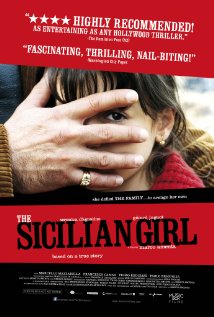 A few days ago I watched the movie The Sicilian Girl, an Italian movie based on events in Italy about twenty years ago. The fictionalized story of Rita Atria, from her childhood in a Mafia family in Sicily, through her turning to the police in hopes of avenging the murders of her father and brother, is told in gritty detail.
I loved it!
For one thing, listening to the Italian language encouraged me–I haven’t forgotten everything I ever learned about Italian! To help with what I did forget, it has English subtitles.
The story has plenty of tension and action, and provided a different point of view for the events than news reports offer. The conclusion is tragic but satisfying.
If you’ve seen the movie (or when you have), share your comments here! Did you like it? Why or why not?
And thanks for reading The Italian South.
 The Italian South